




01. Edit your vector addition worksheet online
Type text, add images, blackout confidential details, add comments, highlights and more.

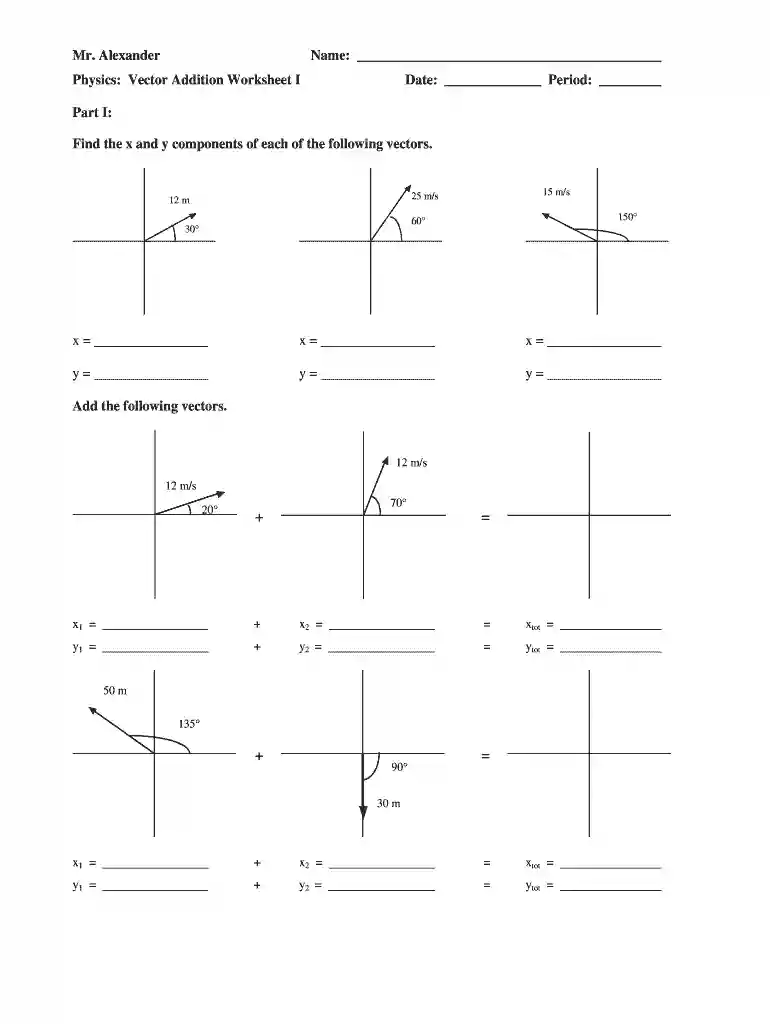
Type text, add images, blackout confidential details, add comments, highlights and more.

Draw your signature, type it, upload its image, or use your mobile device as a signature pad.

Send vector addition worksheet pdf via email, link, or fax. You can also download it, export it or print it out.
Vector addition worksheets are educational tools designed to help students understand the principles of vector addition in physics and mathematics. These worksheets typically present a range of problems where students need to calculate the resultant of two or more vectors based on their components. The main objectives are to enhance understanding of vector components, reinforce problem-solving skills, and illustrate practical applications of vector addition in real-world contexts, such as physics and engineering.
Having access to an answer key enhances the learning experience by allowing students to verify their solutions. When using the vector addition worksheet 1 answer key, students can follow these steps for effective learning:
Completing a vector addition worksheet requires following a structured approach. Here is a detailed breakdown of the steps:
The answer key serves multiple vital purposes for students studying vector addition:
Consider a scenario wherein a student works through problems involving two vectors: Vector A (3 units at 30 degrees) and Vector B (4 units at 120 degrees). After calculating the components:
Vector A Components:
Vector B Components:
After summing the components:
Using the answer key, the student can verify the correctness of their calculations and explore detailed solutions to confirm their understanding.
Understanding key terms associated with vector addition is crucial. Here are some relevant definitions:
These terms support effective communication and comprehension regarding vector operations within the context of educational materials like the vector addition worksheet.
Sure, a typed name is recognized as a legitimate electronic signature when you add it to your form utilizing a compliant solution like DocHub. Simply upload your vector word problems worksheet with answers pdf to our editor, click Sign in the top tool pane → Create your signature → Type your name in the appropriate tab, and select how it will look on your document.
You can complete and eSign your vector addition worksheet with answers pdf on the internet, even on a tight deadline. All you need to access high quality editing tools on any device is a DocHub account, that you can sign up within a couple of moments. When you sign up, add your document or find what you are looking for in our catalog, complete it utilizing the editing tools you need, and put your electronic signature on it at the end.
At DocHub, your data security is our priority. We follow HIPAA, SOC2, GDPR, and other standards, so you can work on your documents with confidence.
Page 1. Vector Components and Vector Addition Worksheet. Find the components of the vectors. Find the sum of any two vectors. Answers on the back. H=10 m. G=35Read more
Nov 17, 2025 This FedRAMP Continuous Monitoring (ConMon) Playbook provides an overview of FedRAMP Rev 5 continuous monitoring (ConMon) requirements andRead more


