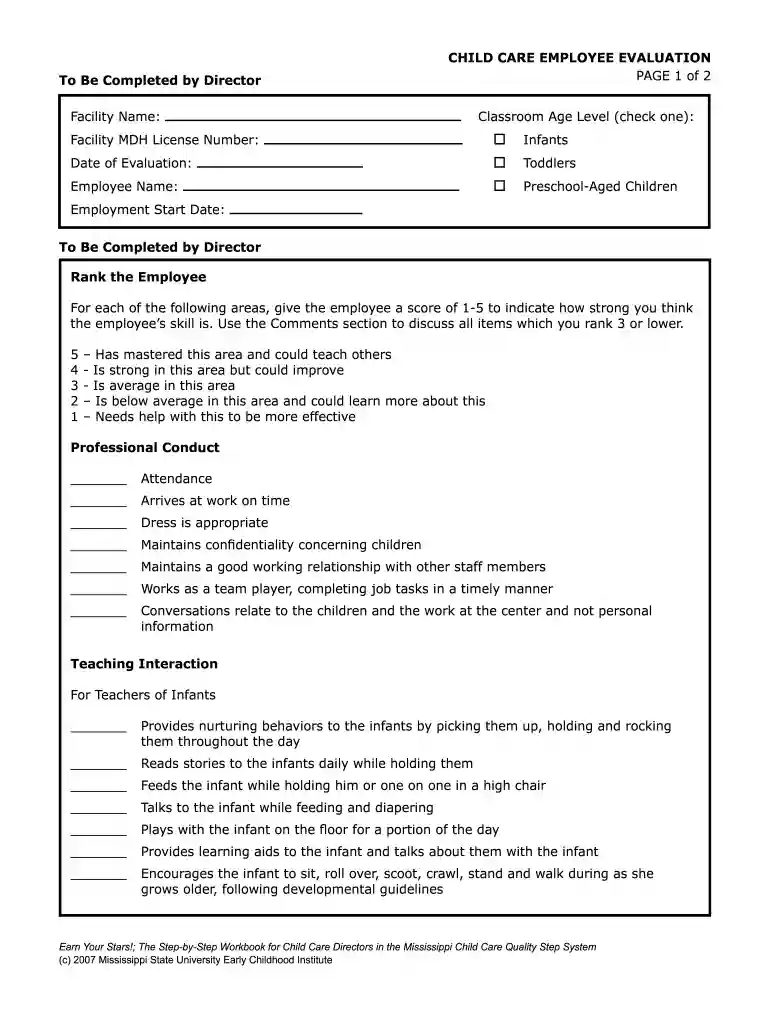
Child care director evaluation template 2026

Get Form
free printable child care staff evaluation form Preview on Page 1

Here's how it works

01. Edit your free printable child care staff evaluation form online
Type text, add images, blackout confidential details, add comments, highlights and more.

02. Sign it in a few clicks
Draw your signature, type it, upload its image, or use your mobile device as a signature pad.

03. Share your form with others
Send childcare staff evaluation form via email, link, or fax. You can also download it, export it or print it out.

Comprehensive Overview of Child Care Director Evaluation Template

Definition and Importance of a Child Care Director Evaluation Template

A child care director evaluation template is a structured tool designed to assess the performance and effectiveness of child care directors. It outlines various competencies related to leadership, staff management, and educational programming in early childhood settings. Utilizing this template ensures that assessments are standardized and comprehensive, allowing for fair evaluations of directors based on established criteria including professional conduct, staff interaction, and program management.

  • Competencies Evaluated:
    • Leadership and conflict resolution
    • Communication skills with staff and parents
    • Knowledge of early childhood education principles
    • Ability to manage budgets and resources

Key Components of the Evaluation Template

A well-structured evaluation template typically includes several key components that facilitate a thorough assessment of the child care director's performance. Each section is tailored to gather specific feedback and ratings from evaluators.

  • Performance Criteria: Listed criteria detailing the expectations for effective management in child care settings.
  • Scoring System: Most templates utilize a scoring scale, commonly from one to five, where one indicates poor performance and five indicates excellent performance.
  • Comments Section: Provides space for qualitative feedback, allowing evaluators to elaborate on scores given for each competency.
  • Signature Lines: A section for both the evaluator and the director to sign, acknowledging completion of the evaluation.

Steps for Completing the Director Evaluation

Completing a child care director evaluation can be made systematic through a step-by-step approach. This ensures each aspect of the director’s performance is considered thoroughly.

  1. Preparation:

    • Gather relevant documentation such as past evaluations and performance metrics.
    • Schedule a meeting to discuss the evaluation process and expectations.
  2. Conducting the Evaluation:

    • Review each competency listed in the template.
    • Rate the director's performance using the established scoring system.
    • Provide comments to substantiate each rating to ensure clarity and context.
  3. Review and Discussion:

    • Coordinate a follow-up session to discuss the evaluation results with the director.
    • Address any concerns raised during the evaluation process.
  4. Finalizing the Evaluation:

    • Obtain signatures from both the evaluator and the director.
    • Keep a copy of the completed evaluation for records and future reference.

Practical Examples of Child Care Director Evaluations

In practice, the child care director evaluation template can be utilized effectively in various scenarios. Here are some practical examples illustrating its application:

  • Annual Review: Many child care centers conduct annual evaluations to assess director performance, which aids in identifying areas for improvement and professional development.
  • Program Changes: Following significant changes in program structure or policy, conducting an evaluation can help gauge the director's adaptability and leadership.
  • Feedback Mechanism: Using the template for informal feedback sessions allows directors to receive constructive feedback throughout the year, rather than solely at formal review times.

Legal and Compliance Considerations

When implementing a child care director evaluation template, be aware of legal and regulatory standards that apply to early childhood education in the U.S. Setting forth clear evaluation criteria ensures that assessments are objective and adhere to industry standards.

  • Anti-Discrimination Policies: Evaluations should be free from bias and compliant with local, state, and federal regulations regarding employment assessment.
  • Confidentiality Agreements: Discuss the sensitivity of evaluation contents and ensure that comments and scores are handled confidentially to maintain trust and professionalism.

Variations of the Child Care Director Evaluation Template

Different childcare programs may adapt the child care director evaluation template to meet their specific needs. Several variants may include:

  • Form Variations: Some templates may incorporate additional fields for areas such as community engagement and parent communication.
  • Standardized Forms for Licensing: Certain childcare licensing bodies may provide their own evaluation templates, which must be used for compliance during inspections.

FAQ and Common Concerns

When utilizing a child care director evaluation template, common questions arise that merit discussion. Addressing these can enhance understanding and improve the evaluation process.

  • Who Should Conduct Evaluations? Generally, evaluations are carried out by the governing board or supervisory personnel who interact regularly with the director.
  • What If a Director Disagrees with the Evaluation? It's essential to foster an environment where directors feel comfortable discussing their evaluations and providing feedback on the process.

By using a child care director evaluation template effectively, childcare centers can promote continuous improvement, ensuring that directors are well-equipped to lead their teams and provide quality early childhood education.

be ready to get more

Complete this form in 5 minutes or less

Get form

Got questions?

We have answers to the most popular questions from our customers. If you can't find an answer to your question, please contact us.
Contact us
It also teaches them responsibility and problem-solving skills. SMART goals (Specific, Measurable, Achievable, Relevant, and Time-bound) equip children with a clear framework for goal-setting that enhances their ability to plan and execute their dreams.
Dedicated and compassionate child care professional with over 10 years of comprehensive experience in education and early childhood development. Seeking daycare provider position to support children as they develop at Happier Kids Daycare.
Goal: Provide a learning environment that fosters positive social, emotional, cognitive, physical, and language development.
Important Qualities Business skills. Preschool and childcare center directors manage childcare centers and need to be able to operate the business effectively. Communication skills. Directors inform parents and staff about the childrens progress. Interpersonal skills. Leadership skills. Organizational skills.
A Childcare Directors goal must prioritize the well-being and development of children. This means setting objectives that enhance educational programs, improve child safety, and foster an environment conducive to learning and growth.

Security and compliance

At DocHub, your data security is our priority. We follow HIPAA, SOC2, GDPR, and other standards, so you can work on your documents with confidence.

Learn more
ccpa2
pci-dss
gdpr-compliance
hipaa
soc-compliance
be ready to get more

Complete this form in 5 minutes or less

Get form

People also ask

A Daycare Teachers career goal should be rooted in a child-centered focus, emphasizing the development and well-being of the children in their care. This means setting objectives that enhance educational methods, improve classroom management, and foster a safe and inclusive environment.
The purpose of a child care director evaluation is to identify areas of strength and areas that need improvement, provide feedback to the director, and determine any necessary support or professional development opportunities.

preschool staff evaluation form