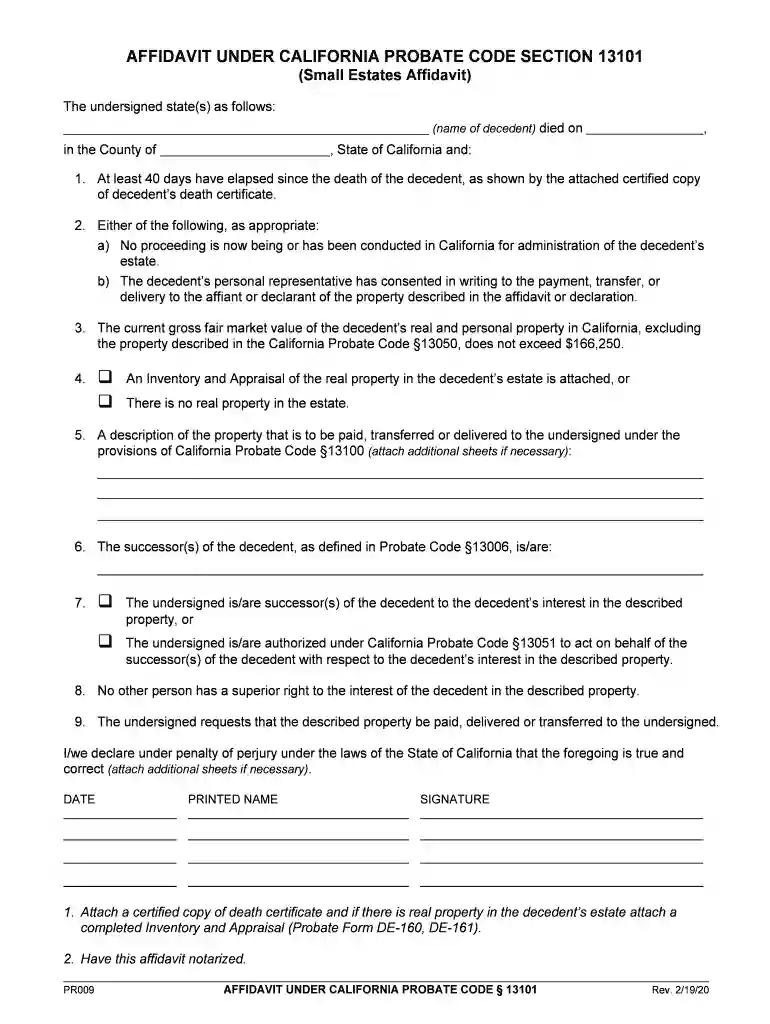
Definition and Purpose of the Affidavit for Collection of Personal Property Under
An affidavit for collection of personal property, under various state-specific probate codes, serves as a legal document that enables the transfer of a deceased person's personal property to their successors without undergoing formal probate proceedings. Typically used for small estates, this form simplifies and expedites the process by allowing a rightful heir or beneficiary to collect the decedent's assets when the total estate value does not exceed a certain threshold. The document requires the affiant to declare the decedent's death, confirm the absence of pending estate administration, and list the property to be transferred.
Key Elements of the Affidavit
- Decedent's Information: Full name, date of death, and residence at the time of death.
- Affiant's Statement: Declaration by the affiant as the rightful heir or representative.
- Estate Value: Confirmation that the estate's value does not surpass the statutory limit for small estates.
- Property Description: Detailed listing of personal property intended for transfer.
- Attachments: Inclusion of necessary documents such as death certificates or inventory lists.
- Legal Verification: Notarization requirement for authenticity and legal standing.
Steps to Complete the Affidavit for Collection of Personal Property Under
- Gather Necessary Information: Collect all required details about the deceased, including documentation like the death certificate and any previously prepared inventory of assets.
- Prepare the Affidavit: Accurately fill out the affidavit form with all relevant information, ensuring all fields are completed and true.
- Listing and Valuation: Calculate the total value of the personal property to confirm it does not exceed the legal maximum for small estate affidavits in your state.
- Signature and Notarization: Sign the affidavit in the presence of a notary public to ensure the document's validity.
- Submit the Affidavit: Follow the applicable submission method, which may involve sending it to the county clerk or directly to institutions holding the decedent's property.
How to Obtain the Affidavit for Collection of Personal Property Under
Securing the necessary affidavit typically involves three primary approaches:
- State Probate Court or Website: Many jurisdictions offer downloadable versions of the affidavit through their official websites or provide physical copies at the probate court.
- Legal Assistance Providers: Attorneys or legal aid organizations can supply the form, especially if they are assisting with estate settlement.
- Online Document Services: Platforms like DocHub may offer customizable templates that cater to state-specific requirements and provide an easy way to prepare the affidavit digitally.
Why Use the Affidavit for Collection of Personal Property Under
This form is particularly beneficial for those dealing with small estate settlements due to several advantages:
- Avoidance of Probate: Facilitates direct transfer of assets without prolonged court involvement.
- Cost Efficiency: Saves on legal fees and court expenses typically associated with probate.
- Expeditious Process: Helps heirs gain access to property more quickly than through traditional probate procedures.
- Simplified Legal Requirement: Reduces the complexity of estate administration, making it accessible to non-specialists.
Legal Use and Requirements
Affidavits for collection of personal property under small estate laws are governed by specific legal criteria to ensure proper execution:
- State-Specific Legal Framework: Each state in the U.S. has its unique provisions and monetary thresholds governing the application of this affidavit.
- Eligibility Criteria: The affiant must meet qualifications such as being the decedent's spouse, child, or designated executor.
- Duty of Truthfulness: The affiant is legally bound to provide accurate information; false statements can result in legal penalties.
State-Specific Rules and Variations
Different states may impose distinct stipulations concerning small estate affidavits, including:
- Value Limitations: The maximum allowable estate value can differ, e.g., California’s threshold under Probate Code Section 13101.
- Additional Documentation: Some states may require extra attachments like an inventory of assets or a list of debts.
- Filing Procedures: Variability in where and how the affidavit must be filed, such as with the county probate office or direct to financial institutions.
Examples of Using the Affidavit for Collection of Personal Property Under
Real-world scenarios illustrate the efficacy and application of this form:
- Inheritance of Bank Accounts: A surviving spouse might use the affidavit to transfer a deceased partner’s savings account directly without probate delays.
- Transfer of Stock Holdings: The affidavit enables heirs to reassign shares held in a brokerage account to themselves as rightful successors.
- Claiming Vehicle Titles: Simplifies the process for family members to legally obtain ownership of a decedent's vehicle.
Important Terms Related to the Affidavit
Understanding key terminology can enhance the accuracy and success of affidavit usage:
- Affiant: The person who swears the affidavit is true and is responsible for its submission.
- Decedent: The individual whose personal property is being transferred posthumously.
- Probate: The legal process involving the validation and distribution of a deceased person’s estate.
- Notarization: The official act of witnessing a signature, crucial for affidavit legitimacy.
By addressing these comprehensive aspects of the affidavit for collection of personal property under, users can engage with the form more effectively and navigate the small estate process with greater confidence.