




01. Edit your sp 7 online
Type text, add images, blackout confidential details, add comments, highlights and more.

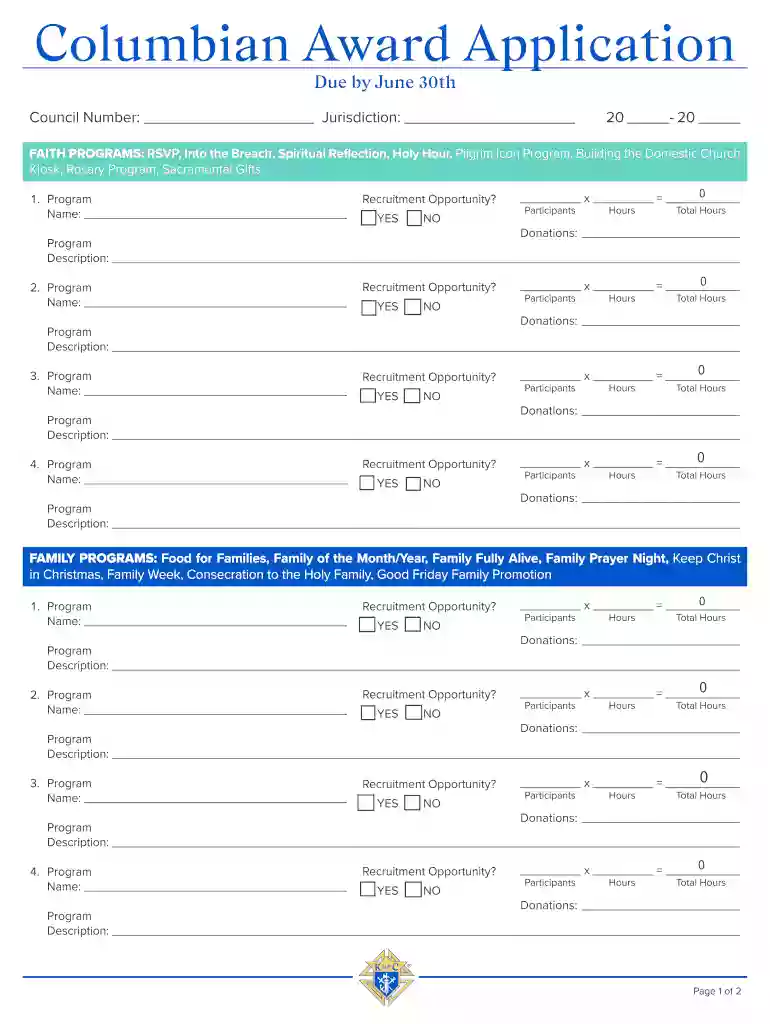
Type text, add images, blackout confidential details, add comments, highlights and more.

Draw your signature, type it, upload its image, or use your mobile device as a signature pad.

Send knights columbian form via email, link, or fax. You can also download it, export it or print it out.
The term "Due by June 30th" typically refers to a deadline by which certain forms, applications, or documents need to be submitted or completed. This due date is commonly seen in various domains, including tax filings, grant applications, and organizational submissions. Understanding this deadline is crucial for ensuring compliance and avoiding potential penalties or loss of opportunity.
To effectively manage submissions with a deadline of June 30th, it is essential to plan meticulously and ensure every detail is in place.
Completing a form with this deadline involves several detailed steps to ensure accuracy and compliance.
Understanding the core elements of the form can enhance completion accuracy.
Personal Information: Name, address, contact details, etc.
Mandatory Sections: These must be filled out to validate the form.
Supplementary Attachments: Additional documents required as proof or evidence.
Authorization Signatures: Necessary endorsements from specific individuals, if applicable.
Detailed Example: In a corporate filing, ensure that consent forms and corporate identification numbers are included where necessary.
Meeting the filing deadline of June 30th encompasses more than just a calendar notification.
Timing Strategy: Consider time zone differences and your method of submission.
Preparatory Milestones: Set earlier personal deadlines to avoid last-minute issues.
Contingency Plans: Develop a backup plan in case of unexpected delays.
Real-World Scenario: International businesses must submit forms according to their operational time zones, affecting how deadlines like June 30th are integrated into business planning.
Compiling the necessary documents is fundamental in successfully addressing a "Due by June 30th" deadline.
Basic Requirements: Identification, tax information, proof of eligibility.
Specific Needs: Depending on the form, additional certifications or licenses might be necessary.
Case Study: A scholarship application due by June 30th may require transcripts, recommendation letters, and a personal statement.
Failure to adhere to deadlines can lead to various penalties, making understanding compliance critical.
Types of Penalties: Fines, increased fees, legal action, or disqualification.
Preventive Measures: Observations of deadlines and preemptive checks can mitigate the risk of facing penalties.
Illustrative Example: Late tax submissions resulting in fines illustrate the implications of missing the June 30th deadline.
Utilizing software can streamline the submission process for documents due by June 30th.
Compatible Platforms: Ensure the software you use supports the format and requirements of the form.
Automation Tools: Use scheduling tools to remind you of approaching deadlines.
Document Management: Implement software that integrates with your document processing to avoid duplication and errors.
Practical Scenario: Utilizing DocHub to manage and submit documents electronically ensures compliance and security for June 30th deadlines.
We've got more versions of the sp 7 form. Select the right sp 7 version from the list and start editing it straight away!
At DocHub, your data security is our priority. We follow HIPAA, SOC2, GDPR, and other standards, so you can work on your documents with confidence.
Jun 11, 2026 Business License Renewal payments are due by June 30, 2026. contact the Finance Department at (540) 347-1101 ext. 101 or taxes@warrentonva.gov.
Jun 1, 2026 Were excited to announce that applications for the Rome Campus J-Term 2027 program are now open! Program Dates: January 9th 22nd,Read more


