




01. Edit your form online
Type text, add images, blackout confidential details, add comments, highlights and more.

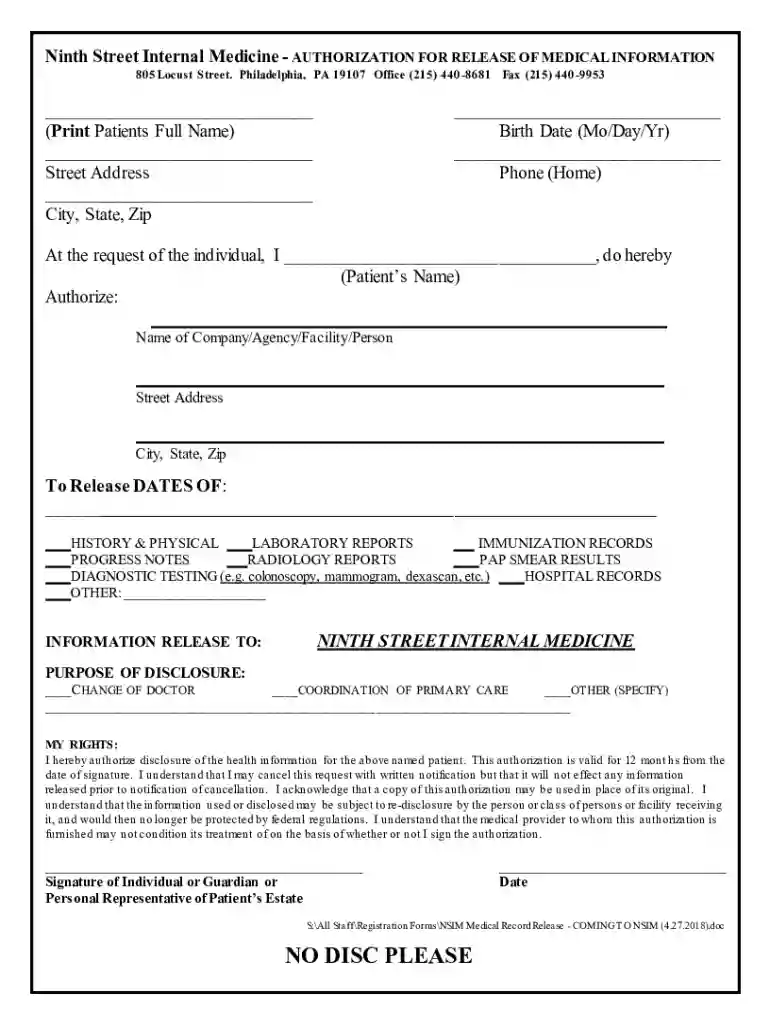
Type text, add images, blackout confidential details, add comments, highlights and more.

Draw your signature, type it, upload its image, or use your mobile device as a signature pad.

Send it via email, link, or fax. You can also download it, export it or print it out.
The "Ninth Street Internal Medicine- AUTHORIZATION FOR RELEASE OF" is a legal document utilized by patients to allow Ninth Street Internal Medicine to disclose their medical information to specified individuals or entities. This document is crucial for ensuring that patient data is handled according to legal standards and patient preferences. It outlines which medical records can be shared, the purpose of the disclosure, and the duration of the authorization, which is typically valid for twelve months unless revoked.
Using the "Ninth Street Internal Medicine- AUTHORIZATION FOR RELEASE OF" form involves several essential steps.
Completing the "Ninth Street Internal Medicine- AUTHORIZATION FOR RELEASE OF" involves a systematic approach:
The proper and legal use of the authorization form is critical in maintaining compliance with health privacy laws such as the Health Insurance Portability and Accountability Act (HIPAA). This form ensures that patient information is shared responsibly and only with the patient’s explicit consent. Understanding that this document grants certain access rights to the recipient is paramount, as it impacts both patient privacy and the legal handling of medical data.
Signing the "Ninth Street Internal Medicine- AUTHORIZATION FOR RELEASE OF" is significant for a variety of reasons:
The "Ninth Street Internal Medicine- AUTHORIZATION FOR RELEASE OF" is widely used by:


Understanding specific legal and medical terminology enhances clarity while filling out the form:
Consider real-world scenarios that highlight the application of this form:
Each of these use cases underscores the versatility and necessity of this form across various life situations.
We've got more versions of the Ninth Street Internal Medicine- AUTHORIZATION FOR RELEASE OF form. Select the right Ninth Street Internal Medicine- AUTHORIZATION FOR RELEASE OF version from the list and start editing it straight away!
At DocHub, your data security is our priority. We follow HIPAA, SOC2, GDPR, and other standards, so you can work on your documents with confidence.
by CUN Cu 2010 Established in 1995, the Interstate Technology Regulatory Council (ITRC) is a state-led, national coalition of personnel from the environmental regulatoryRead more
Generally, only a patient may authorize release of his/her medical information. 3819 Chestnut Street, Suite 214, Philadelphia, PA 19104.
by ST Amann 2024 Cited by 2 What Is Prior Authorization, and Why Are We Here? The prior authorization (PA) process is time-intensive and inefficient for patients, physicians,Read more


