







Definition & Meaning
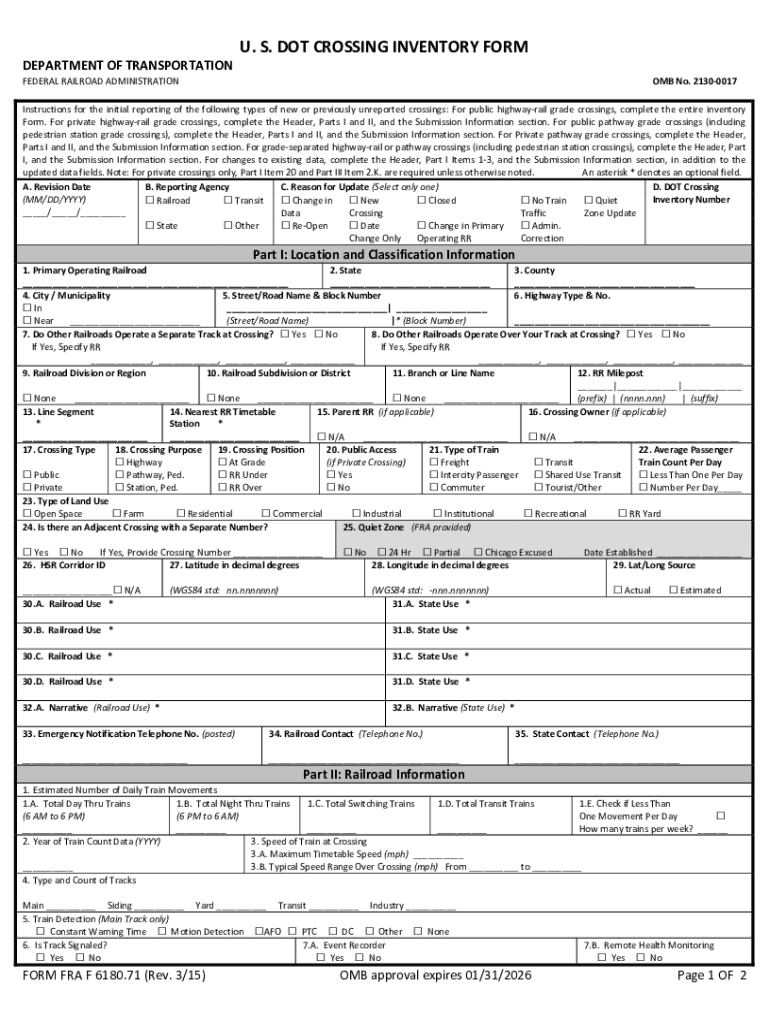
"49 CFR Part 234 -- Grade Crossing Safety - eCFR" refers to the section of the Code of Federal Regulations that addresses standards and protocols for ensuring safety at highway-rail and pathway grade crossings. This regulation outlines the responsibilities of railroads, as well as federal and state agencies, in maintaining and reporting on the safety conditions of these crossings. It includes provisions for reporting new crossings, updating existing information, and ensuring compliance with federal safety standards.
Key Responsibilities
- Railroads: Must report specific information about crossings, maintain crossing equipment, and ensure adherence to safety standards.
- Federal and State Agencies: Oversee compliance and conduct inspections to verify the safety of grade crossings.
Importance
This regulation is crucial for the prevention of accidents at rail crossings, helping to save lives and reduce injury risks associated with train and vehicle interactions.
Key Elements of the 49 CFR Part 234
Understanding the core components of this regulation is essential for compliance:
Inventory and Reporting Requirements
Railroads are required to maintain an inventory of all grade crossings, including details such as:
- Location: Exact geographic coordinates and local address information.
- Type of Crossing: Public, private, or pedestrian.
- Traffic Control Devices: Presence of gates, lights, bells, and other warning systems.
Maintenance and Inspection Protocols
To ensure the safety of crossings:
- Regular Inspections: Scheduled checks on equipment functionality and safety measures.
- Immediate Repairs: Prompt action to fix any issues identified during inspections.
Grade Crossing Equipment Standards
Equipment at crossings must meet federal standards, including:
- Signal Visibility: Must be clearly visible to approaching traffic under various weather and lighting conditions.
- Reliability Measures: Regular testing to ensure the operational reliability of crossing signals and safety devices.
Steps to Complete the 49 CFR Part 234 - Grade Crossing Safety Form
Navigating the requirements of this form efficiently involves several steps:
Gathering Required Information
Before completing the form, collect:
- Crossing Details: Accurate and comprehensive data regarding the crossing location and characteristics.
- Railroad Data: Information on the operating line that crosses the intersection.
Submission Process
- Online Submission: Preferred method for most entries due to ease of access and tracking capabilities.
- Mail Submission: An option for those without reliable internet access or as a backup for online issues.
Review and Verification
Ensure accuracy by:
- Double-Checking Entries: Verify all data before submission to avoid errors.
- Confirming Receipt: Use confirmation receipts or tracking numbers for record-keeping.
Legal Use of the 49 CFR Part 234
Proper adherence to this regulation involves staying informed of the legal implications:
Compliance Obligations
Railroads and relevant agencies must adhere to:
- Reporting Deadlines: Regular updating of crossing information as prescribed by the regulation.
- Safety Standards: Implementation of federally mandated safety measures and equipment checks.
Penalties for Non-Compliance
Failure to comply can result in:
- Fines: Monetary penalties proportional to the severity and duration of non-compliance.
- Operational Restrictions: Possible imposition of restrictions on crossings or rail operations until compliance is achieved.
Important Terms Related to 49 CFR Part 234
Understanding specific terminology is crucial for navigating the form:
Crossing Types
- Public Crossing: Open and accessible to the general public.
- Private Crossing: Limited access, typically for specific users or property owners.
Warning Systems
- Passive Devices: Signs and markers without automated mechanisms.
- Active Devices: Includes gates, lights, and audible signals.
Inspection Reports
- Scheduled Inspections: Routine checks to ensure ongoing safety compliance.
- Spot Inspections: Unscheduled assessments conducted to address specific concerns or incidents.
Examples of Using the 49 CFR Part 234
Practical application scenarios illustrate the regulation’s real-world impact:
Case Study: Urban Intersection
In a large city, enhanced safety measures such as new electronic gates and signal improvements have been implemented under 49 CFR Part 234 guidelines, resulting in a significant reduction in collision incidents.
Rural Crossing Upgrade
A remote rural crossing added new signage and active warning systems, which aligns with the regulations and addresses unique visibility challenges, enhancing safety for nearby communities.
State-Specific Rules for the 49 CFR Part 234
While the regulation provides federal guidance, states may have additional or specific rules that impact how the regulation is applied locally:
State Variations
- Supplementary Guidelines: Some states may impose extra safety measures or specific reporting processes.
- Local Inspection Requirements: State agencies might conduct additional inspections beyond federal mandates.
Coordination with State Agencies
Railroads must maintain communication with state agencies to ensure full compliance with both federal and state regulations, accommodating any state-specific requirements or expectations.
Digital vs. Paper Version
Options for how the form can be managed and submitted vary based on user preference and accessibility:
Digital Efficiency
- Ease of Access: Online platforms provide streamlined access and submission processes, reducing the time and effort needed for compliance.
- Immediate Updates: Digital forms can be easily updated and submitted in real-time, enhancing accuracy and timeliness.
Paper Backup
While primarily digital, maintaining paper copies serves as a reliable backup in case of technical issues or for those who prefer traditional record-keeping methods.




