






Definition and Purpose of State Court Civil Forms
State court civil forms are standardized documents used in legal proceedings within state courts. These forms are utilized in various civil matters such as lawsuits, motions, orders, and notices. They are designed to facilitate the legal process by providing a uniform format for parties to submit information and evidence. Courts mandate the use of these forms to ensure that documents are complete and accurate, which aids in the efficient administration of justice.
Types of State Court Civil Forms
- Complaint Forms: Used to initiate a lawsuit. They include information about the plaintiff, defendant, and the nature of the complaint.
- Motion Forms: Filed when a party requests the court to make a specific ruling or order.
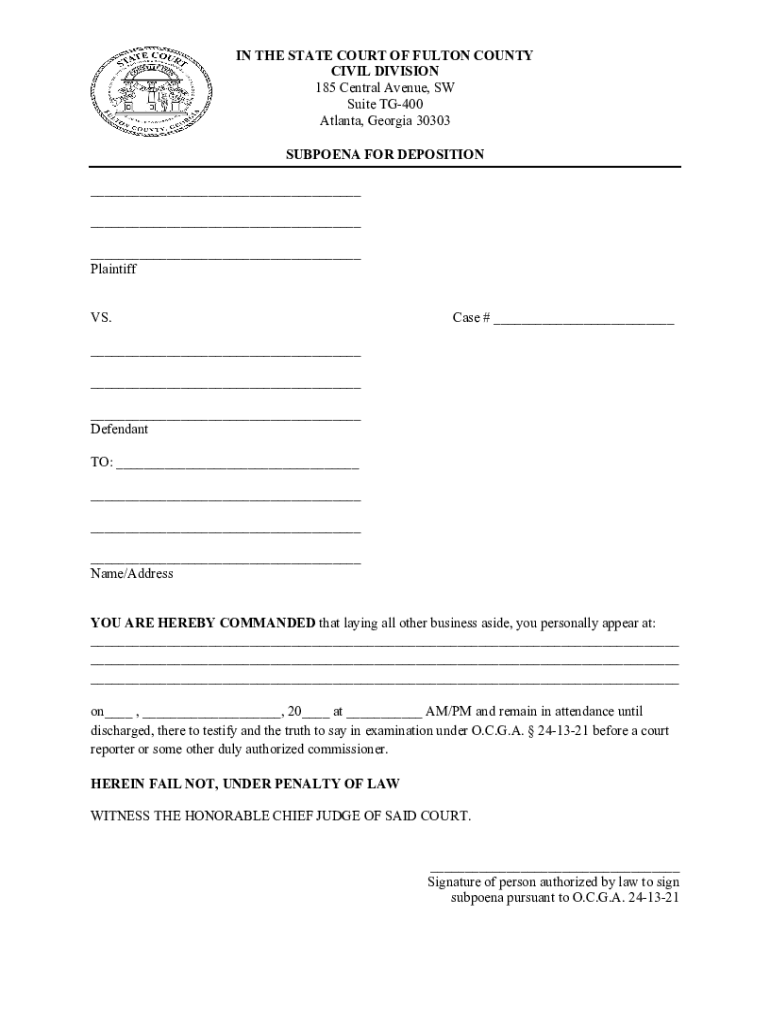
- Subpoena Forms: These demand the presence of a person for deposition or to produce documents.
- Summons Forms: Notify a party of legal proceedings and compel their response.
- Judgment Forms: Provide the official record of a court's decision in a case.
Practical Example
In Fulton County, individuals appearing in a civil case might use a subpoena form to compel witness testimony. This is crucial for gathering evidence and supporting arguments during court hearings.
How to Obtain State Court Civil Forms
Accessing state court civil forms can be done through several means, ensuring they are available to individuals needing them for legal proceedings. They are typically available from:
- Court Websites: Most state court websites offer downloadable forms, which are categorized based on their purpose.
- Clerk of Court Offices: Local court clerks have copies of necessary forms and provide guidance on completion.
- Legal Aid Organizations: These entities often supply forms and assist individuals in understanding their use.
- Online Legal Platforms: Services like DocHub allow users to access and fill out state court civil forms digitally, offering convenience and additional tools like editing and electronic signatures.
Steps to Complete State Court Civil Forms
Filling out state court civil forms correctly is vital for ensuring the court accepts them without delays. Here is a generic step-by-step process:
- Identify the Correct Form: Determine the type of legal action involved and select the appropriate form.
- Read Instructions Thoroughly: Each form comes with instructions on how to fill out the various sections. Understanding these is essential.
- Fill in Personal Information: Include details such as names, addresses, and contact numbers for all involved parties.
- Provide Case Details: Clearly outline the facts and claims relevant to the case.
- Review and Edit: Check for any errors or omissions and ensure clarity in the information provided.
- File the Form: Submit the completed form to the appropriate court clerk’s office along with any required filing fees.
Key Considerations
- Accuracy is Crucial: Errors can lead to delays or rejections.
- Signatures Required: Ensure all required parties sign the form where necessary.
- Deadlines: Be aware of filing deadlines to prevent adverse legal consequences.
Who Typically Uses State Court Civil Forms
These forms are widely used by several parties involved in civil litigation:
- Plaintiffs and Defendants: Individuals or organizations representing themselves or their interests in court.
- Attorneys: Legal professionals working on behalf of clients to file necessary legal documents.
- Prosecutors and Public Defenders: Engage these forms for various pre-trial and trial activities.
- Clerks and Court Staff: Use these documents to process and manage court cases effectively.
State court civil forms are integral to the functioning of the civil judicial system, catering to individuals from diverse backgrounds and cases ranging from family law to commercial disputes.
Important Terms Related to State Court Civil Forms
Comprehending certain legal terms aids in understanding and using these forms:
- Litigant: A party involved in a lawsuit.
- Pro Se: Representing oneself without an attorney in legal matters.
- Jurisdiction: The court’s authority to hear a case.
- Affidavit: A written statement confirmed by oath for use as evidence in court.
- Ex Parte: Proceedings or actions taken by or for one party without the other party's presence.
Understanding these terms helps in accurately completing forms and effectively participating in the legal process.
State-Specific Rules for State Court Civil Forms
Each state imposes specific rules and regulations governing the use and submission of civil forms, reflecting local legal nuances:
- Form Design Variations: Some states customize forms to include specific identifiers like county names.
- Submission Protocols: Certain forms might require notarization or additional supporting documents.
- Filing Fees: These can vary depending on the type and number of forms submitted.
Variations arise due to federalism, as states exercise authority over civil procedure rules, making it imperative for users to comprehend their local requirements.
Examples of Using State Court Civil Forms
Using state court civil forms appropriately can make a significant difference in litigation outcomes:
Real-World Scenario
A business involved in a contract dispute might file a complaint form to initiate proceedings against a partner alleged to have breached an agreement. By correctly filling out and submitting the complaint form with necessary contractual documents, the court is informed about the case and parties involved, facilitating the resolution process.
Understanding the myriad types and uses of state court civil forms helps individuals navigate the legal system effectively, enabling resolution of a broad array of civil matters.