







Definition and Purpose of the New Jersey Employment Application
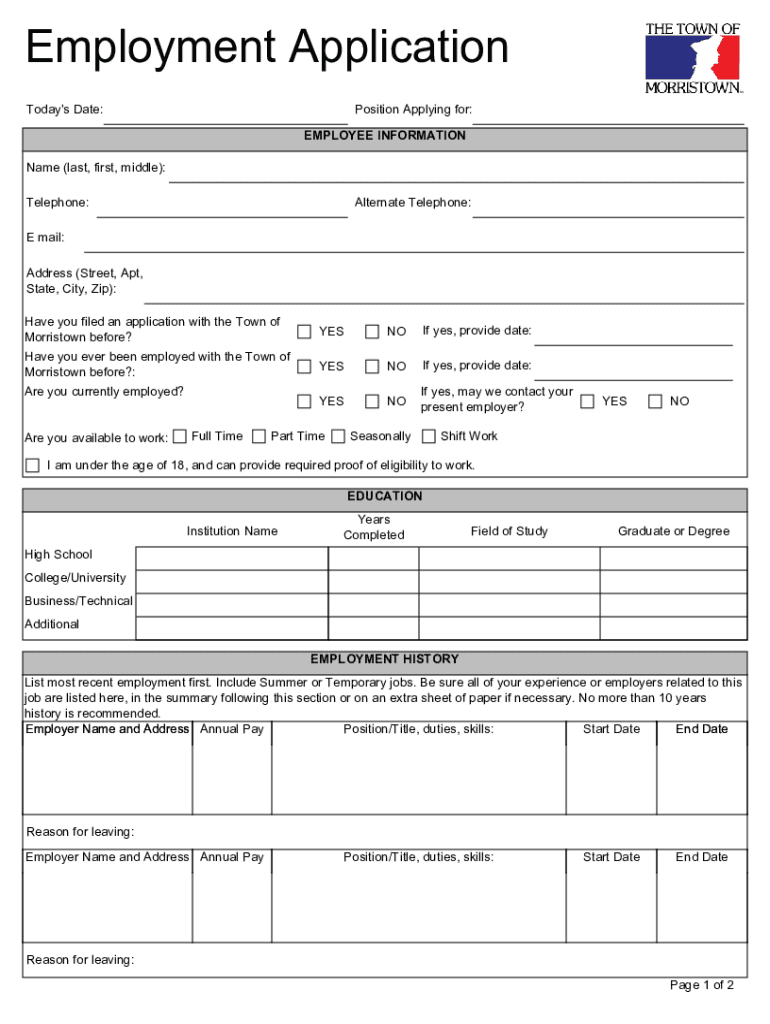
The New Jersey Employment Application is a comprehensive document designed to collect detailed background information from job applicants within the state. It serves as a standardized method for employers to assess potential hires by gathering relevant personal details, employment history, educational background, military service, professional skills, and references. This form also emphasizes adherence to equal employment opportunity standards, ensuring a fair hiring process for all applicants.
Important Sections of the New Jersey Employment Application
Personal Information
The application requests applicants to provide basic personal data, such as name, address, contact information, and social security number. This crucial information allows employers to identify and reach out to potential candidates directly. Ensuring accuracy in this section is vital for smooth communication and verification processes.
Employment History
Applicants are required to detail their previous employment experiences, including the names of past employers, job titles, duties, and durations of employment. This section helps employers gauge an applicant's work experience and their ability to fulfill the potential job responsibilities. Specific attention to chronological order and consistency can strengthen an applicant's profile.
Educational Background
In this section, candidates list their academic qualifications, including any degrees or certifications attained, institutions attended, and graduation dates. This information helps employers verify the educational claims of an applicant and assess their compatibility with the job's educational requirements.
Military Service and Relevant Skills
Beyond civilian employment, the form also seeks details on any past military service. Applicants describe their service branch, rank, and skills acquired during their tenure. This can be particularly advantageous for veterans, as it enables them to demonstrate unique skills and experiences gained in the military that may be applicable to civilian roles.
How to Obtain and Complete the New Jersey Employment Application
Obtaining the Form
The New Jersey Employment Application can typically be obtained through the hiring entity or employer. It might be available for download on company websites or collected in-person at their offices. Some state or municipal job portals also host the form, or it may be provided upon request by contacting the intended employer directly.
Steps to Complete the Application
- Gather Necessary Information: Prepare all relevant personal, employment, and educational documents to ensure accuracy.
- Fill Out the Sections: Carefully complete each section, paying attention to instructions regarding attachments or additional information required.
- Review and Confirm: Double-check entries for any inaccuracies or omissions. Corrections can be made before final submission.
- Submit the Form: Submit the completed application via the method preferred by the employer, be it electronically or physically.
Who Typically Uses the New Jersey Employment Application


Potential Job Applicants
Individuals seeking employment in New Jersey, ranging from recent graduates entering the workforce to seasoned professionals looking for new opportunities, use this form to apply for various job openings statewide.
Employers and Hiring Managers
These individuals utilize the form to streamline the applicant screening process, ensuring all candidates are evaluated on consistent criteria. They analyze the collected data to determine which applicants meet the essential qualifications for the role in question.
Key Elements and Legal Considerations
Equal Employment Opportunity
The application upholds the principles of equal employment opportunity, ensuring non-discriminatory practices in hiring based on race, color, religion, sex, or national origin. This aligns with federal and state labor laws to promote fairness.
Legal Obligations
Applicants must be honest and transparent when completing the form. Providing false information can lead to disqualification from the job application process and, in some cases, legal ramifications.
State-Specific Considerations
Compliance with New Jersey Regulations
Employers and applicants must be aware of state-specific regulations that may affect employment application processes, such as specific disclosures or eligibility requirements pertinent to New Jersey.
Special Notes for Lifeguard Applicants
For lifeguard positions, specific mention is made to adhere to American Red Cross standards. This includes certification prerequisites that applicants must possess for roles involving lifesaving responsibilities.
Form Submission and Record-Keeping
Methods of Submission
Applicants can usually submit their forms electronically via email or online job portals. Alternatively, traditional methods such as postal mail or in-person delivery at an employer's office are sometimes used, depending on the company's preference.
Importance of Record-Keeping
Maintaining copies of the submitted application is crucial for both the applicant and the employer. This documentation supports transparency in the hiring process and serves as a reference for verifying submitted information.
Penalties for Non-Compliance
Employers must adhere to labor laws when managing employment applications, and any non-compliance could lead to investigations or sanctions by labor regulatory bodies. Similarly, applicants attempting to falsify information risk suspension or ban from applying to positions within that organization.


