
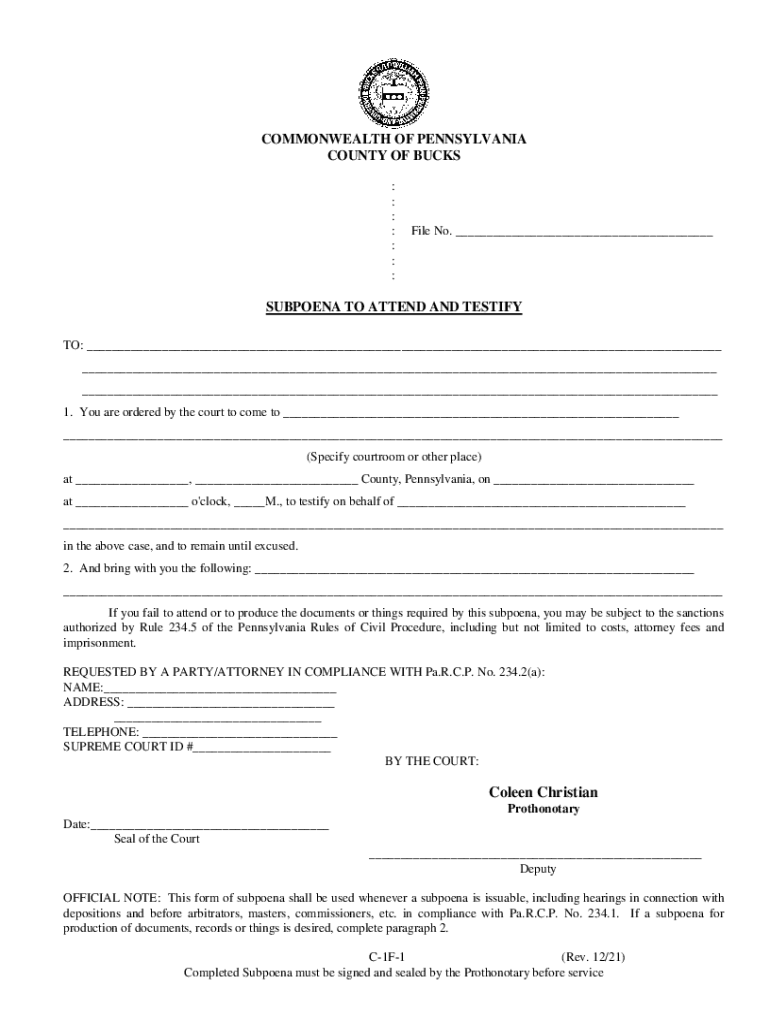







Definition & Meaning
Pennsylvania court forms and other information refer to a range of official documents utilized for legal proceedings within the state of Pennsylvania. These forms are mandated by the Commonwealth of Pennsylvania to facilitate various legal processes, such as filing claims, responding to lawsuits, or requesting court orders. The forms ensure consistency and clarity in legal documentation, providing standardized templates that help individuals, legal representatives, and court officials process legal matters efficiently.
- Types of Forms: These forms include subpoenas, motions, petitions, and affidavits, among others, each serving specific legal functions.
- Purpose: They help streamline the legal process, ensuring all parties adhere to required protocols when handling legal issues.
- Legislative Basis: The forms are rooted in Pennsylvania's legal framework, adhering to state laws and judicial standards.
Understanding the definition and intended use of these forms is crucial for anyone involved in legal matters within Pennsylvania.
Steps to Complete Pennsylvania Court Forms
Completing Pennsylvania court forms accurately is vital for the successful navigation of legal processes. Below is a step-by-step guide:
- Identify the Required Form:
- Determine the specific form needed based on your legal situation, such as a subpoena or a petition for custody.
- Obtain the Form:
- Access the form online through the Pennsylvania court's official website or obtain a physical copy from the courthouse.
- Read Instructions Carefully:
- Each form comes with detailed instructions. Ensure you understand the instructions to correctly complete the form.
- Fill Out Personal Information:
- Accurately provide your full name, contact information, and any relevant personal details necessary for the form.
- Detail the Specifics of the Case:
- Clearly articulate the facts and circumstances related to the legal matter, following the form’s guidelines.
- Review and Legal Verification:
- Double-check all information for accuracy. Consider having a legal professional review the completed form for errors or omissions.
- Sign and Date the Form:
- Provide all required signatures and dates as specified in the form instructions.
- Submit the Form:
- Submit the form through the designated method, be it online, via mail, or in person at the appropriate Pennsylvania courthouse.
Each step in this process is essential to ensure the form is accepted by the court and the legal proceedings can continue without unnecessary delays.
Important Terms Related to Pennsylvania Court Forms
Familiarity with legal terminology is crucial when dealing with Pennsylvania court forms. Here are some key terms:
- Prothonotary: The clerk of the court responsible for maintaining records and documents.
- Affidavit: A written statement confirmed by oath, used as evidence in court.
- Petitioner: The individual or entity presenting a petition to the court.
- Respondent: The party responding to a petition or appeal in a legal proceeding.
- Subpoena: A document ordering someone to attend court or produce documentation.
Understanding these terms will help facilitate communication and comprehension throughout the court process.
Legal Use of Pennsylvania Court Forms
The legal use of Pennsylvania court forms encompasses various judicial and administrative functions:
- Filing Legal Actions: Forms are used to initiate legal proceedings like lawsuits, motions, and appeals.
- Responding to Court Orders: Parties involved must use appropriate forms to respond to subpoenas or court directives.
- Documentation of Legal Agreements: Legal agreements and decisions, such as custody arrangements, are documented using standardized forms.
- Enforcement of Legal Rights: Forms are necessary to ensure legal rights are upheld and disputes are addressed according to state laws.
It is imperative to use these forms correctly to maintain legal integrity and avoid potential penalties.
Examples of Using Pennsylvania Court Forms
Illustrative examples can provide context for how these forms are employed:
- Case Preparation: A lawyer prepares and submits a motion for summary judgment using the court's standardized form.
- Custody Battle: Parents use specific forms to petition for changes in custody arrangements, detailing their reasons and evidence.
- Small Claims: An individual files a small claims form to recover unpaid debts or damages, ensuring adherence to court protocols.
These examples highlight the forms’ practical applications, emphasizing their role in maintaining orderly legal proceedings.
Form Submission Methods (Online / Mail / In-Person)
Submitting Pennsylvania court forms involves several options, allowing flexibility depending on the form and urgency:
- Online Submission:
- Many forms can be submitted electronically through the Pennsylvania court's e-filing system, providing a convenient and efficient option.
- Mail Submission:
- Physical forms can be mailed to the relevant court address, often accompanied by required filing fees and additional documentation.
- In-Person Submission:
- Forms may be delivered directly to the courthouse, which provides immediate confirmation of receipt and allows for any questions to be addressed on the spot.
Each method has its procedural requirements, which should be followed precisely to ensure successful submission.
State-Specific Rules for Pennsylvania Court Forms
Pennsylvania's legal system has specific rules governing the use of court forms, ensuring compliance:
- Format and Presentation:
- Forms must be completed legibly, with specific font sizes and margins as dictated by state rules.
- Deadline Adherence:
- Submission of forms must meet strict deadlines to avoid case dismissals or other legal repercussions.
- Required Documentation:
- Completing forms may require additional documentation, such as financial statements or identification proof, ensuring the form meets evidentiary standards.
Familiarity with these state-specific rules will ensure correct form usage and compliance with Pennsylvania’s legal processes.
Penalties for Non-Compliance
Non-compliance with the requirements for Pennsylvania court forms can result in significant penalties:
- Dismissal of Case:
- Failure to submit necessary forms accurately or timely can lead to case dismissal or denial.
- Fines and Contempt Charges:
- Non-compliance may incur fines or charges of contempt of court, impacting legal standing.
- Delayed Proceedings:
- Incorrect forms can cause delays in legal proceedings, affecting outcomes and prolonging resolution.
Understanding the consequences of non-compliance emphasizes the importance of correctly managing court documentation within Pennsylvania.




