Definition & Meaning
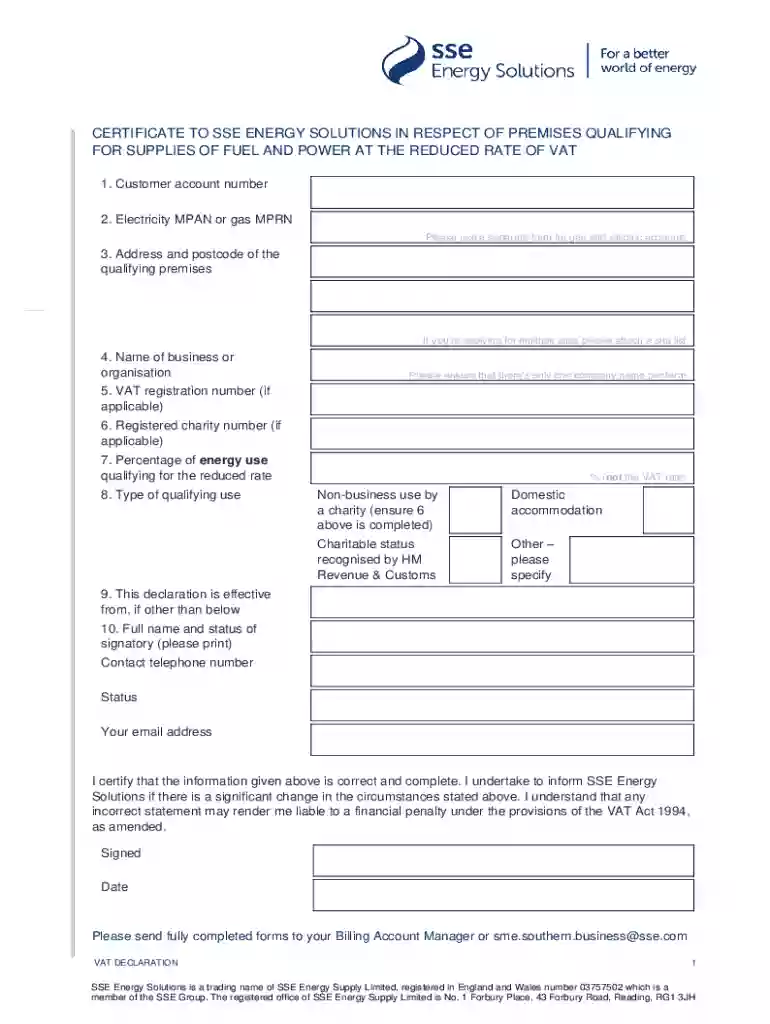
A certificate to Scottish and Southern Energy in respect of reduced VAT rates functions as a formal declaration utilized by customers to apply for reduced VAT rates on fuel and power supplies. This specific form is vital for businesses and individuals aiming to leverage tax benefits for qualifying premises, thereby reducing their operational costs.
Purpose of the Certificate
- Helps users apply for reduced VAT rates on energy supplies.
- Verifies eligibility for tax benefits based on energy usage.
- Provides legal documentation of the customer's declaration regarding energy use.
Attestation and Accuracy
- The signatory confirms the accuracy of the provided information.
- Acknowledges potential repercussions for misstatements, ensuring compliance with legal standards.
How to Use the Certificate
Utilizing the certificate effectively involves understanding its structure and complying with its requirements. It is essential to gather the necessary details and fill out the form accurately.
Filling Out the Required Sections
- Enter the customer account number and address.
- Provide the business name and VAT registration number.
- Specify the energy use percentage and qualifying use type.
Certification Process
- Carefully review each section to ensure all information is correct.
- Sign and date the certificate, confirming the validity of the information.
How to Obtain the Certificate
Securing the certificate involves a few straightforward steps, ensuring that users can effectively apply for reduced VAT rates without unnecessary delays.
Official Sources for the Certificate
- Obtain the certificate directly from Scottish and Southern Energy's official website.
- Request a physical copy by contacting customer service if digital access is unavailable.
Necessary Information for Application
- Gather all preliminary data, including customer account details and business identifiers.
- Ensure VAT registration information is up-to-date to ease the application process.
Steps to Complete the Certificate
Completing the certificate involves a sequence of precise steps, each crucial for the document's acceptance and eventual benefit realization.
- Collection of Information: Start by gathering the essentials like the VAT registration number, energy use percentages, and customer account specifics.
- Filling Out the Form: Enter the collected information accurately into the designated fields.
- Review Process: Check for errors and ensure all necessary fields are completed.
- Signing: Sign the certificate to certify the information's accuracy before submission.
Finalizing and Submitting
- Ensure all sections reflect accurate data before sending the form.
- Follow the specified submission method—online, by mail, or in person.
Who Typically Uses the Certificate
Understanding the typical users of such certificates helps in recognizing its utility across various sectors.

Typical Users
- Businesses with significant energy consumption seeking tax relief.
- Organizations legally eligible for VAT reductions on energy supplies.
- Individuals or sole proprietors operating qualifying premises.
Usage Across Industries
- Manufacturing and industrial sectors taking advantage of lower VAT rates.
- Retail businesses where energy expenses contribute substantially to operational costs.
Key Elements of the Certificate
The certificate comprises several critical components, each of which contributes to its function as a legally binding document for VAT rate reductions.
Fundamental Components
- Customer Details: Includes account number and registered business address.
- VAT Information: VAT registration details critical for tax considerations.
- Energy Utilization Data: Specifics on the percentage and type of energy use that qualify for reduced rates.
Certification Details
- Signatory Approval: Legal attestation by the signatory confirming form accuracy.
- Potential Penalties: Legal implications outlined for inaccuracies or misstatements.
Legal Use of the Certificate
Legally, the certificate serves as a formal acknowledgment of a customer's claim for reduced VAT rates based on qualifying energy use, ensuring compliance with taxation laws.
Legal Adherence
- Assures correctness and truthfulness of submitted information per legal requirements.
- Acts as a compliance tool, mitigating legal or fiscal risks related to energy tax claims.
Certification and Verification
- Reinforces the binding nature of the certified information submitted.
- Requires alignment with local and national tax regulations for VAT reductions.
Examples of Using the Certificate
Demonstrating practical use scenarios aids in understanding the certificate's applicability and benefits across different settings.
Real-World Scenarios
- A manufacturing company reducing operational costs through VAT rate adjustments on energy.
- Retail chains benefiting from tax savings in compliance with allocation percentages for qualifying use.
Diverse Industry Applications
- Commercial establishments updating energy policies to maximize tax reductions.
- Government facilities managing budget constraints via strategic energy use certification.