




01. Edit your form online
Type text, add images, blackout confidential details, add comments, highlights and more.

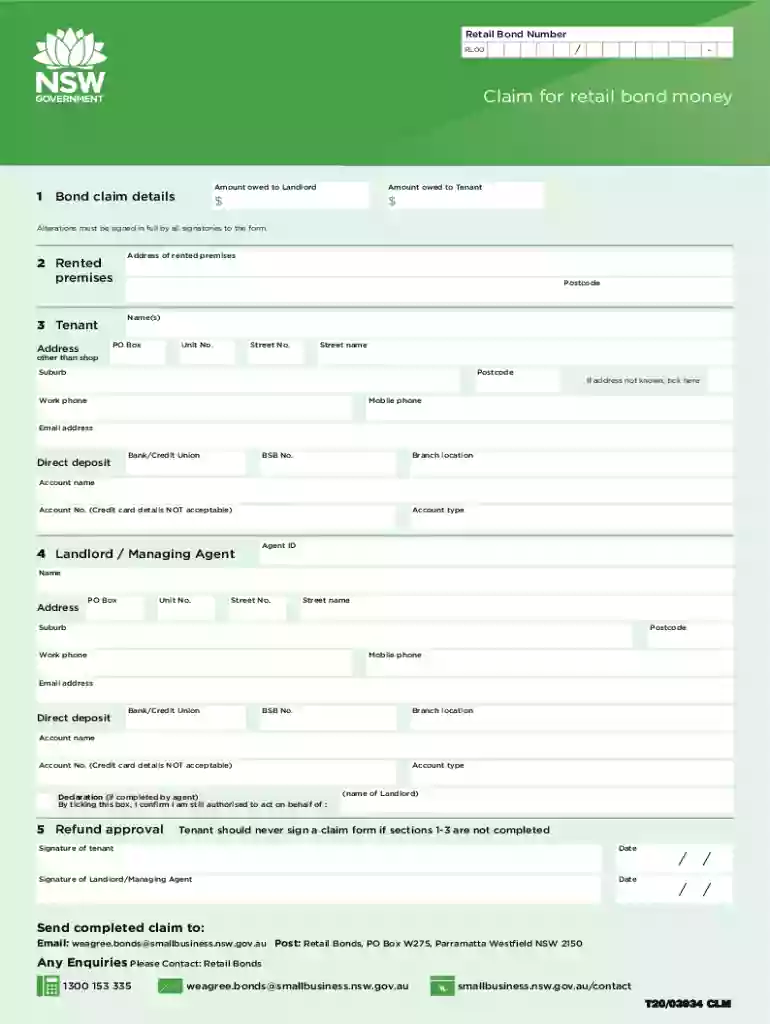
Type text, add images, blackout confidential details, add comments, highlights and more.

Draw your signature, type it, upload its image, or use your mobile device as a signature pad.

Send it via email, link, or fax. You can also download it, export it or print it out.
The term "claim for retail bond money" refers to the process by which individuals, typically tenants or landlords, recover funds held as a security deposit in a retail agreement. This type of claim is made when exiting a retail lease, ensuring that any bond money, which serves as a financial guarantee for the fulfillment of lease obligations, is returned to the rightful party. Understanding this process is crucial for those involved in retail leasing arrangements, as it impacts the final settlement of financial matters upon lease termination.
The form for claiming retail bond money is structured to facilitate the efficient retrieval of deposit funds. Utilizers of the form must provide detailed information to ensure accurate processing.
Completing a retail bond claim involves several key steps to ensure all necessary details are accurately recorded and submitted.
Gather Necessary Documentation
Fill Out Personal and Lease Information
Specify Claim Amount
Submit Supporting Evidence
Review for Completeness and Accuracy
Sign and Submit
Understanding common terminology is crucial for those involved in the process of claiming retail bond money, as it ensures clarity and helps avoid misunderstandings.
Legal considerations play a significant role in the retail bond claim process, ensuring compliance with local and federal laws.
Submitting a claim for retail bond money requires a meticulous gathering of documents to support the claim.
Illustrating practical applications can help clarify how the retail bond claim process works in different scenarios.
We've got more versions of the Claim for retail bond money Claim for retail bond money form. Select the right Claim for retail bond money Claim for retail bond money version from the list and start editing it straight away!
| Versions | Form popularity | Fillable & printable |
|---|---|---|
| 2020 | 4.7 Satisfied (36 Votes) |
At DocHub, your data security is our priority. We follow HIPAA, SOC2, GDPR, and other standards, so you can work on your documents with confidence.
We instill investor confidence. Learn more about our firm and the benefits of partnering with us to meet your financial goals.Read more
If this form is being completed as part of a savings bond debt, please check this box. 1. DESCRIPTION OF BONDS. Describe the missing bonds in the spaces below.Read more


