







Definition & Meaning
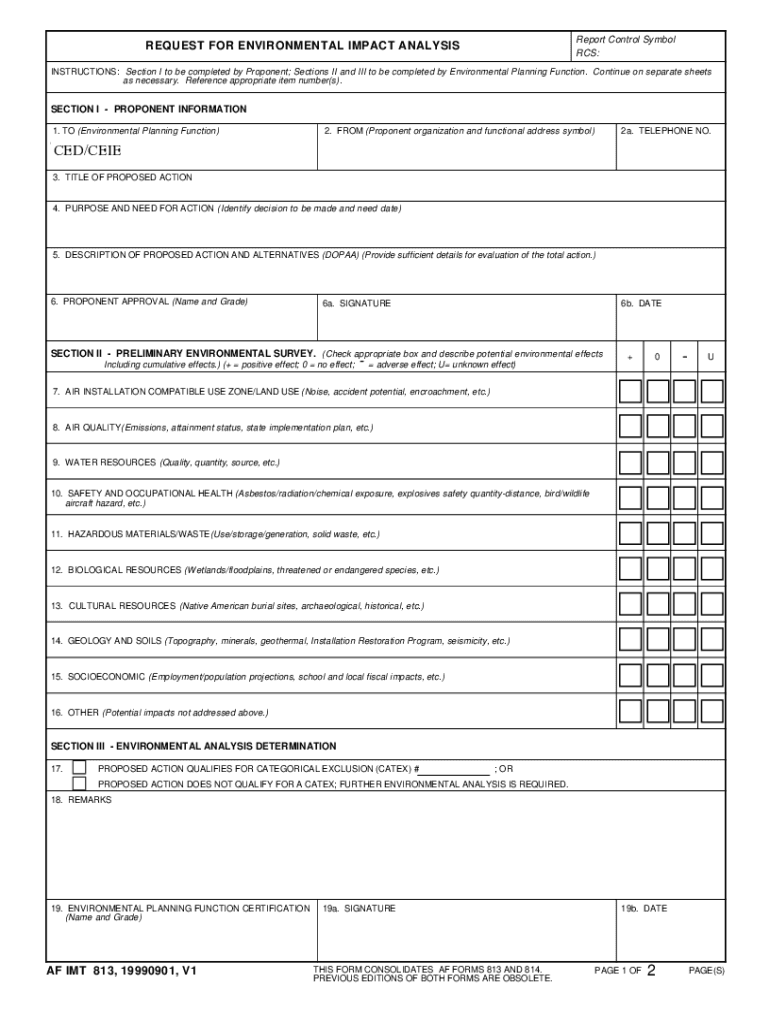
The Request for Environmental Impact Analysis (REIA) is a formal document employed in evaluating the potential environmental consequences of a proposed action or project. Its primary function is to collect detailed information from proponents about their initiatives, especially concerning their effects on various environmental factors such as air quality, water resources, and biological diversity. The REIA is indispensable for determining whether a proposed action qualifies for categorical exclusion or necessitates further detailed analysis.
Key Elements of the Request for Environmental Impact Analysis
-
Proponent Information: This section requires comprehensive details about the individual or organization proposing the action. Information typically includes contact details and the nature of the organization, providing a foundational context for the environmental review.
-
Preliminary Environmental Survey: A crucial element where the proponent assesses various environmental factors. This includes examining potential impacts on air and water quality, ecosystems, and local wildlife. The survey helps establish a baseline environmental condition before the project's potential disturbances.
-
Determination & Assessment of Impact: This part assesses whether the proposed action poses significant environmental effects. The determination informs whether the project can proceed with minimal environmental concern or if further analysis, such as an Environmental Impact Statement (EIS), is necessary.
Steps to Complete the Request for Environmental Impact Analysis
-
Gather Necessary Information: Compile all relevant details regarding the proposed action, including its objectives, the scope of implementation, and anticipated environmental outcomes.
-
Conduct an Environmental Survey: Perform a preliminary survey focusing on critical environmental factors such as local wildlife habitats, water resources, and air quality predictions.
-
Fill Out the Form Sections: Accurately complete each section of the REIA form, ensuring that the information is both comprehensive and concise.
-
Review & Submit: Before submission, review all entered data for accuracy and completeness. Depending on your jurisdiction, submit the document through the designated online platform, mail, or in-person.
Why Should You Request for Environmental Impact Analysis
Requesting an Environmental Impact Analysis is essential for several reasons. Primarily, it aids in safeguarding environmental integrity by predicting potential adverse effects caused by a proposed project. Additionally, an REIA ensures compliance with legal mandates, reducing the risk of facing regulatory penalties. Furthermore, it promotes transparency and informed decision-making, crucial for maintaining public trust and stakeholder engagement in developmental projects.
Legal Use of the Request for Environmental Impact Analysis
The REIA is legally required under various U.S. federal and state regulations. Compliance with these regulations facilitates project approval by demonstrating proactive environmental stewardship. The content of the REIA must align with standards set by legal frameworks like the National Environmental Policy Act (NEPA), ensuring that environmental considerations are systematically integrated into project planning and decision-making processes.
Who Typically Uses the Request for Environmental Impact Analysis
This document is predominantly used by project proponents, including developers, government agencies, and corporations planning significant projects or alterations in land use. It also serves environmental consultants tasked with evaluating the implications of proposed actions. Additionally, policymakers and environmental advocates may review REIAs to ensure that projects align with sustainability goals and regulations.


Important Terms Related to Request for Environmental Impact Analysis
-
Categorical Exclusion: A category of actions that do not individually or cumulatively have a significant effect on the environment, allowing them to bypass further analyses.
-
Environmental Impact Statement (EIS): A document that provides a detailed analysis of the significant environmental impacts of a proposed action which cannot be categorically excluded.
-
Proponent: The individual or entity proposing and supporting a project or action requiring an environmental review.
Examples of Using the Request for Environmental Impact Analysis
An REIA form might be used in a variety of scenarios, such as evaluating the environmental impacts of constructing a new highway or expanding industrial operations. In another instance, a local government might employ an REIA to assess potential environmental outcomes from redeveloping a municipal park. Real-world case studies often highlight how thorough environmental analysis can lead to modifications in project design to mitigate harmful environmental impacts.
State-specific Rules for the Request for Environmental Impact Analysis
While the REIA is governed by federal law, specific states may impose their own additional requirements. For example, California's Environmental Quality Act (CEQA) mandates more rigorous analyses in certain scenarios compared to other states. Understanding these variations is crucial for ensuring that projects comply with all applicable laws, thereby facilitating smoother approval pathways.
Form Submission Methods (Online/Mail/In-Person)
The submission method for an REIA form can vary based on the governing authority's procedures. Many jurisdictions now support online submission platforms, which streamline the process and reduce paper waste. Alternatively, proponents may submit completed forms via mail or in person, depending on specific institutional requirements or preferences.
Digital vs. Paper Version
There is a growing trend towards digital submission of REIAs, benefiting from ease of distribution, storage, and reduced environmental impacts compared to paper versions. Digital forms are often more accessible, allow for easy amendments, and are compatible with various document management software, offering significant workflow efficiencies.
Penalties for Non-Compliance
Failure to comply with REIA requirements can result in significant consequences, including fines, project delays, or even project cessation. Ensuring thorough compliance with the relevant regulations not only avoids these penalties but also supports sustainable and responsible project planning, reinforcing an organization's commitment to environmental stewardship.
Software Compatibility
Compatibility with document management software such as DocHub, QuickBooks, and TurboTax enhances efficiency in handling REIA forms. These platforms provide tools for editing, signing, and collaborating on forms, which can streamline workflows significantly and reduce the administrative burden associated with environmental compliance documentation.




