
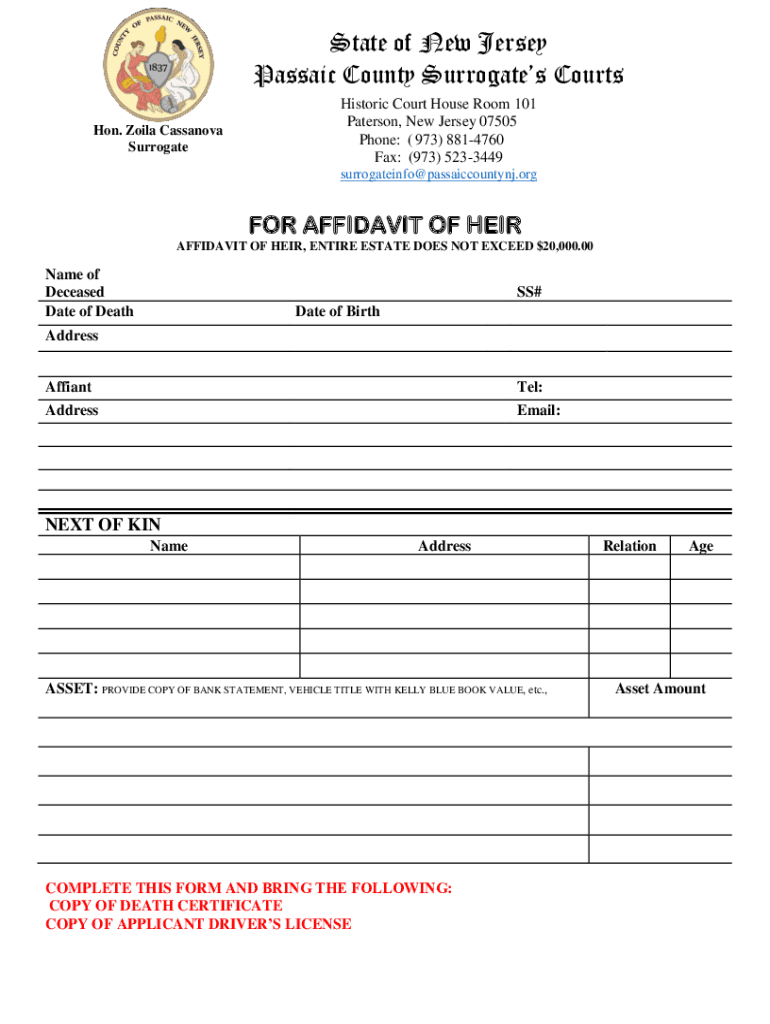







Definition and Meaning of the New Jersey Surrogate Court by County Trust & Will
The New Jersey Surrogate Court by County Trust & Will refers to a specialized legal process for managing the execution of wills and the administration of trusts in New Jersey. Each county in New Jersey has its own Surrogate Court, which deals with probate issues such as validating wills, appointing executors, and overseeing the distribution of estates according to the decedent’s wishes or state law. This service is particularly focused on facilitating the management of estates at a county level, offering a detailed framework for handling estate matters efficiently.
Steps to Complete the New Jersey Surrogate Court by County Trust & Will
-
Gather Necessary Documents: Collect all pertinent documents, including the original will, death certificate, and a list of assets and liabilities.
-
File the Will with the Surrogate Court: Submit the original will to the appropriate Surrogate’s office in the county where the decedent resided. This initiates the probate process.
-
Appointment of an Executor: If named in the will, the executor needs to file documents to be officially appointed by the Surrogate Court. If there's no executor, the court will appoint a personal representative.
-
Notify Heirs and Beneficiaries: The executor is responsible for notifying all interested parties, such as heirs and other beneficiaries, about the probate proceedings.
-
Settle Debts and Taxes: All outstanding debts and taxes associated with the estate must be settled. This includes filing any necessary tax returns.
-
Distribute the Assets: Once debts are paid, the executor distributes the remaining assets according to the will or, if there is no will, according to state intestacy laws.
-
Finalize Estate Closure: Submit a final accounting to the court for approval to close the estate formally.
Required Documents for the New Jersey Surrogate Court by County Trust & Will
- The Original Will: The primary document needed to initiate probate proceedings.
- Death Certificate: A certified copy of the death certificate is necessary for probate filing.
- Inventory of Assets: Detailed list of the decedent’s assets, including real estate, bank accounts, and personal property.
- List of Beneficiaries: A comprehensive list of all individuals or entities named in the will.
- Letters Testamentary or Administration: Issued by the court to authorize the executor to act on behalf of the estate.
Importance of Utilizing the New Jersey Surrogate Court by County Trust & Will
- Legal Compliance: Ensures that all probate proceedings are conducted in accordance with New Jersey state laws.
- Orderly Distribution: Provides an official framework for distributing the decedent’s assets, minimizing family disputes.
- Debt Resolution: Establishes an official process for settling outstanding debts, protecting the estate from creditor claims.
- Tax Obligations: Facilitates appropriate filing and payment of estate and inheritance taxes, preventing legal complications.
Legal Use and Implications
Using the New Jersey Surrogate Court is pivotal for legally executing a will or trust. The court’s procedures provide a structured means to authenticate wills, safeguard against fraudulent claims, and ensure that executors fulfill their fiduciary duties. The legal oversight provided by the court is crucial in mitigating potential family conflicts and securing the decedent’s wishes.
State-Specific Rules for Handling Trusts and Wills
- Intestacy Laws: In the absence of a will, New Jersey’s intestacy laws determine the distribution of assets, typically favoring spouses and children.
- Inheritance Tax: New Jersey imposes an inheritance tax based on the beneficiary’s relationship to the decedent; knowing these rules is vital for proper estate planning.
- Executor’s Responsibilities: New Jersey law requires executors to act in the estate’s best interest, maintaining fiduciary responsibilities to beneficiaries.
Form Submission Methods for the New Jersey Surrogate Court by County Trust & Will
- In-Person: Submissions are made directly at the Surrogate’s Office where staff assist with document filing.
- Mail: For convenience, documents can be mailed to the county’s Surrogate Court office.
- Online: Some counties offer preliminary submission processes online, streamlining initial steps like gathering necessary forms and making appointments.
Penalties for Non-Compliance
Failure to comply with New Jersey probate laws can lead to significant penalties, including:
- Fines: Monetary penalties may be imposed for failing to file necessary documents or reports.
- Removal of Executor: If an executor neglects their duties entirely, the court may remove them from their position.
- Liability for Losses: Executors may face personal liability for losses incurred to the estate due to mismanagement.
By adhering to the above steps and regulations, individuals and legal professionals can efficiently navigate the complexities of the probate process through the New Jersey Surrogate Court by County Trust & Will.


