




01. Edit your cross connection control report online
Type text, add images, blackout confidential details, add comments, highlights and more.

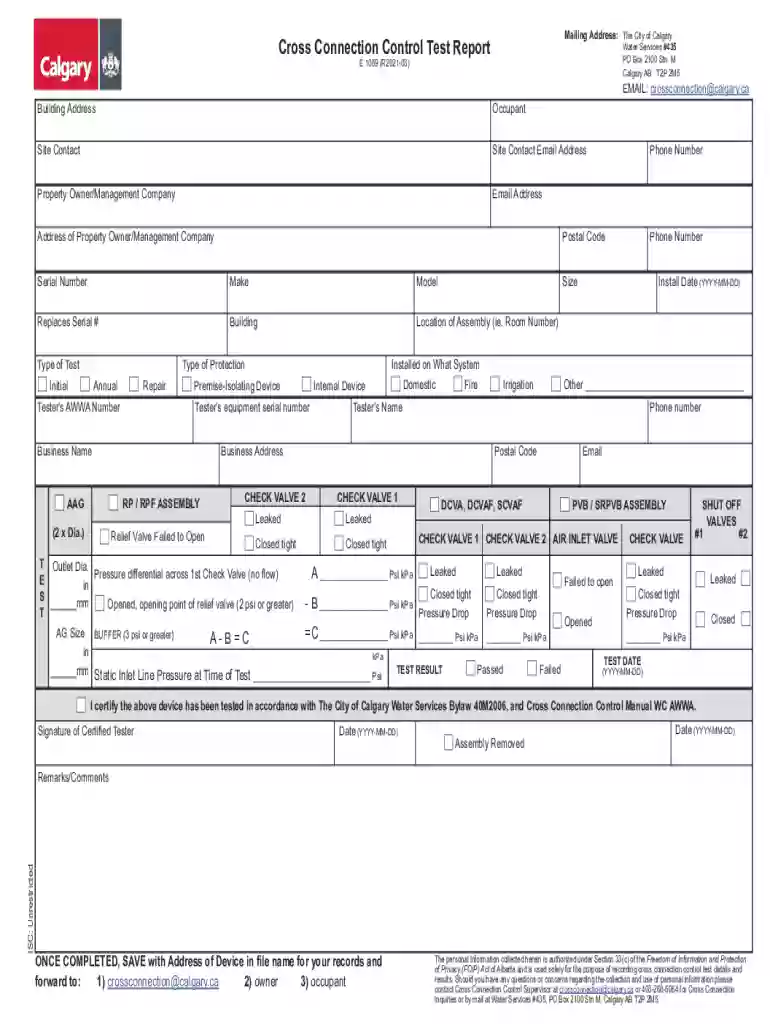
Type text, add images, blackout confidential details, add comments, highlights and more.

Draw your signature, type it, upload its image, or use your mobile device as a signature pad.

Send cross connection report via email, link, or fax. You can also download it, export it or print it out.
The Cross Connection Control Test Report is a crucial document focused on ensuring the safety and compliance of water systems. A cross-connection is any physical link between a safe water supply and any other source of contamination. The report documents the testing and analysis of backflow prevention devices, which are critical in preventing contaminants from entering clean water systems. Typically used by local authorities or water utilities, this report helps maintain the integrity of public water supplies. It is vital in identifying, testing, and verifying that preventative measures are in place and effective.
Utilizing the Cross Connection Control Test Report involves several key steps. First, ensure that the relevant parties complete the report accurately. This typically means engaging with certified testers who can assess backflow prevention devices. The tester fills out the report, detailing the location, type, and condition of devices, alongside the test results. Facility managers and property owners must review these reports to confirm compliance with local regulations. Finally, completed reports should be submitted to the appropriate local water authority to verify adherence to safety standards.
Completing the Cross Connection Control Test Report involves systematic steps:
Identify the testing site: Ensure access to all required areas within the premises.
Hire a certified tester: Contact a professional with the necessary certification to conduct a thorough inspection.
Perform the test: The tester will check each backflow prevention device, assessing their operational status and recording findings accurately.
Complete the report: Fill in details such as device specifications, test results, and any maintenance required.
Review for accuracy: Verify all information against actual test data to ensure the report is both accurate and complete.
Submit the report: Send the report to the relevant water authority by the required deadline for compliance.
It is essential to complete a Cross Connection Control Test Report for maintaining the safety and quality of public water systems. Unchecked cross-connections pose significant health risks, as they can allow contaminants to enter the drinking water. By ensuring proper testing and reporting, property owners and facility managers help prevent potential exposure to harmful substances. Additionally, completing this report is often a regulatory requirement, with compliance ensuring legal adherence and safeguarding against potential penalties.
Understanding related terminology enhances comprehension and accuracy:
Backflow: The undesirable reversal of the flow of water or mixtures of water and other undesirable substances into the distribution pipes of a potable water system.
Backflow Prevention Device: A mechanical device installed on a water line to prevent backflow—a condition allowing used water or potentially contaminated water to flow back into the clean water supply.
Potable Water: Water that is safe to drink or use for food preparation.
Certified Tester: An individual who has received training and certification to test water systems for compliance with safety standards.
Certain elements are critical within the Cross Connection Control Test Report:
Contact Information: Includes details of the property owner and the certified tester.
Device Details: Specifies the type, model, and location of backflow prevention devices installed.
Test Results: Comprehensive documentation of each device's performance during testing.
Compliance Verification: A section detailing whether devices meet local safety regulations.
Legal compliance when completing the Cross Connection Control Test Report is mandatory. Many states and municipalities have strict regulations governing water safety and require the submission of this report to remain compliant. Failure to submit accurate and timely reports could lead to fines and further regulatory action. Legally, entities responsible for a property's water system must ensure that the testing and understanding of test results align with local statutory requirements to safeguard public health.
The typical users of the Cross Connection Control Test Report are property managers, facility maintenance teams, and local governmental bodies responsible for water system safety. Municipalities often mandate these reports as part of their broader water quality management programs. Certified testers are directly involved in preparing and verifying the reports. Health and safety inspectors also review the reports to ensure compliance with public health regulations.


Submitting a Cross Connection Control Test Report efficiently requires understanding available methods:
Online Submission: Many municipalities offer portals for digital uploads, allowing for faster processing and confirmation.
Mail: Traditional mail submissions are still accepted in certain jurisdictions, although this method might take longer to process.
In-Person: Direct submission to the local water authority's office can ensure immediate acknowledgment of receipt, often required for sensitive or compliance-critical environments.
We've got more versions of the cross connection control report form. Select the right cross connection control report version from the list and start editing it straight away!
At DocHub, your data security is our priority. We follow HIPAA, SOC2, GDPR, and other standards, so you can work on your documents with confidence.
This document provides background information and recommendations for practitioners who are planning to use controlled pressure method (CPM) testing for vaporRead more
To carry out an effective cross-connection control program the local health agency is generally responsible for enforcing the laws, rules, regulations andRead more


