




01. Edit your ohio marriage license example online
Type text, add images, blackout confidential details, add comments, highlights and more.

Type text, add images, blackout confidential details, add comments, highlights and more.

Draw your signature, type it, upload its image, or use your mobile device as a signature pad.

Send ohio marriage certificate example via email, link, or fax. You can also download it, export it or print it out.
An Ohio marriage certificate serves as a vital legal document that validates a marriage. It is essential for various personal and legal affairs, including name changes, insurance, and tax purposes. The form captures critical information about both parties and their marriage, ensuring proper documentation in accordance with Ohio state laws.
Providing accurate information is critical when completing the marriage certificate. Any discrepancies, such as misspellings of names or incorrect dates, can lead to challenges in obtaining certified copies or other related documents. Therefore, double-checking details before submission is advisable.
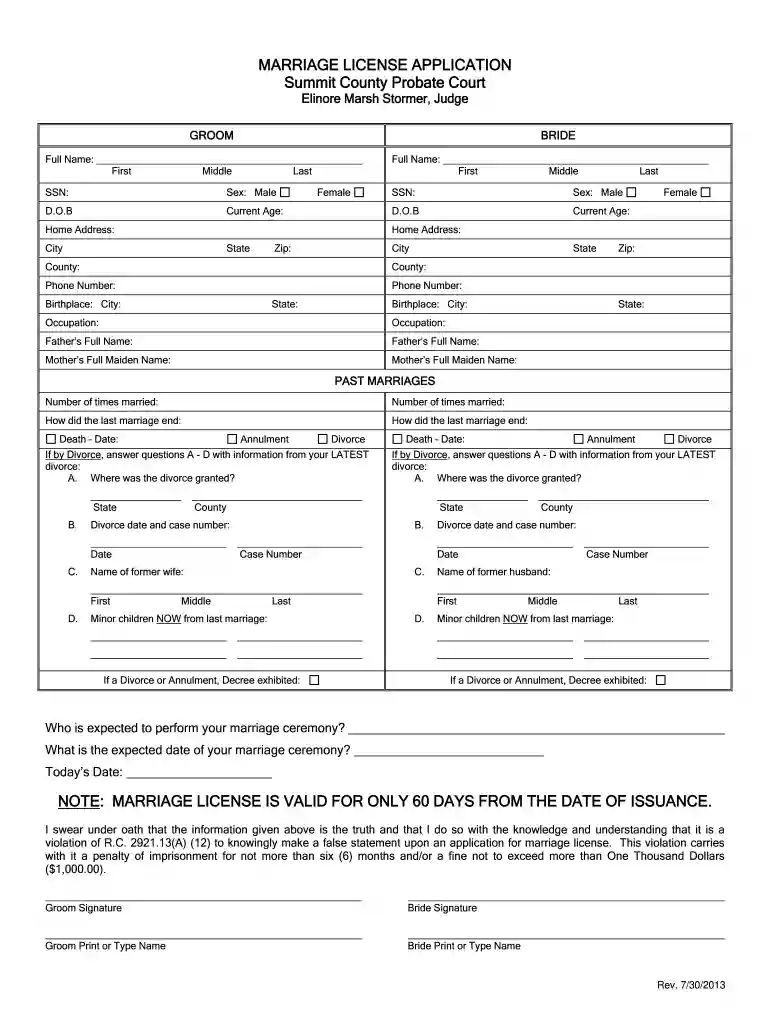
To obtain a marriage certificate in Ohio, couples must first complete a marriage license application, which serves as the preliminary step to securing the marriage certificate. This process involves gathering required information and personal documents.
An example of a filled-out Ohio marriage license application provides clarity on how to accurately complete the form. For instance, John Smith, born in Columbus, Ohio, would list his birth date and Social Security number clearly on the form, followed by Jane Doe, who was born in Dayton, Ohio.
Groom's Details:
Bride's Details:
Clear instructions regarding the submission and verification process make it easier for engaged couples to follow necessary steps.
After marriage, obtaining a certified copy of the marriage certificate is often necessary for legal and administrative purposes. This can be done through the local county's health department or probate court.
Marriage records in Ohio serve as an official registrar of marriages and provide public access to marriage information.
Individuals can access marriage records through various means:
Understanding the structured nature of Ohio marriage records can assist parties in the effective management of their legal documentation following marriage.
In completing the marriage license application, several common errors can occur, which may lead to delays or complications during the processing.
This proactive approach helps ensure that navigating the marriage license process in Ohio is as seamless as possible.
We've got more versions of the ohio marriage license example form. Select the right ohio marriage license example version from the list and start editing it straight away!
| Versions | Form popularity | Fillable & printable |
|---|---|---|
| 2013 | 4.9 Satisfied (29 Votes) |
At DocHub, your data security is our priority. We follow HIPAA, SOC2, GDPR, and other standards, so you can work on your documents with confidence.
For example, an entry in Josephs journal contains a transcription of a marriage certificate he issued in January 1836 to William Cahoon and his bride, NancyRead more
This article gives information on recognition of nonbinary gender identities in law, government, services, and businesses in the USA.Read more


