




01. Edit your mechanic evaluation form online
Type text, add images, blackout confidential details, add comments, highlights and more.

Type text, add images, blackout confidential details, add comments, highlights and more.

Draw your signature, type it, upload its image, or use your mobile device as a signature pad.

Send mechanic performance evaluation sample via email, link, or fax. You can also download it, export it or print it out.
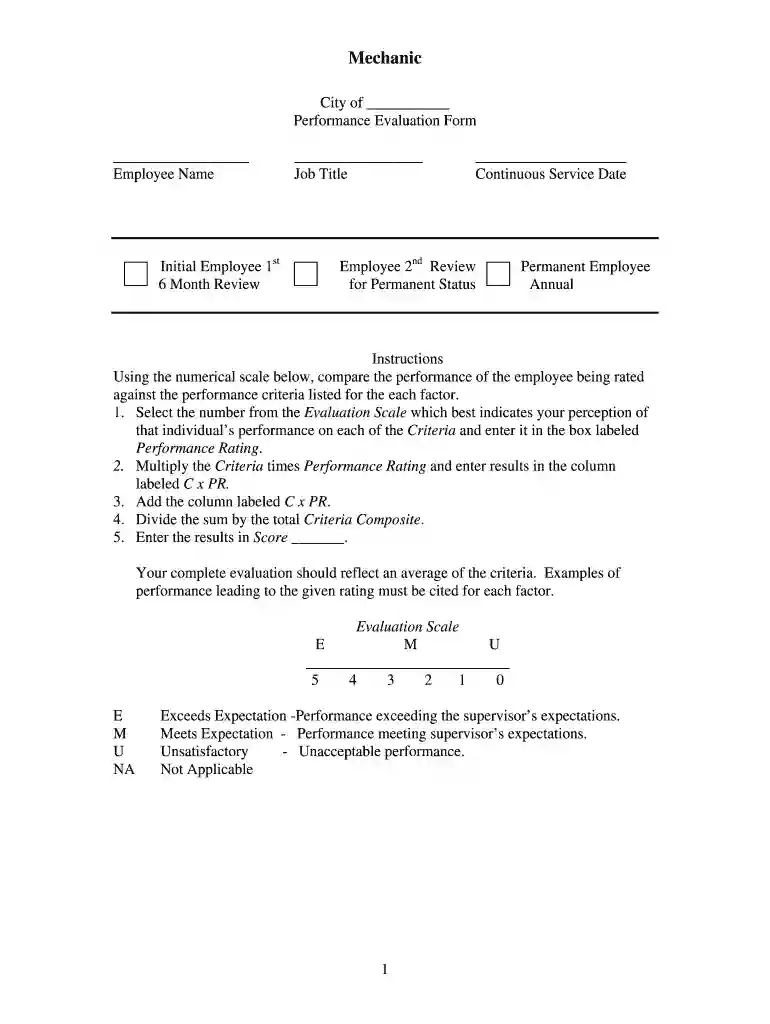
A mechanic evaluation form is structured to assess the performance and skills of a mechanic over a predefined evaluation period. This form is crucial for providing feedback and identifying areas for improvement. Here are the essential components that define its structure and purpose.
Mechanic performance is typically rated using a numerical scale, which allows for quantitative assessment. Commonly, a five-point scale is used where:
This section allows supervisors to provide specific comments regarding the mechanic's performance. It can include positive feedback, constructive criticism, and recommendations for professional development.
The form serves multiple purposes beyond performance review. It is an essential instrument for human resource practices, providing the basis for promotions, raises, and disciplinary actions.
Feedback is crucial in fostering a culture of continuous improvement. It motivates mechanics by recognizing accomplishments and highlighting developmental opportunities.
Maintaining a standardized evaluation process facilitates compliance with organizational policies and industry regulations. The completed mechanic evaluation form should be filed securely for future reference and may be subject to review by higher management or regulatory bodies.
Different organizations may tailor mechanic evaluation forms to suit specific needs, including those for various specialties within the automotive industry, such as:
Usage of mechanic evaluation forms should comply with employment laws and regulations, including non-discrimination policies and privacy considerations. It is important to ensure that evaluations are fair, objective, and based on clearly defined criteria.
Documenting evaluations accurately protects both the employer and employee. It serves as evidence of performance over time and can mitigate potential disputes regarding employment decisions.
The form can be applied in various scenarios, ensuring broad applicability across different mechanics' roles. Here are a few examples:
In conclusion, a mechanic evaluation form comprises a systematic approach to assess performance comprehensively, guiding the professional growth of mechanics and serving organizational goals effectively.
We've got more versions of the mechanic evaluation form form. Select the right mechanic evaluation form version from the list and start editing it straight away!
| Versions | Form popularity | Fillable & printable |
|---|---|---|
| 2006 | 4 Satisfied (29 Votes) |
According to eSignature laws, forms signed digitally have the same validity as those approved with pen and paper. You can eSign almost any business and personal paperwork. Four types of documents still demand wet signatures only - wills and testamentary trusts, court orders and other court forms, state statutes governing divorce, adoption, or other family law, and notice of cancellation of utility services. If you adhere to the regulations and utilize a reliable and compliant software solution, like DocHub, you can eSign your automotive technician performance review form without printing it.
If you store your papers in Google Drive, there is no need to download your diesel mechanic performance evaluation on the computer and upload it back to our editor. A much simpler way is to install a browser extension created by DocHub to simplify this flow. The extension allows editing PDFs right in your internet browser. Alternatively, you can integrate your DocHub and Gmail accounts for more efficient editing.
At DocHub, your data security is our priority. We follow HIPAA, SOC2, GDPR, and other standards, so you can work on your documents with confidence.
Apr 27, 2021 This note presents an overview of how the gradcheck() and gradgradcheck() functions work. It will cover both forward and backward mode AD for both real andRead more
Your complete evaluation should reflect an average of the criteria. Examples of performance leading to the given rating must be cited for each factor.Read more


