Type text, add images, blackout confidential details, add comments, highlights and more.
02. Sign it in a few clicks
Draw your signature, type it, upload its image, or use your mobile device as a signature pad.
03. Share your form with others
Send rapid hiv test form via email, link, or fax. You can also download it, export it or print it out.
How to use or fill out HIV Test Form 2013 with DocHub
Ease of Setup
DocHub User Ratings on G2
Ease of Use
DocHub User Ratings on G2
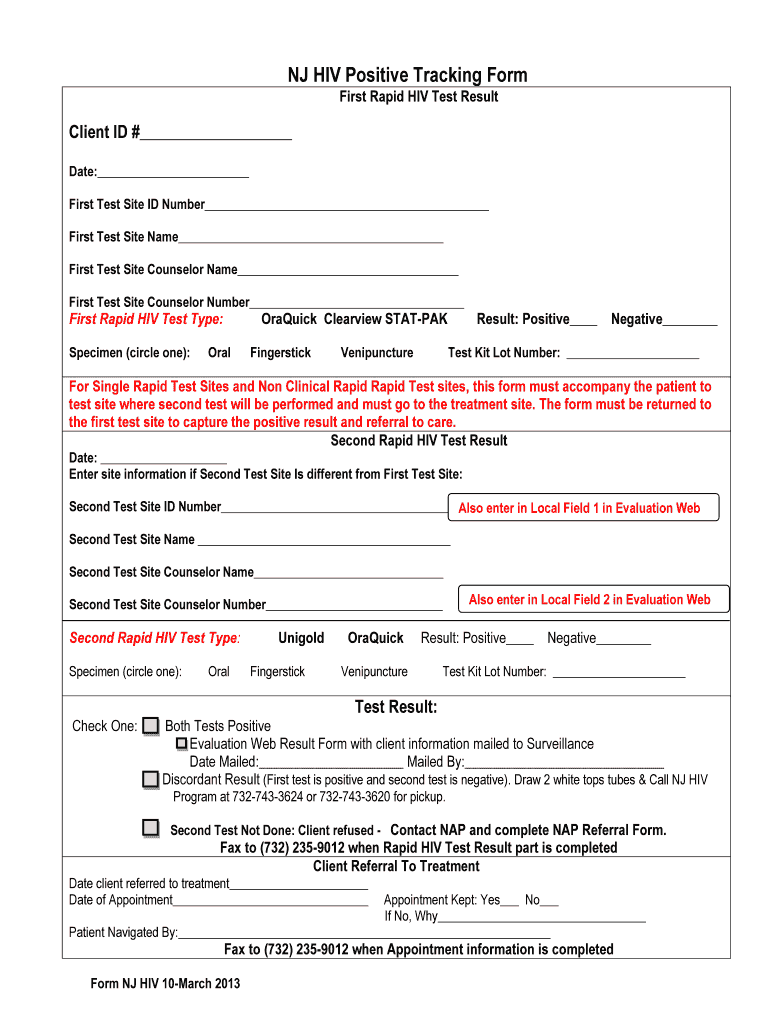
Click ‘Get Form’ to open the HIV Test Form 2013 in our editor.
Begin by entering the Client ID number and the date at the top of the form. This information is crucial for tracking purposes.
Fill in the First Test Site details, including ID number, name, counselor name, and counselor number. Ensure accuracy as this will be used for follow-up.
Select the type of rapid HIV test performed by circling the appropriate specimen type: OraQuick, Clearview, or others listed.
Indicate the result of the first test by checking either Positive or Negative. Record the Test Kit Lot Number for reference.
If a second test is required, enter its details similarly under 'Second Rapid HIV Test Result', ensuring all fields are completed accurately.
Complete client referral information at the bottom of the form, including appointment dates and whether it was kept.
Start using our platform today to fill out your HIV Test Form 2013 easily and for free!
Must a person sign a written consent form before an test? According to the law, a person can also consent verbally to an test. It is however advisable to obtain written proof that the person has been pre-test counselled and that they agree to have an test.
How to see test report?
You place the swab in a vial that shows a positive or negative result (similar to a pregnancy test). You can view results within 20 to 40 minutes. If the results are positive, youll need additional testing to confirm the results.
What states require consent for testing?
Abstract. In 2014, New York and Nebraska were the only states that still required written informed consent for testing, a signature element of public policy that dated from the 1980s.
What are the 4 types of tests?
There are three types of tests: nucleic acid tests (NAT), antigen/antibody tests, and antibody tests, and they all have different window periods: Nucleic Acid Test (NAT)A NAT can usually tell if you have infection 10 to 33 days after exposure.
When is informed consent for testing required, select all that apply.?
The informed consent process is only required for diagnostic testing. Once the patient is aware of their infection, informed consent is not required for testing that is conducted to monitor the disease.
hiv paperwork
MEPS HIV test resultsClia hiv test accuracyHIV result 5a MEPSCDC HIV testing guidelinesAntibodies are generally detectable weeks after infection with hivHIV result 5a meaningAntiretroviral therapy art is a widely acceptable treatment for hiv art involvesThese tests do not test for hiv itself but detect the presence of antibodies
Security and compliance
At DocHub, your data security is our priority. We follow HIPAA, SOC2, GDPR, and other standards, so you can work on your documents with confidence.
There are no exceptions to the requirement that testing be voluntary and with the verbal informed consent of the person being tested or his/her surrogate.
What year was the first test approved by the FDA?
March 1985 marks a key milestone in the fight against , since the U.S. Food and Drug Administration (FDA) approved the first-ever test to screen blood donors for exposure to .
What are the requirements for testing?
CDC recommends all patients between the ages of 13 and 64 get tested for at least once as part of routine health care. Screen patients who may have ongoing risk factors for at least annually. Use opt-out approach to remove stigma associated with testing and foster earlier diagnosis and treatment.
Cookie consent notice
This site uses cookies to enhance site navigation and personalize your experience.
By using this site you agree to our use of cookies as described in our Privacy Notice.
You can modify your selections by visiting our Cookie and Advertising Notice.