
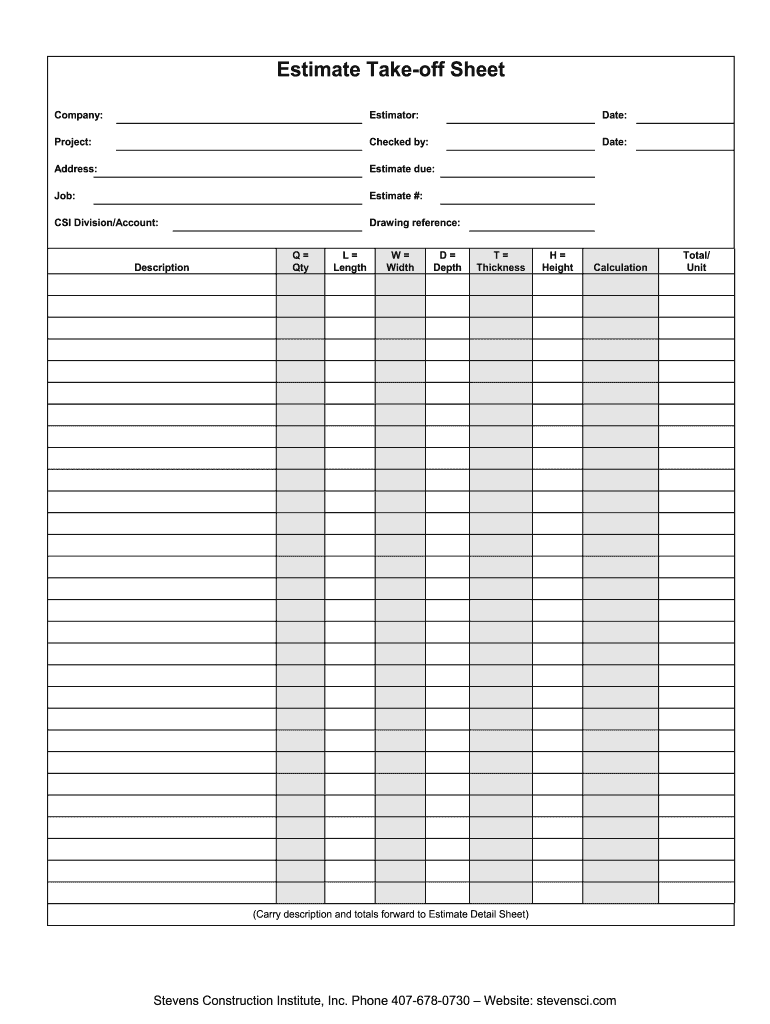







Definition and Meaning of a Take Off Sheet
A take off sheet is a crucial document used primarily in construction and project management. It serves as a detailed outline of the materials, quantities, and specifications required for a project. The take off sheet helps estimators calculate project costs and is essential for effective project budgeting.
Typically, the document includes sections that identify:
- Project Information: Name of the project, location, and client details.
- Estimator Details: The name of the individual or team responsible for preparing the take off.
- Material Specifications: A comprehensive list of materials needed, including types and descriptions.
- Measurements: Essential dimensions such as quantity, length, width, depth, thickness, and height to ensure accurate calculations.
The importance of the take off sheet lies in its role as a foundational component for project proposals, bids, and overall project management efficiency.
How to Use the Take Off Sheet Example PDF
Utilizing a take off sheet example PDF effectively requires a systematic approach. Follow these steps to maximize its utility:
-
Download and Open the PDF: Obtain the take off sheet example PDF from a reputable source. Ensure you have the necessary software to view and edit PDF files, such as DocHub.
-
Familiarize Yourself with the Layout: Review the structure of the take off sheet. Understand the headings and sections that should be filled in, such as project details, estimator information, and material lists.
-
Fill in Project Information: Begin with basic project details like the project title, location, and client name. This establishes the context of the take off.
-
Input Material Details: Move on to the material section, where you'll list all required items. Include specifics such as quantity, dimensions, and descriptions.
-
Calculate Totals: After filling out the material information, compute totals based on your measurements. This section may involve simple arithmetic or more complex calculations depending on the project scope.
-
Review and Save: Thoroughly check for accuracy before finalizing your take off sheet. Once confirmed, save your document to ensure that your work is not lost.
By following these steps, you can leverage the take off sheet for accurate budget estimates and effective project management.
Steps to Complete the Take Off Sheet Example PDF
Completing a take off sheet example PDF requires careful attention to detail. Here is a methodical process to ensure completeness:
-
Preparation:
- Gather all necessary project documentation, including plans and specifications.
- Understand the requirements and terms specified in the project bid.
-
Document Layout:
- Open the take off sheet PDF and assess its structure. Identify sections for project and estimator information, material lists, and measurement specifications.
-
Input Basic Information:
- Fill in the header section with project title, project manager's name, contact information, and any relevant identifiers.
-
Material Identification:
- Create a detailed list of materials needed:
- Use categories (e.g., electrical, plumbing) for organization.
- Detail specifications for each material, such as grade and type.
- Create a detailed list of materials needed:
-
Measurements:
- Accurately measure and input quantities, dimensions, and other relevant data in straightforward columns.
-
Add Calculations:
- Utilize formulas to calculate totals automatically if applying software tools. Otherwise, manually total quantities as needed.
-
Collaborate and Review:
- Share the completed take off with team members to foster collaboration and receive feedback. Address any discrepancies or misunderstandings.
-
Finalize the Document:
- Once all sections are complete, save and securely store the file. You may want to print a copy for physical records.
By following these steps, you ensure that the take off sheet is comprehensive and precise, ultimately enhancing your project's bidding and management processes.
Key Elements of the Take Off Sheet Example PDF
Understanding the key elements of a take off sheet example PDF is essential for accurate project estimation. These elements include:
-
Estimator Details:
- Name and contact information of the person preparing the sheet.
-
Project Overview:
- Essential information regarding project name, client specifications, and location.
-
Material List:
- A thorough inventory of all materials required, including types, descriptions, and quantities.
-
Measurements:
- Precise dimensions for each material, commonly noting length, width, height, thickness, and volume.
-
Calculations:
- Sections dedicated to summarizing total quantities and projected costs for budgeting.
-
Sections for Notes:
- Space allocated for any additional comments or clarifications regarding material requirements and project specifics.
Each of these elements intricately interconnects, facilitating a holistic view of project demands and helping ensure comprehensive and accurate estimating.
Examples of Using the Take Off Sheet Example PDF
Utilizing a take off sheet example PDF can enhance various projects. Here are notable scenarios in which its application is beneficial:
-
Construction Projects:
- A contractor can use the take off sheet to draft a proposal for a residential building by listing materials such as lumber, roofing, and plumbing fixtures, alongside their estimated quantities.
-
Renovation Estimations:
- A remodeling company may refer to a take off sheet to detail costs associated with a kitchen renovation, specifying cabinets, electrical wiring, and plumbing needs.
-
Electrical Work:
- An electrical contractor can prepare an electrical takeoff sheet template that includes wire lengths, outlet counts, and fixture specifications necessary for a new installation.
-
Cost Control:
- Project managers can refer to take off sheets as a baseline for comparing actual expenditures versus initial projections throughout the life cycle of a project.
These examples illustrate the versatility and necessity of employing a take off sheet in various project scenarios, ensuring accurate estimations and budgeting alignment.
Who Typically Uses the Take Off Sheet Example PDF
The take off sheet primarily caters to professionals in the construction and engineering sectors. Its users generally include:
-
Estimators:
- Specialists tasked with calculating project costs based on materials and labor. They rely on take off sheets to create accurate financial proposals.
-
Contractors:
- General contractors use these sheets during bidding processes to outline material requirements and associated costs, streamlining project management.
-
Project Managers:
- Individuals overseeing construction projects utilize take off sheets to monitor and control spending, ensuring they remain within budget.
-
Architects and Engineers:
- Design professionals may leverage take off sheets to communicate project specifications clearly, verifying that materials and dimensions align with design plans.
-
Subcontractors:
- Those responsible for specific trades (e.g., electrical, plumbing) employ take off sheets to ascertain what materials they need for their scope of work.
The usage of take off sheets aids these professionals in maintaining efficiency and clarity in project estimations, ultimately contributing to successful project execution.






