






Definition and Meaning of FL-160
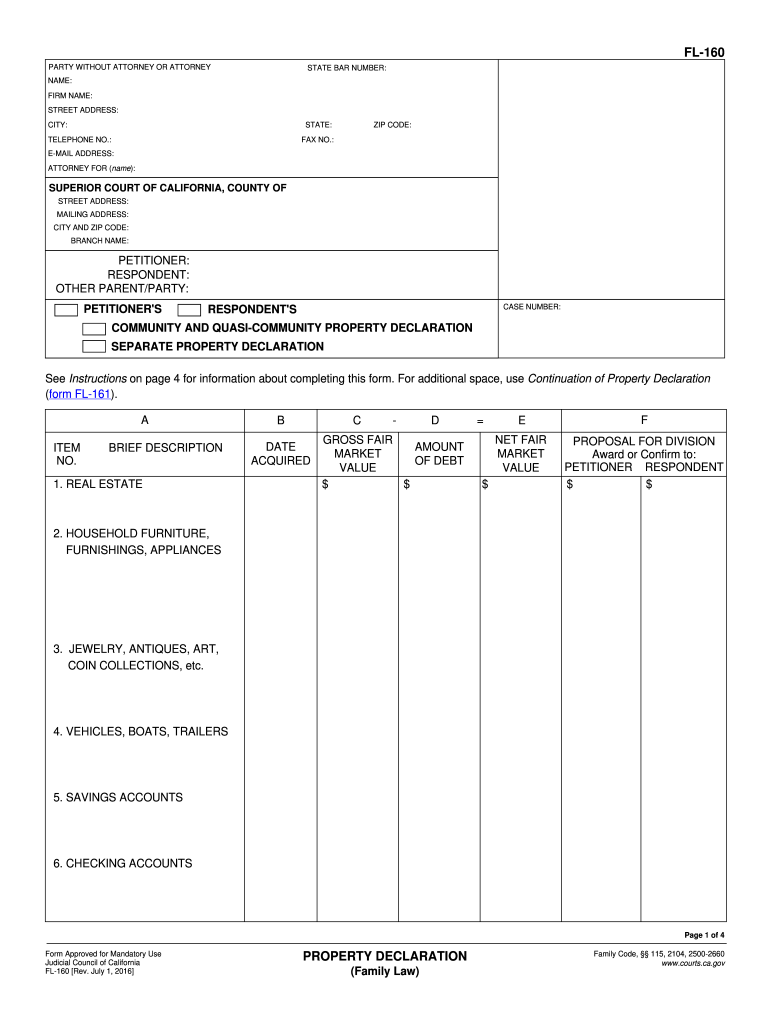
The FL-160 form, known as the Property Declaration, is a mandatory form used in California family law cases. It requires parties involved in a legal separation or divorce proceeding to disclose their assets and debts comprehensively. The document is crucial for ensuring equitable distribution of property, providing detailed lists of community, quasi-community, and separate property. Each asset or debt must be accurately described with information such as acquisition date, gross fair market value, associated debts, and net fair market value. By filling out FL-160, parties can propose their preferred division of assets, facilitating a transparent and fair legal process.
How to Obtain the FL-160 Form
The FL-160 form can be obtained easily online. The California Courts website offers a downloadable PDF of the form, which can be filled out digitally or printed for manual completion. Physical copies can also be acquired at local family law courts in California. Requesting the document directly from a legal advisor or family law attorney is an alternative option, ensuring that you receive any pertinent instructions for completion specific to your case. For those without internet access, most county courts offer copies upon request, including any related instructions and additional forms that may be required to accompany the Property Declaration.
Steps to Complete the FL-160 Form
-
Gather Financial Information: Collect all relevant documents, including bank statements, property deeds, loan statements, and investment records.
-
Fill Out Personal Information: Enter your basic personal information, such as name, case number, and court details, at the top of the form.
-
List Assets: For each type of property, include a description, acquisition date, gross fair market value, associated debts, and net fair market value. Distinguish between community, quasi-community, and separate property.
-
List Debts: Document all liabilities, specifying the nature of the debt and the creditor, along with current balances and any relevant terms.
-
Propose Division: Clearly outline your proposal for how assets and debts should be divided between you and the other party.
-
Review and Sign: Thoroughly review the completed form for accuracy. Sign the declaration asserting that the information provided is true and correct to the best of your knowledge.
-
Submit the Form: File the FL-160 along with required attachments at the family law court handling your case. Adhere to any specific court rules regarding submission.
Legal Use of the FL-160 Form
The FL-160 form serves a critical function in legal separation and divorce proceedings in California. Its primary purpose is to ensure that all parties involved have fully disclosed relevant financial information, enabling the court to make informed decisions regarding the division of property and debts. The form minimizes disputes by providing a comprehensive and organized breakdown of each party's financial situation. Legal practitioners often rely on this documentation to support negotiations or mediation sessions in efforts to reach amicable settlements outside of court. Accuracy and honesty in the FL-160 are mandatory, as misrepresentation can lead to legal ramifications, including potential penalties or case dismissal.
Key Elements of the FL-160 Form
-
Community Property: This section lists all jointly acquired assets during the marriage. Examples include jointly held real estate, shared bank accounts, and vehicles purchased during the union.
-
Quasi-Community Property: Items listed here are acquired while living outside California but would be considered community property under California law.
-
Separate Property: Details individually owned property acquired before the marriage, after separation, or through inheritance or gift.
-
Debt Details: Each debt must include the creditor's name, the original and current balance, and any relevant interest rates or terms.
-
Proposal for Division: An essential part of the document, this section outlines the filer’s preferences on how assets and debts should be distributed between the parties, potentially guiding settlement discussions.
State-Specific Rules for the FL-160 Form
While the FL-160 is a California-specific requirement, the way it is applied and evaluated can vary slightly across different family courts within the state. Each county may have additional filing requirements or procedural nuances. For example, exhibits might be necessary to support the form's content, particularly where high-value assets are concerned. Some courts may request additional documentation, verification forms, or financial summaries, especially in complex cases involving significant assets or intricate financial arrangements. Legal representation may offer guidance relevant to local specifications and procedural norms to ensure compliance with court expectations.
Important Terms Related to the FL-160
- Community Property: Assets acquired jointly during a marriage, typically subject to equal division.
- Quasi-Community Property: Property attained while living outside California, treated as community property if it would qualify as such under California law.
- Separate Property: Items acknowledged as owned exclusively by one spouse, usually acquired before marriage or post-separation.
Understanding these terms is crucial for accurately completing the FL-160, as they determine how assets and debts are categorized and subsequently divided. Accurate classification aids the legal process by clarifying what is to be considered for negotiation or court-ordered division.
Filing Deadlines and Important Dates
Adhering to filing deadlines is crucial when handling the FL-160. The timing for submission typically aligns with broader case schedules and may coincide with initial filings for divorce or separation proceedings. Missing these deadlines can result in delayed proceedings or unfavorable legal outcomes. In most cases, the FL-160 should accompany, or promptly follow, the filing of a Petition for Dissolution of Marriage. Ensure compliance with any specific deadlines issued by the court, which can vary depending on the case complexities or court workload. Always verify deadlines with legal counsel or directly with the court to avoid unnecessary setbacks.
Examples of Using the FL-160
Consider a scenario where spouses jointly own a family home, multiple vehicles, and have retirement accounts. In completing the FL-160, they must meticulously outline each asset's details, recording acquisition dates, values, and any loans or encumbrances. Suppose one spouse owned a car before marriage. In this case, it should be listed under separate property, with supporting documentation showing its acquisition date and value. Such diligence not only helps protect interests but also streamlines the divorce process by minimizing potential disputes over asset classification and division. Through the FL-160, spouses can clearly state their preferences, such as one retaining the family home, which can then be negotiated or adjudicated fairly.