Stat dec qld 2025

Get Form
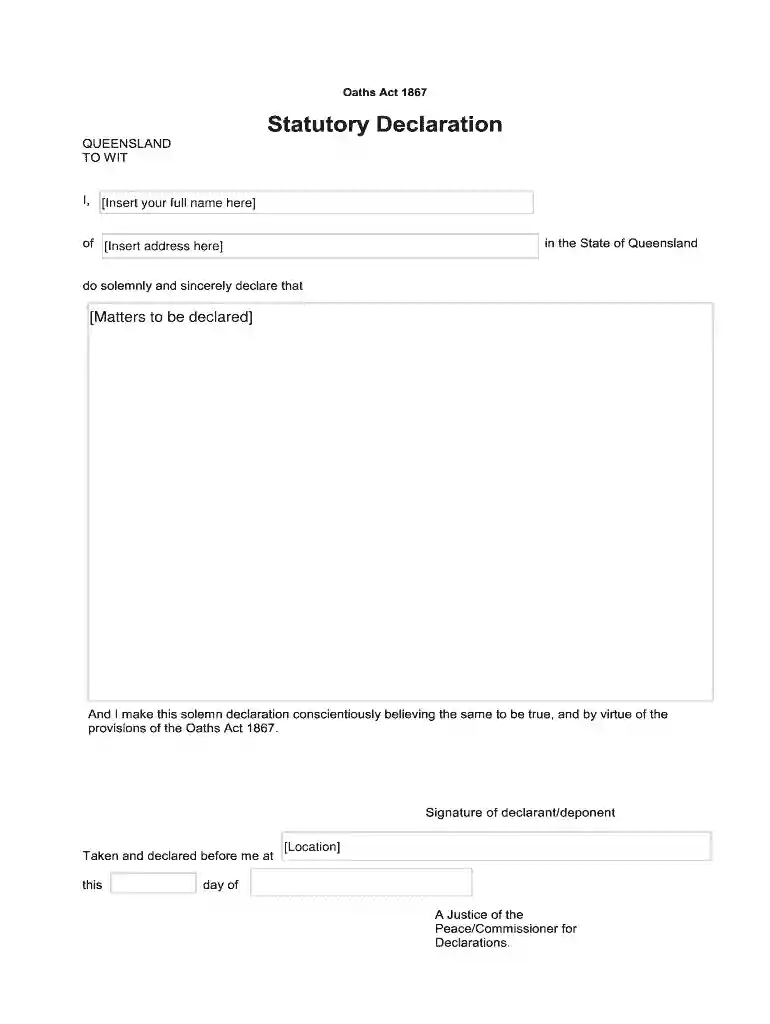
free statutory declaration form qld Preview on Page 1

Here's how it works

01. Edit your free statutory declaration form qld online
Type text, add images, blackout confidential details, add comments, highlights and more.

02. Sign it in a few clicks
Draw your signature, type it, upload its image, or use your mobile device as a signature pad.

03. Share your form with others
Send blank affidavit form qld via email, link, or fax. You can also download it, export it or print it out.

Definition and Purpose of the Statutory Declaration in Queensland

A statutory declaration (stat dec) in Queensland is a legally recognized document under the Oaths Act 1867. It allows an individual to declare certain facts as true, affirming their sincerity and belief in the statements made. The declaration is often used in legal and official contexts where proof of identity or particular circumstances is required, such as applying for government services, verifying identity for loan applications, or confirming residency status.

Key features of a statutory declaration include:

  • Legally binding: It holds legal weight, similar to giving evidence in court.
  • Affirmation of truth: The individual making the declaration must believe the statements contained within it to be accurate.
  • Notarization or witnessing: Typically requires a qualified witness, such as a lawyer or justice of the peace, to affirm the identity of the declarant.

Steps to Complete the Statutory Declaration in Queensland

Completing a statutory declaration in Queensland involves several clear steps to ensure the document is valid and legally recognized.

  1. Obtain the correct form: Download the appropriate statutory declaration form from a reliable source, such as a government website or legal documentation service.
  2. Fill in personal details: Include your full name, address, and any other required personal information.
  3. Provide the statements: Detail the facts you wish to declare as true. Be precise and clear, avoiding ambiguity.
  4. Sign the declaration: Do not sign the form until you are in the presence of your witness. Your signature confirms your affirmation of the truthfulness of the statements made.
  5. Get the document witnessed: A qualified individual must sign the form to verify your identity and affirm that you have signed in their presence.
  6. Copy and keep records: After completion, make a copy of the signed declaration for your records. You may need to present this document later, depending on its intended use.

Important Terms Related to Statutory Declarations in Queensland

Understanding key terminologies is essential for effectively navigating the statutory declaration process. Some of the important terms include:

  • Oaths Act 1867: The legislation governing the creation and use of statutory declarations in Queensland.
  • Qualified Witness: A person authorized to witness and sign statutory declarations, including justices of the peace, lawyers, and certain public officials.
  • Declarant: The individual making the statutory declaration, attesting to the truth of the information included in the document.

Legal Use of the Statutory Declaration in Queensland

Statutory declarations hold significant legal weight and can be used in various contexts. They typically serve the following purposes:

  • Identity verification: Often required when applying for official documents or services, such as passports or driver licenses.
  • Evidence in court: When presenting facts about personal circumstances, statutory declarations can serve as a form of evidence.
  • Affirmation for government and legal processes: Useful in situations like property transactions, where declarations may be required to confirm certain facts.

Failure to adhere to the proper use and guidelines of statutory declarations can result in legal consequences, including penalties for making false declarations.

State-Specific Rules for Statutory Declarations in Queensland

While statutory declarations are governed by similar laws across Australia, Queensland has specific rules that must be followed:

  • Form requirements: The statutory declaration must be completed in a specific format as outlined under the Oaths Act 1867.
  • Witness qualifications: Certain qualifications must be met by witnesses, ensuring they possess the authority to verify the identity of the declarant properly.
  • Penalties for inaccuracies: Providing false information or failing to present the declaration in the proper manner can lead to severe penalties, including potential criminal charges.

Ensuring compliance with these state-specific rules is crucial for any individual using a statutory declaration in Queensland.

Examples of Using the Statutory Declaration in Queensland

Statutory declarations can be applied in various real-life situations. Here are some examples where they may be utilized:

  • Government applications: A citizen applying for a government assistance program may be required to submit a statutory declaration confirming their financial status.
  • Immigration purposes: An individual may need to provide a statutory declaration to affirm their residency or immigration status within the country.
  • Legal matters: Statutory declarations are often used in family law cases to declare financial or custodial arrangements.

These real-world scenarios demonstrate the versatility and necessity of statutory declarations in formalizing important information across different sectors.

See more stat dec qld versions

We've got more versions of the stat dec qld form. Select the right stat dec qld version from the list and start editing it straight away!
Versions Form popularity Fillable & printable
2001 4.6 Satisfied (65 Votes)
be ready to get more

Complete this form in 5 minutes or less

Get form

Got questions?

We have answers to the most popular questions from our customers. If you can't find an answer to your question, please contact us.
Contact us
A statutory declaration is a written statement that is declared to be true and correct in the presence of an authorised witness. Statutory declarations are used in many settings. They are mainly used in dealings with organisations (government and non-government).
If the statutory declaration is to be signed on paper and in person, the witness can be: a justice of the peace (JP) a commissioner for declarations (Cdec) a notary public a lawyer a licensed conveyancer in another state or territory any person who is authorised by law to administer an oath in another state
A Commonwealth statutory declaration does not expire. It is valid for as long as the information in it is true. However, some organisations that ask for statutory declarations have time limits. Find out if you can use an existing Commonwealth statutory declaration from the person who asked you for it.
A statutory declaration is a written statement that is declared to be true and correct in the presence of an authorised witness.
A statutory declaration is a statement of facts that you declare to be true and accurate. It can be used as evidence. Statutory declarations can be used for many purposes and can be requested by a person, organisation or government agency.

People also ask

A statutory declaration is a formal statement made affirming that something is true to the best knowledge of the person making the declaration. It has to be signed in the presence of a solicitor, commissioner for oaths or notary public.
Generally, a statutory declaration must state: I, [name], do solemnly and sincerely declare that [declare the facts here] and I make this solemn declaration conscientiously believing the same to be true and by virtue of the provisions of the Oaths Act 1867.

statutory declaration qld