
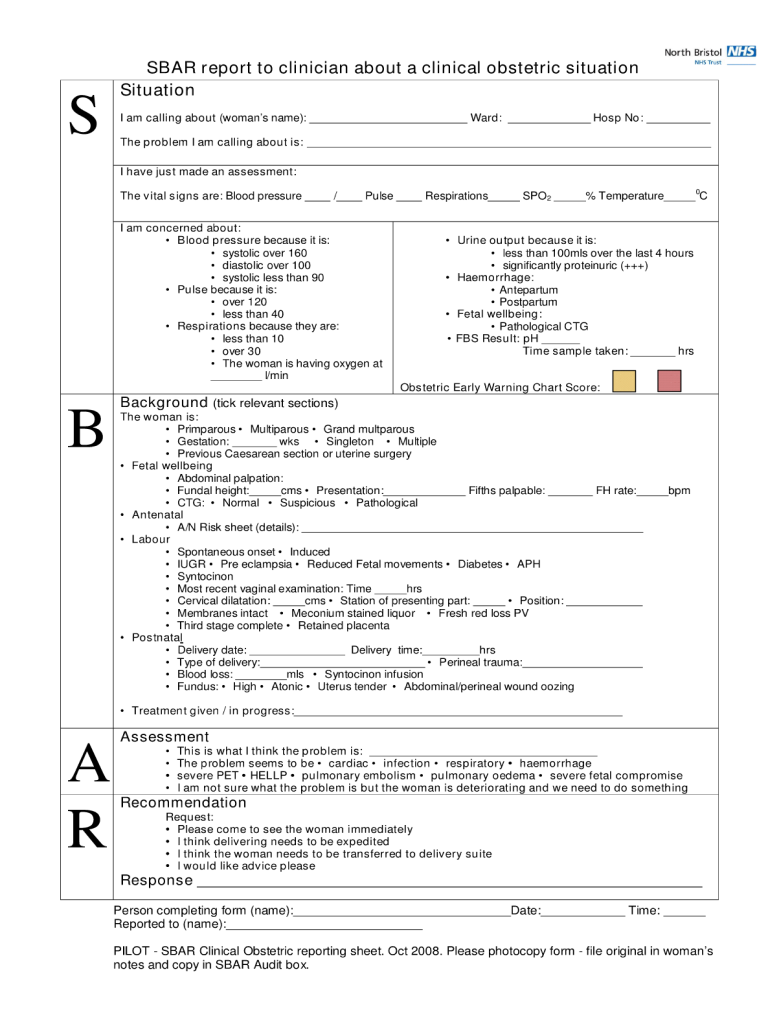







Understanding the SBAR Template in Healthcare
The SBAR template, commonly used in healthcare settings, is an essential communication tool designed to enhance clarity and efficiency in conveying critical information between healthcare professionals. SBAR stands for Situation, Background, Assessment, and Recommendation. Each component plays a vital role in ensuring that essential details are succinctly communicated, improving patient care and safety.
Key Components of the SBAR Template
-
Situation
This first section outlines the immediate context or issue at hand. It is crucial for summarizing the current situation concisely to ensure the next steps can be addressed effectively. Examples include:- “Patient John Doe in Room 205 is experiencing chest pain.”
- “The blood pressure reading for Mary Smith has dropped to 80/50.”
-
Background
Providing relevant background information enables the receiver of the information to understand the context better. Key elements to include in this section are:- Patient history: Previous conditions, allergies, or medications.
- Recent treatments or interventions that relate to the current situation.
- Example: “John has a history of hypertension and was recently discharged after a heart surgery.”
-
Assessment
In this part, practitioners give their professional evaluation based on the situation and background. This assessment should be objective and data-driven. For instance:- “The patient’s vital signs indicate possible cardiogenic shock.”
- “Patient exhibits signs of dehydration and requires immediate fluid replacement.”
-
Recommendation
This final section offers actionable suggestions tailored to the situation discussed. This may include requests for specific interventions or referrals to other medical staff. Examples are:- “I recommend administering IV fluids and monitoring vital signs every 30 minutes.”
- “A consult from cardiology may be necessary for further evaluation.”
Advantages of Using the SBAR Template
-
Streamlined Communication
Utilizing the SBAR template provides a structured approach, which aids in reducing misunderstandings and ensures all necessary information is presented clearly. -
Improved Patient Safety
Clear communication facilitated by SBAR can lead to timely interventions, minimizing potential risks related to patient care. -
Facilitating Team Collaboration
SBAR encourages teamwork by providing a common language for various healthcare providers, which enhances the collaborative effort in patient care.
Examples of SBAR in Action
-
Nursing Handoff Report
During a shift change, a nurse might relay patient information using the SBAR format to ensure continuity of care. For example:- Situation: “The patient is in Room 312, showing increased respiratory distress.”
- Background: “She has a history of asthma and was given nebulizer treatments earlier.”
- Assessment: “Current oxygen saturation is at 88%.”
- Recommendation: “Consider increasing the frequent use of the nebulizer and monitoring the patient's response closely.”
-
Emergency Situations
In emergencies, time is critical. Utilizing the SBAR format can help in making swift, informed decisions. For example, a paramedic might communicate with a hospital:- Situation: “We are en route with a 52-year-old male unconscious following a car accident.”
- Background: “He has no known medical history and is currently intubated.”
- Assessment: “The patient’s GCS score is three.”
- Recommendation: “Prepare the trauma team for immediate surgery upon arrival.”
Recommendations for Effective SBAR Use
-
Practice Regularly
Frequent use of the SBAR template in daily communications among healthcare teams can enhance proficiency and comfort with the format. -
Tailor the Template
Adjust the SBAR structure to fit specific scenarios or specialties to maximize its effectiveness. -
Feedback Loop
Encourage team members to provide feedback on SBAR communications to continuously improve clarity and precision.
Challenges and Considerations
-
Training and Familiarity
Ensuring that all team members are trained in the SBAR methodology is essential for its overall effectiveness. -
Cultural Sensitivity
Recognizing that communication styles can vary among different cultures or disciplines, adaptations may be required to ensure mutual understanding.
The SBAR template is a foundational communication tool in the healthcare sector, allowing for effective and concise exchanges of crucial patient information. Incorporating this structured approach leads to improved patient outcomes and fosters collaborative teamwork within healthcare settings.




