




01. Edit your r44 weight and balance online
Type text, add images, blackout confidential details, add comments, highlights and more.

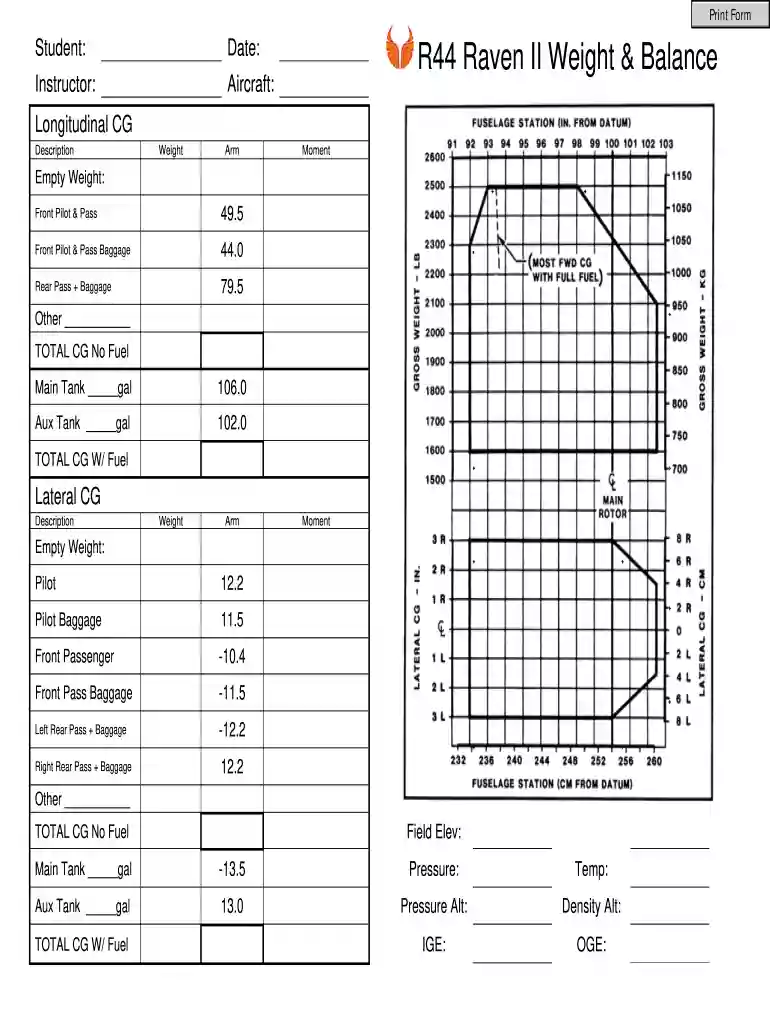
Type text, add images, blackout confidential details, add comments, highlights and more.

Draw your signature, type it, upload its image, or use your mobile device as a signature pad.

Send r44 weight and balance sheet via email, link, or fax. You can also download it, export it or print it out.
The R44 weight and balance processes are critical for ensuring the safety and performance of the Robinson R44 helicopter. Understanding and calculating weight limitations help pilots maintain operational efficiency while adhering to federal aviation regulations.
Accurate weight calculations are essential for ensuring that the R44 operates within its designed limits. The helicopter has a maximum gross weight, typically 2,400 pounds for most models. Exceeding this limit can lead to reduced performance, increased fuel consumption, and difficulties in managing flight control. Accurate calculations also contribute to effective flight planning and fuel management.
The R44 weight and balance sheet is a critical document that outlines the helicopter's loading conditions, aiding in ensuring the center of gravity (CG) remains within safe limits. This sheet includes:
Using an R44 weight and balance calculator can streamline the process of determining safe load configurations. It allows users to input weights (pilot, passengers, baggage, fuel) and instantly calculate the resulting CG position.
Conducting weight and balance calculations for the R44 involves systematic steps:
Total Weight = 1,400 + 360 + 50 + 150 = 1,910 pounds. The CG calculations should then be applied based on the arms provided, ensuring the result aligns with operational guidelines.
Understanding the regulatory framework surrounding the R44's weight and balance is crucial. The Federal Aviation Administration (FAA) mandates strict adherence to these weight limit guidelines.
Exceeding prescribed weight limits for the R44 can lead to various operational hazards, including compromised control effectiveness and worsened stopping distances.
Maintaining a thorough understanding of the R44 weight and balance is paramount for pilots. By systematically executing weight measurements and adhering to established guidelines, pilots can ensure safe, efficient operations. Regular use of weight and balance sheets, calculators, and adherence to FAA regulations will facilitate operational success for all R44 flights.
At DocHub, your data security is our priority. We follow HIPAA, SOC2, GDPR, and other standards, so you can work on your documents with confidence.
A/C Type: R44 Raven II. Name: This sheet is used for all Dual Local flights Weight Balance (Zero Fuel). Right Front - Door**. Left Front - Passenger.Read more
Weight Balance, R44. 1576.4 lb. 106.5 in. Longitudinal Moment. 167936 in-lb. Location. (in). Moment. (in-lb). Right Front Seat. 178 lb. 49.5. 8811. Left FrontRead more


