



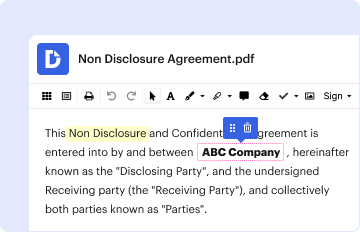
01. Edit your cbp 349 form online
Type text, add images, blackout confidential details, add comments, highlights and more.

Type text, add images, blackout confidential details, add comments, highlights and more.
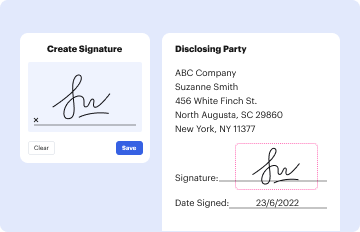
Draw your signature, type it, upload its image, or use your mobile device as a signature pad.

Send harbor maintenance fee quarterly summary report via email, link, or fax. You can also download it, export it or print it out.
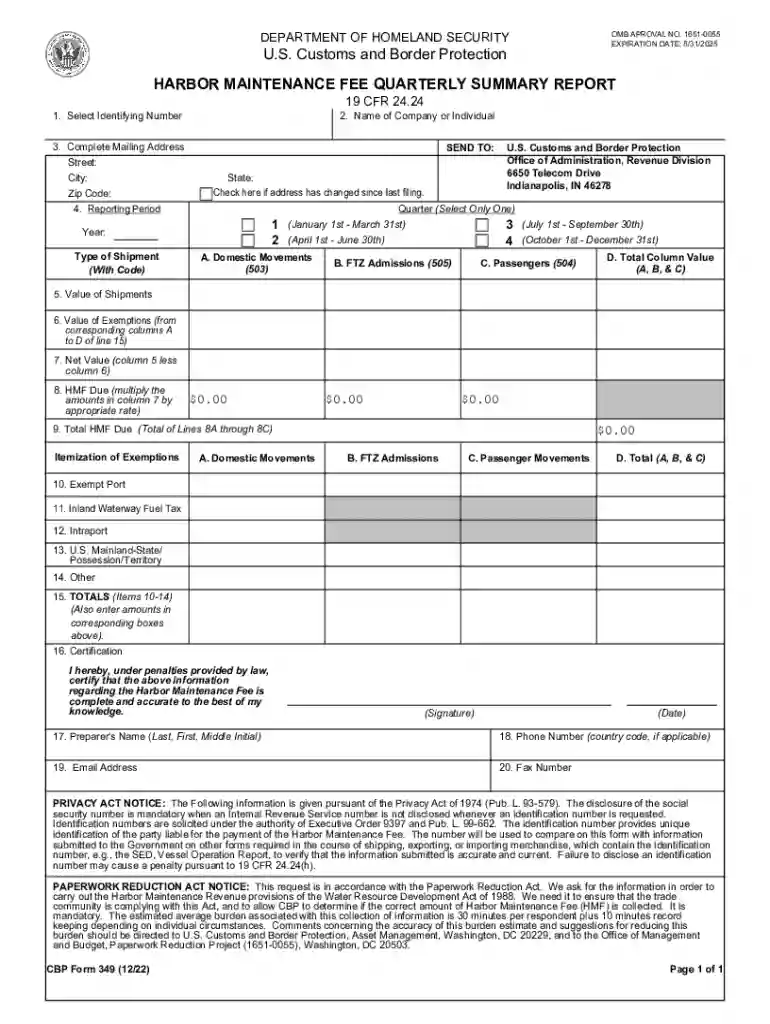
The CBP Form 349 is specifically designed for the Harbor Maintenance Fee Quarterly Summary Report. Issued by the U.S. Customs and Border Protection, under the Department of Homeland Security, this form facilitates the reporting of various types of shipments. These include domestic and Foreign Trade Zone admissions along with passenger movements. While the form predominantly gathers data on shipment values and exemptions, it also calculates the Harbor Maintenance Fee due. The information collated aids in ensuring that users adhere to tax requirements tied to harbor maintenance.
Using CBP Form 349 involves documenting shipments that are subject to the Harbor Maintenance Fee. It serves as a record for companies to report all relevant shipping transactions within a specified quarterly period. Understanding its purpose and function is essential for ensuring that submissions are accurate and comprehensive. Additionally, it provides a breakdown of the methods by which shipments are classified and categorized, ensuring compliance with government reporting standards. Users should familiarize themselves with each section, especially those related to exemptions and shipment value, to prevent errors in reporting.
Gather Required Information: Before starting, collect all necessary documents supporting shipment transactions, including manifests and import declarations.
Identify Shipment Types: Classify each shipment as domestic movements, Foreign Trade Zone admissions, or passenger movements.
Determine Shipment Values: Accurately assess and enter the value of each shipment. Exemptions should be noted appropriately.
Calculate Fees: Use the form's guidelines to compute the Harbor Maintenance Fee based on the value and type of shipments.
Review Instructions: Pay close attention to the instructions offered in the form for filling out each section correctly.
Submission: Ensure all sections are completed, and submit the form via the designated method, be it online, by mail, or in-person.
Primarily, CBP Form 349 is used by businesses operating in sectors that rely heavily on importing and shipping via U.S. harbors. This includes logistics companies, import/export businesses, and entities utilizing Foreign Trade Zones. Additionally, it is relevant to companies involved in transporting passengers where the Harbor Maintenance Fee is applicable. These users benefit from understanding how to correctly report and possibly minimize fees associated with their shipping activities.


The CBP Form 349 must be filed quarterly, with deadlines typically aligning with standard fiscal quarters. These deadlines are crucial for ensuring compliance and avoiding potential penalties. Companies should maintain a robust schedule, ensuring that documentation is ready and reviewed ahead of time. It is important to check dates specific to the current fiscal year to avoid discrepancies.
Failing to file the CBP Form 349 correctly or adhering to filing deadlines may result in financial penalties. Companies may face fines or additional scrutiny from U.S. Customs and Border Protection. Non-compliance can also lead to increased fees or legal repercussions, emphasizing the need for diligence and accurate reporting. Businesses should therefore ensure they keep comprehensive records and fully understand all form requirements to mitigate these risks.
We've got more versions of the cbp 349 form form. Select the right cbp 349 form version from the list and start editing it straight away!
At DocHub, your data security is our priority. We follow HIPAA, SOC2, GDPR, and other standards, so you can work on your documents with confidence.
The CBP Form 349 must either be submitted electronically to CBP using the Automated Clearinghouse (ACH) via an Internet account established by the payer andRead more
Sep 3, 2025 CBP Form 349 - Harbor Maintenance Fee Quarterly Summary Report. *The OMB Date is expired, however this form is still valid for use and isRead more
THE GUIDELINE. 7. 3.1. Classification. 7. 3.2. Antimicrobial stewardship. 8. 3.3. Asymptomatic bacteriuria in adults. 8. 3.3.1 Evidence question.Read more


