
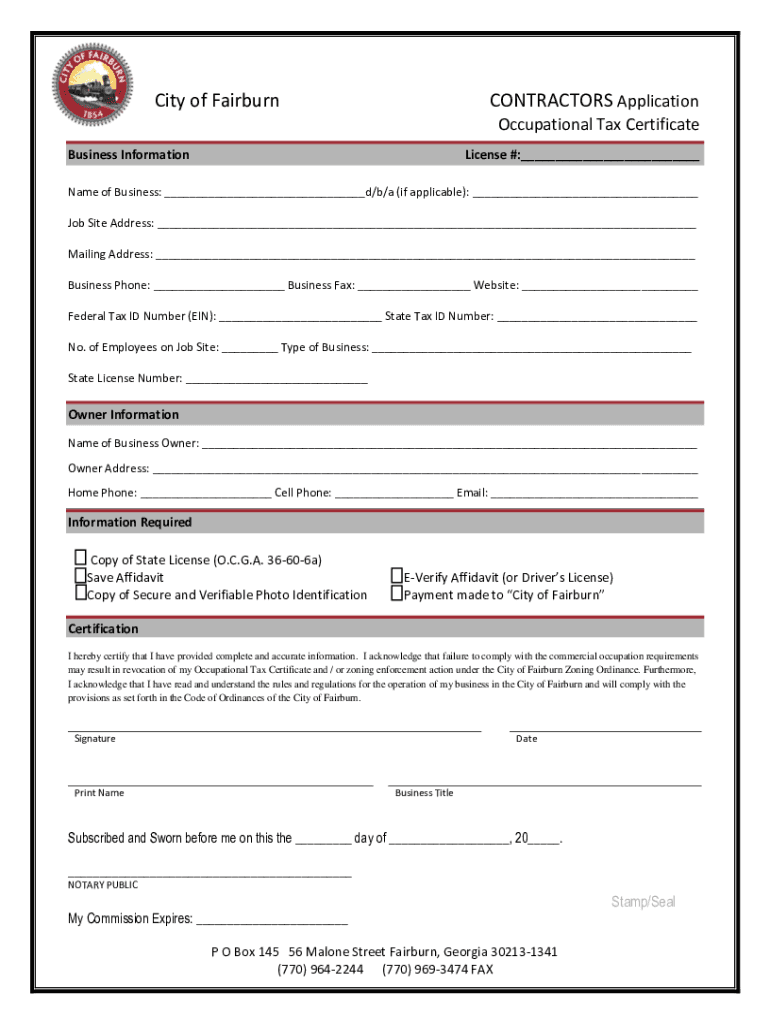







Definition & Meaning
The Georgia occupational tax certificate is a mandatory document for business operations within certain jurisdictions in Georgia, confirming that a business entity is authorized to operate legally. It essentially serves as a business license, ensuring compliance with local government regulations. While often referred to colloquially as a business license, its primary function is to validate that businesses are registered for occupational tax purposes. The certificate symbolizes that the business has met all applicable registration and tax obligations required by municipal or county authorities.
Examples of Use
- Businesses across various sectors, such as retail, hospitality, and professional services, must obtain this certificate before commencing operations.
- The certificate is prominently displayed at business premises, signaling legal compliance.
- During expansions or relocations within Georgia, businesses must ensure their tax certificate reflects the updated information.
How to Obtain the Georgia Occupational Tax Certificate
Obtaining the Georgia occupational tax certificate requires navigating specific steps laid out by local jurisdictions. While processes may vary slightly between counties or cities, the core steps remain consistent.
Steps to Acquire the Certificate
-
Identify Your Jurisdiction: Most Georgia municipalities have their department responsible for the issuance of occupational tax certificates.
-
Complete the Application Form: Acquire the application either online or in-person from the relevant local government office. Necessary information typically includes business and owner details, business type, and estimated gross revenue.
-
Submit Required Documents: These may include proof of name registration, federal and state tax ID numbers, and property lease agreements.
-
Pay Applicable Fees: Fees are based on business type and projected revenue, often detailed in a fee schedule accompanying the application.
-
Receive Approval: The approval process may take a few days to several weeks, depending on the location and volume of applications.
Important Considerations
- Verification of Legal Status: Businesses must provide affidavits confirming the legal status of the business owner under Georgia law.
- Regulation Compliance: Additional permits may be required for businesses in regulated industries.
Key Elements of the Georgia Occupational Tax Certificate
The occupational tax certificate comprises several key components that ensure your business meets the state's regulatory requirements.
Core Elements
- Business Identification: Includes business name, address, owner, and contact details.
- Classification: Specifies the type of business and its industry category.
- Fees and Tax Rates: Clearly outlines the applicable tax rates and total fees paid.
- Validation Period: Indicates the certificate's validity, generally requiring renewal annually.
- Certification Seal: An official seal or signature signifying municipal or county verification.
Document Format
- Electronic and Paper Options: Combine traditional paper formats and electronic versions, which offer ease of distribution and verification.
Who Typically Uses the Georgia Occupational Tax Certificate
Various entities within Georgia utilize the occupational tax certificate to comply with state regulations, ranging from startups to established businesses.


Target Users
- Small Business Owners: Those establishing a presence in specific Georgia locales.
- Corporations and LLCs: Larger entities expanding operations within the state.
- Home-Based Businesses: Entrepreneurs operating from residential locations.
Special Considerations
- Business Variability: Adapt requirements based on the nature and scale of business operations.
- Specific Requirements: New businesses versus established ones may experience unique documentation or procedural necessities.
Required Documents
Correct documentation is essential for a successful application process for the Georgia occupational tax certificate.
List of Mandatory Documents
- Business Registration Proof: Documentation showing legal business registration.
- Identification Documents: State or federal identification for proprietors.
- Lease or Ownership Papers: Proof of a legal right to use business premises.
- Tax Identification Numbers: Federal and state tax IDs for tax tracking purposes.
Additional Documents
- Zoning Permits: Especially important for businesses with physical locations.
- Industry-Specific Licenses: Additional certification for sectors such as healthcare or food service.
State-Specific Rules for the Georgia Occupational Tax Certificate
Distinctive rules apply to occupational tax certificates across Georgia’s municipalities and counties, often necessitating customized compliance strategies.
Unique Regional Regulations
- Variances in Fee Structures: Local governments may set varying fee schedules, typically reflecting the business's size and sector.
- Electronic Filing Adoption: Some regions encourage or mandate electronic filing to streamline processing.
Illustrative Scenarios
- Cross-Jurisdiction Operations: Businesses operating in multiple areas must obtain certificates relevant to each locality.
- Changes in Operation: Transfers, expansions, or alterations in business activities require notifying the authority for certificate updates.
Penalties for Non-Compliance
Failure to secure a Georgia occupational tax certificate can incur serious penalties, impacting business viability.
Possible Consequences
- Fines and Fees: Imposed on businesses operating without proper certification.
- Legal Action: Persistent non-compliance may lead to court orders or business shutdowns.
- Reputation Damage: Loss of trust and credibility among customers and business partners.
Preventive Measures
- Timely Renewals: Ensuring on-time certificate renewal avoids lapses in compliance.
- Regular Updates: Keep abreast of regulatory changes to remain compliant.
Application Process & Approval Time
Applying for the Georgia occupational tax certificate involves several steps, and understanding these can help expedite the process.
Detailed Application Steps
- Prepare Documentation: Gather essential documents ahead of the application.
- Complete the Application: Fill out the form with accurate details to avoid delays in processing.
- Submit and Await Approval: Submission can be online or in person, with processing times varying by jurisdiction.
Expected Timeframes
- Average Approval Duration: Generally, two to four weeks depending on the completeness of your application.
- Follow-up Opportunities: Contact the issuing office for status updates, reducing approval bottlenecks.
Conclusion
By comprehensively understanding the requirements and specifics surrounding the Georgia occupational tax certificate, businesses can ensure compliance and avoid potential pitfalls. This knowledge enables effective navigation of legal obligations and fosters successful business operations within Georgia.




