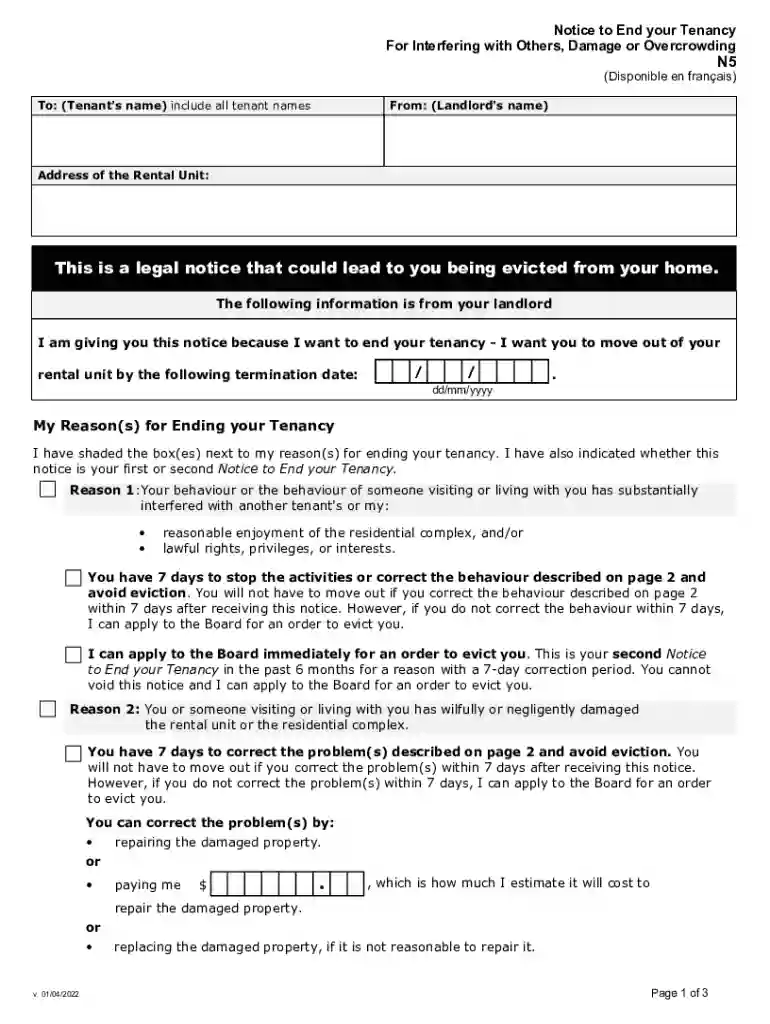
From: (Landlord's name) 2026

Get Form
form n5 ontario Preview on Page 1

Here's how it works

01. Edit your form n5 ontario online
Type text, add images, blackout confidential details, add comments, highlights and more.

02. Sign it in a few clicks
Draw your signature, type it, upload its image, or use your mobile device as a signature pad.

03. Share your form with others
Send rent receipt via email, link, or fax. You can also download it, export it or print it out.

Definition & Meaning

The "From: (Landlord's name)" section is a critical part of any document intended as a formal notice from a landlord to a tenant. It identifies the source of the communication, ensuring that the tenant understands the origin of the notice and its legal weight. This portion is generally found at the top of the document and serves as a basis for formal communication, providing necessary contact details for the landlord. Including the landlord's full legal name aids in establishing the document's authenticity and helps mitigate any disputes about its validity.

Key Elements of the From: (Landlord's name)

At its core, the elements within the "From: (Landlord's name)" section should comprise more than just the landlord's name. To enhance clarity and completeness, consider including:

  • Full legal name of the landlord or property management entity.
  • Contact information like phone number and email address.
  • Physical mailing address for further correspondence.
  • Date of the document issuance to track deadlines and compliance periods. This information guarantees that tenants have comprehensive contact details for any queries or follow-ups regarding the notice.

Legal Use of the From: (Landlord's name)

The legal use of the "From: (Landlord's name)" involves accurately identifying the party responsible for issuing the written communication. This section is crucial in legal contexts, such as eviction notices or demands for compliance. By providing precise details, this part of the document establishes the party's authority to initiate legal proceedings if the tenant fails to comply with the lease agreement. In jurisdictions across the United States, these details conform to state and federal regulations governing landlord-tenant communications.

State-Specific Rules for the From: (Landlord's name)

Each state may have specific requirements related to landlord-tenant communications, including the "From: (Landlord's name)" section. Understanding these nuances is essential for compliance:

  • California: Requires landlords to provide their mailing address on all official communications.
  • New York: Mandates inclusion of contact details to ensure seamless tenant-landlord interactions.
  • Texas: Notices must include specific legal language, ensuring clarity about the document's intent. These variations reflect the diverse legal landscapes that landlords must navigate. Make sure to consult local regulations to ensure compliance with state-specific rules.

Steps to Complete the From: (Landlord's name)

Completing the "From: (Landlord's name)" section involves several key steps:

  1. Identify the Landlord: Use the full legal name of the individual or corporation.
  2. Add Contact Information: Include a phone number, email, and physical address.
  3. Insert Date and Property Address: Clearly indicate when and where the notice applies.
  4. Validate Accuracy: Double-check all details for spelling errors and typos.
  5. Consult Legal Counsel: Ensure the section meets all legal requirements.

Who Typically Uses the From: (Landlord's name)

The "From: (Landlord's name)" section is commonly used by:

  • Individual Landlords: Managing their properties independently.
  • Property Management Companies: Handling multiple properties on behalf of owners.
  • Legal Representatives: Acting on behalf of landlords in official capacities. These parties utilize the form for various purposes, from issuing eviction notices to formal notifications about lease terms and conditions.
decoration image ratings of Dochub

Why Should You Include From: (Landlord's name)

Inclusion of the "From: (Landlord's name)" is essential for several reasons:

  • Validity: Establishes the document's authenticity.
  • Transparency: Provides clear contact information for tenants.
  • Accountability: Ensures clarity in communications between landlord and tenant. This section acts as the initial foundation for any formal document related to landlord-tenant interactions, thus its inclusion is non-negotiable.

Examples of Using the From: (Landlord's name)

Here are some scenarios where the "From: (Landlord's name)" section plays a crucial role:

  • Eviction Notice: Providing clear identification of the landlord when a tenant breaches the lease agreement.
  • Lease Renewal Notification: Communicating potential terms for renewing a lease.
  • Property Maintenance Request: Issuing notices regarding required property maintenance. These examples illustrate the broad applicability of this section across various situations that require formal landlord notifications.

Important Terms Related to From: (Landlord's name)

Understanding terms associated with the "From: (Landlord's name)" section aids in comprehension:

  • Notice to Comply: A formal request demanding tenant adherence to lease terms.
  • Lease Agreement: The contract establishing the relationship and obligations between landlord and tenant.
  • Eviction Proceedings: Legal actions initiated due to tenant non-compliance. These terms form the foundational language of landlord-tenant relations and inform the use of the "From: (Landlord's name)" section in official notices.

See more From: (Landlord's name) versions

We've got more versions of the From: (Landlord's name) form. Select the right From: (Landlord's name) version from the list and start editing it straight away!
Versions Form popularity Fillable & printable
2022 4.9 Satisfied (52 Votes)
2018 4.7 Satisfied (44 Votes)
2002 4.4 Satisfied (546 Votes)
be ready to get more

Complete this form in 5 minutes or less

Get form

Got questions?

We have answers to the most popular questions from our customers. If you can't find an answer to your question, please contact us.
Contact us

Yes, you can utilize DocHub for signing any business and private documentation, including your n5 form. All electronic signatures you generate with our tool are legally binding and court-admissible, as DocHub complies with criteria required by ESIGN and UETA. Save your accomplished form with a detailed Audit Trail if necessary.

If you store your paperwork in Google Drive, there is no need to download your notice tenant on the computer and upload it back to our editor. A much simpler way is to set up a browser extension developed by DocHub to streamline this flow. The extension allows editing PDFs right in your web browser. Alternatively, you can integrate your DocHub and Gmail accounts for more efficient modifying.

Synonyms of landlord (noun owner of property leased) property owner. proprietor. freeholder. hotelier.
A lessor may be called a landlord. A lessor is a person or legal entity that owns a property and rents it out to a lessee, who in term pays the lessor to live in their property.
Landlord Entities means Landlord, Landlords investment manager, and the trustees, boards of directors, officers, general partners, beneficiaries, stockholders, employees and agents of each of them.

Security and compliance

At DocHub, your data security is our priority. We follow HIPAA, SOC2, GDPR, and other standards, so you can work on your documents with confidence.

Learn more
ccpa2
pci-dss
gdpr-compliance
hipaa
soc-compliance
be ready to get more

Complete this form in 5 minutes or less

Get form

People also ask

In the United States landlord is still the correct term, it is synonymous with property owner.
1. : the owner of property (such as land, houses, or apartments) that is leased or rented to another. 2. : the master of an inn or lodging house : innkeeper.
In the US theyre called landlords usually if its one person renting to another or if its a fairly small business. In larger scale, more formal transactions theyre often called leasors or leasing agents.
early 15c. (late 13c. as a surname), owner of a tenement, one who rents land or property to a tenant, from land (n.) + lord (n.).
New York allows tenants to refuse viewings at any time, including during the leases final month. Landlord entry for the purpose of showing the property requires the tenants explicit consent. Without it, the landlord must obtain a court order to legally conduct viewings.

termination tenant