







Definition and Meaning of the 1New Patient Packet Letter
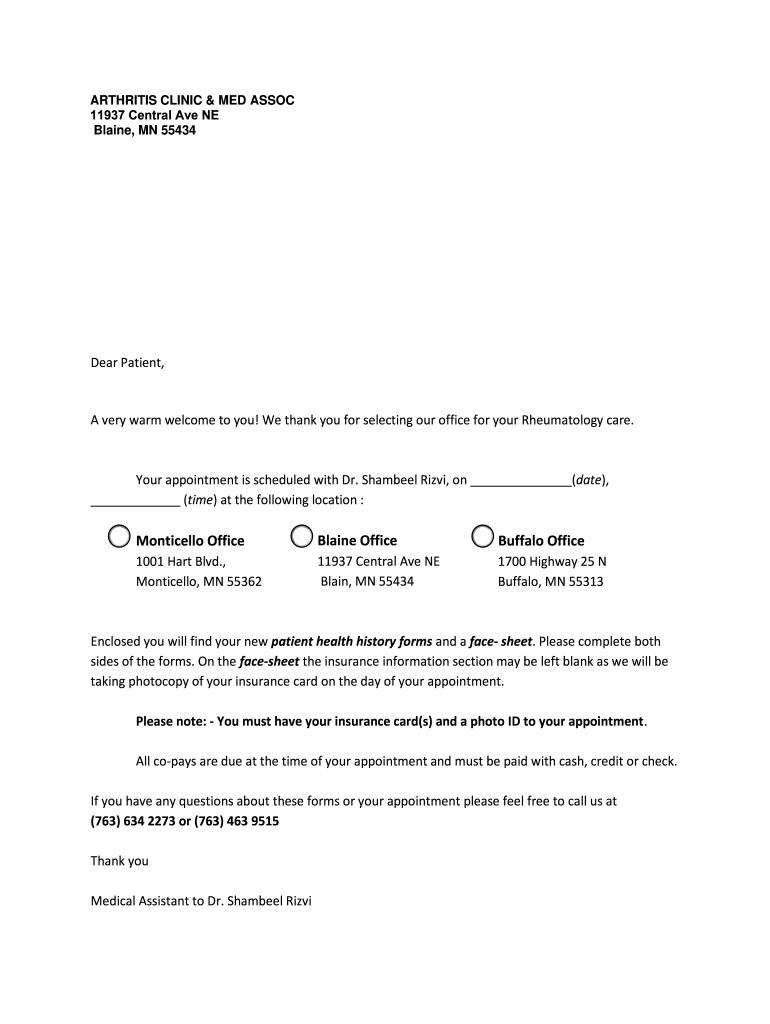
The "1New Patient Packet Letter" serves as a crucial introduction for new patients at medical facilities like the Arthritis Clinic & Medical Associates. This document is designed to facilitate the onboarding process by providing comprehensive information regarding upcoming medical appointments. At its core, the new patient packet functions as a preparatory tool, outlining important details such as the scheduled date, time, and location of an appointment with a healthcare provider, like Dr. Shambeel Rizvi in this context.
The packet typically includes instructions for patients to prepare for their visit, highlighting necessary actions like completing health history forms and gathering essential identification and insurance documents. Additionally, it serves as a medium for conveying any specific payment details or policies that the patient must be aware of before their consultation. This standardized communication not only ensures that patients arrive at their healthcare appointments fully prepared but also aids medical offices in collecting all necessary information prior to the meeting.
How to Use the 1New Patient Packet Letter
To utilize the new patient packet letter effectively, it's essential first to carefully review the contents upon receipt. New patients should:
-
Verify Appointment Details:
- Confirm the appointment date and time.
- Take note of the location and the attending doctor.
-
Complete Required Forms:
- Fill out any included health history forms accurately.
- Ensure the information is comprehensive and reflects current health conditions.
-
Prepare Necessary Documents:
- Gather and bring identification such as a driver's license or passport.
- Bring current insurance cards or any related documentation.
-
Understand Payment Procedures:
- Review any included payment instructions or clinic billing policies.
- Prepare for co-pays or fees that may be due at the time of the visit.
These steps help ensure that applications run smoothly, providing the healthcare provider with all required information and ensuring a streamlined experience for the patient.
How to Obtain the 1New Patient Packet Letter
Obtaining a new patient packet involves several straightforward steps:
-
Contact the Medical Facility:
- Call or email the clinic where the appointment is scheduled.
- Request the new patient packet if it has not been received.
-
Online Access:
- Some clinics offer digital versions of the packet on their website.
- Log in to the facility's patient portal to download any relevant documents.
-
Mail or In-Person:
- If digital access is unavailable, request that the packet be sent via mail.
- Alternatively, visit the clinic to retrieve a physical copy directly.
Ensuring access to this packet well before the appointment allows ample time for preparation.
Steps to Complete the 1New Patient Packet Letter
Completing the new patient packet requires attention to detail and thoroughness:
-
Review All Sections:
- Carefully read through each part of the packet.
- Note any areas requiring additional documentation or consideration, such as medical history or medication lists.
-
Fill Out Each Section:
- Enter patient information including name, address, and contact details.
- Provide detailed medical history, noting any known conditions, past surgeries, or allergies.
- List current medications and dosages accurately.
-
Family History:
- Complete the family medical history section to highlight potential hereditary conditions.
-
Sign All Necessary Areas:
- Ensure that the document is signed where required, indicating acknowledgement and consent.
-
Attach Additional Necessary Documents:
- Include copies of insurance cards or any other requested documents with the packet.
Completing these steps in advance helps facilitate an efficient check-in process on the day of the appointment.
Key Elements of the 1New Patient Packet Letter
The new patient packet contains several critical elements:
- Appointment Information: Details on timing and location.
- Patient Information Section: Includes both personal and contact details.
- Medical History Forms: Covers past medical conditions and treatments.
- Medication List: Current prescriptions, including dosage information.
- Family Medical History: Addresses hereditary health concerns.
- Insurance and Payment Details: Instructions on payment policies, including co-pays or fees.
Each element is included to gather necessary data and ensure comprehensive patient care plans are in place.
Important Terms Related to the 1New Patient Packet Letter
Familiarity with specific terms can assist in better understanding and completing the packet:
- Co-Pay: The portion of the medical bill that the patient is responsible for paying, separate from what the insurance covers.
- Health History: A record of a patient's past and present medical issues and surgeries.
- Insurance Card: The physical card proving medical insurance coverage, often requested by healthcare providers.
- Primary Care Provider (PCP): The healthcare professional primarily responsible for a patient's care.
Legal Use of the 1New Patient Packet Letter
The new patient packet serves legal and practical functions, ensuring compliance with healthcare regulations:
- HIPAA Compliance: Protects patient confidentiality and guarantees sensitive information is documented securely.
- Informed Consent: By signing the packet, patients acknowledge and consent to treatments and agree to the clinic's terms.
- Documentation for Record Keeping: Provides a legally binding record of the patient's consent and medical history, essential for accurate record maintenance.
Understanding these implications helps patients appreciate the broader significance of completing their packet accurately.
Examples of Using the 1New Patient Packet Letter
Real-world scenarios illustrate the application of the packet:
-
A new patient at the Arthritis Clinic receives a packet packet prior to meeting Dr. Shambeel Rizvi. Upon reviewing the packet, they realize they are missing critical insurance information and promptly rectify this by contacting their provider.
-
A patient needing a detailed family medical history fills out the packet at home and discovers a significant hereditary condition of which they were unaware, which they then discuss during their appointment.
Each scenario underscores the importance of the packet as an invaluable resource in preparing for healthcare visits.




