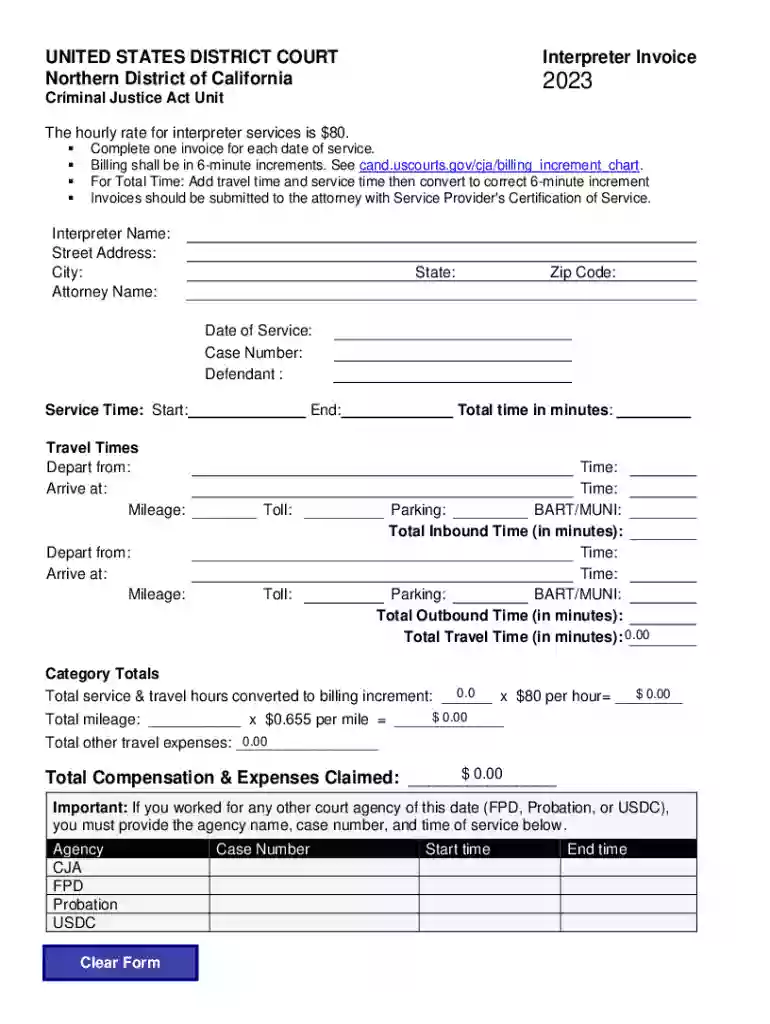
Authorization and Payment for Investigative, Expert, and Other 2026

Get Form
Authorization and Payment for Investigative, Expert, and Other Preview on Page 1

Here's how it works

01. Edit your form online
Type text, add images, blackout confidential details, add comments, highlights and more.

02. Sign it in a few clicks
Draw your signature, type it, upload its image, or use your mobile device as a signature pad.

03. Share your form with others
Send it via email, link, or fax. You can also download it, export it or print it out.

Definition & Meaning

The "Authorization and Payment for Investigative, Expert, and Other" form is a critical document used within the United States legal system. It primarily serves a financial function, authorizing funds for various expenses related to legal investigations, expert witnesses, and additional services required for case preparation and defense. The form ensures that appointed legal representatives have the necessary resources to effectively advocate for their clients. It is essential to understand that this document facilitates the allocation and reimbursement of expenses under specific legal guidelines, often pertaining to cases managed under the Criminal Justice Act.

Application in Legal Contexts

  • Ensures defendants have access to resources necessary for an adequate defense.
  • Supports investigative efforts by covering expenses for expert analysis and testimony.
  • Covers other necessary services that are critical for case handling.

Impact on Legal Outcomes

Funding through this form can significantly impact the outcome of a legal case by enabling comprehensive investigative work and expert consultation, which may be instrumental in establishing a robust defense strategy.

Key Elements of the Authorization and Payment for Investigative, Expert, and Other

Understanding the structural components of this form is crucial for efficient processing and approval. Each section requires precise information to justify the expense and ensure compliance with legal standards.

Essential Components

  1. Case Information: Includes details such as case number, court district, and involved parties.
  2. Expense Justification: A detailed explanation of why the requested funds are necessary, including the type of service (investigative, expert, or other) and its relevance to the case.
  3. Cost Estimates: A breakdown of anticipated costs, supported by quotes or estimates from service providers.
  4. Approval Signatures: Mandatory signatures from authorized legal representatives and court officials, ensuring that the fund allocation is legitimate and necessary.

Documentation Support

Proper documentation is vital for the approval process. This should include:

  • Credentials of experts or service providers.
  • Detailed invoices or cost breakdowns.
  • Any other documentation that reinforces the necessity and reasonableness of the requested funds.

Steps to Complete the Authorization and Payment for Investigative, Expert, and Other

Filling out this form accurately and comprehensively is crucial for smooth processing and approval.

Detailed Process

  1. Gather Necessary Information: Collect all pertinent details related to the case and the nature of the required services.
  2. Document the Justification: Clearly articulate the need for each expense, linking it directly to the case’s requirements.
  3. Complete the Form: Fill in all required sections, ensuring accuracy and clarity. Use precise figures for all cost estimates.
  4. Attach Supporting Documents: Enclose any relevant documentation that corroborates the funds' necessity.
  5. Submit for Approval: Obtain required signatures and submit the form to the appropriate legal authority for authorization.

Follow-Up Procedures

To facilitate approval, maintain contact with court officials to address any queries or provide additional documentation swiftly.

Who Typically Uses the Authorization and Payment for Investigative, Expert, and Other

This form is primarily utilized by legal professionals within the judicial system, particularly those appointed to represent clients under specific legal provisions like the Criminal Justice Act.


decoration image ratings of Dochub

Typical Users

  • Defense Attorneys: To secure resources for case preparation where external expertise is essential.
  • Public Defenders: In situations requiring specialized knowledge or investigative work.
  • Court-Appointed Legal Representatives: For initiating reimbursements related to case expenditures.

Beneficial Use Cases

  • Complex cases involving forensic analysis.
  • Legal defenses relying on expert testimony.
  • Situations necessitating in-depth investigation to uncover critical evidence.

Legal Use of the Authorization and Payment for Investigative, Expert, and Other

This form must be employed within the confines of legal stipulations to ensure compliance and legitimate expenditure of funds.

Compliance and Regulations

  • All fund requests must adhere to the guidelines outlined by the judiciary.
  • Unauthorized or unexplained expenditures are typically denied.

Proper Application

Use this form to request and obtain necessary authorizations for all investigative, expert, or ancillary services that are indispensable to a case's success and integrity.

State-Specific Rules for the Authorization and Payment for Investigative, Expert, and Other

While there are overarching federal guidelines, state-specific regulations may also apply, affecting how this form is used and processed.

Variances by State

  • Different Approval Processes: Some states may require additional documentation or distinct procedural steps.
  • State Funding Limits: Certain states may impose limits on reimbursable amounts or differentiate between state and federal case processing.

Implications for Legal Practitioners

Understanding state-specific requirements can prevent delays in form processing and ensure that all procedures are met within the legal framework applicable to the jurisdiction in question.

Examples of Using the Authorization and Payment for Investigative, Expert, and Other

Implementing this form effectively requires a strategic approach. Real-world examples highlight its importance in legal contexts.

Use Case Scenarios

  • Criminal Defense: Securing forensic experts for evidence analysis to support defense claims.
  • Civil Litigation: Engaging financial analysts to provide expert testimony on complex financial matters.
  • Family Law: Utilizing psychological evaluations to impact custody decisions.

Success Stories

In criminal cases, authorized payments have permitted comprehensive investigations leading to the discovery of crucial evidence, pivotal in establishing reasonable doubt and favorably influencing case outcomes.

See more Authorization and Payment for Investigative, Expert, and Other versions

We've got more versions of the Authorization and Payment for Investigative, Expert, and Other form. Select the right Authorization and Payment for Investigative, Expert, and Other version from the list and start editing it straight away!
Versions Form popularity Fillable & printable
2023 4.7 Satisfied (23 Votes)
2022 4.6 Satisfied (40 Votes)
2011 4 Satisfied (51 Votes)
be ready to get more

Complete this form in 5 minutes or less

Get form

Got questions?

We have answers to the most popular questions from our customers. If you can't find an answer to your question, please contact us.
Contact us
Criminal Justice Act (CJA) | Federal Judicial Center.
Enacted in 1964, the CJA establishes a comprehensive system for appointing and compensating legal representation for accused persons who are financially unable to retain counsel in federal criminal proceedings.
310.20.10 With Prior Authorization (a) With prior authorization, compensation for investigative, expert, and other services is limited to the amounts in the following table for CJA- compensable work performed on or after the effective date. For guidelines applicable to capital cases, see: Guide, Vol. 7A, 660.10.
Arraignment. Arraignment shall be conducted in open court and shall consist of reading the indictment or information to the defendant or stating to the defendant the substance of the charge and calling on the defendant to plead thereto.
Section 33(8)(a) of the CJA 2010 prohibits a firm that is unable to identify and verify a customer due to the failure of that customer to provide the necessary documentation or information, from providing any service or carrying out any transactions sought by that customer while the documentation or information

Security and compliance

At DocHub, your data security is our priority. We follow HIPAA, SOC2, GDPR, and other standards, so you can work on your documents with confidence.

Learn more
ccpa2
pci-dss
gdpr-compliance
hipaa
soc-compliance
be ready to get more

Complete this form in 5 minutes or less

Get form