Transcript: Obligations under APES 310 - dealing with client 2026

Get Form
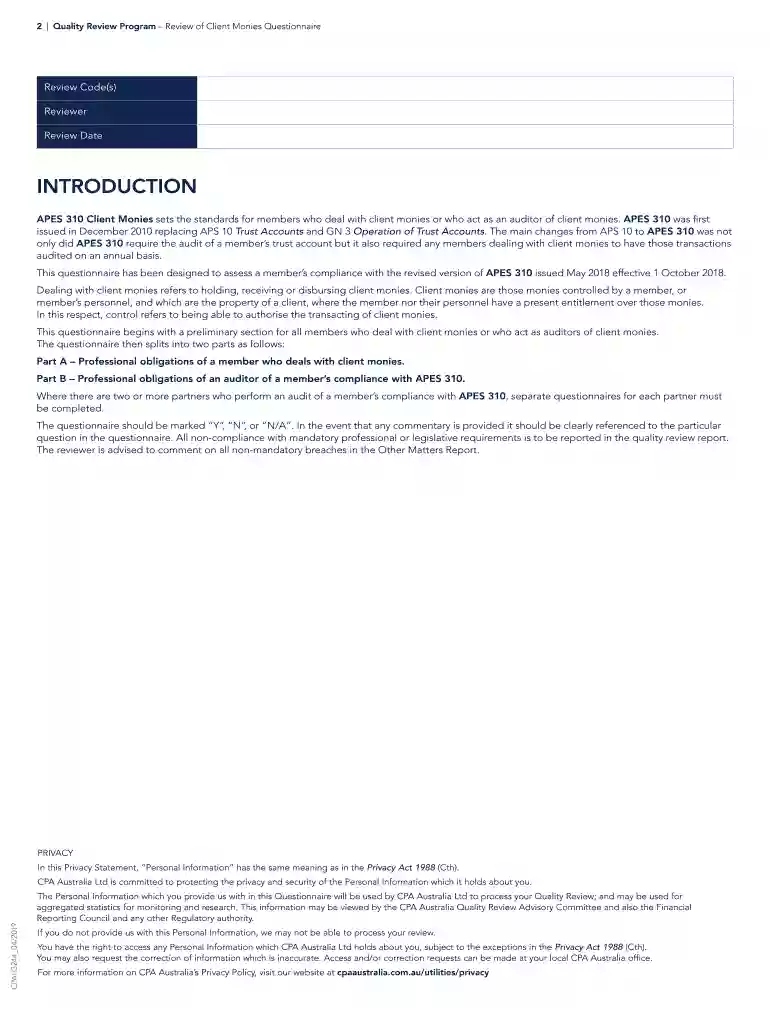
Transcript: Obligations under APES 310 - dealing with client Preview on Page 1

Here's how it works

01. Edit your form online
Type text, add images, blackout confidential details, add comments, highlights and more.

02. Sign it in a few clicks
Draw your signature, type it, upload its image, or use your mobile device as a signature pad.

03. Share your form with others
Send it via email, link, or fax. You can also download it, export it or print it out.

How to use or fill out Transcript: Obligations under APES 310 - dealing with client

Form edit decoration
9.5
Ease of Setup
DocHub User Ratings on G2
9.0
Ease of Use
DocHub User Ratings on G2
  1. Click ‘Get Form’ to open it in the editor.
  2. Begin with the preliminary section, ensuring you understand the definitions and obligations outlined in APES 310. This sets the foundation for your responses.
  3. In Part A, address each question regarding your professional obligations as a member dealing with client monies. Mark 'Y', 'N', or 'N/A' as appropriate, and provide comments where necessary.
  4. Proceed to Part B, focusing on your responsibilities as an auditor. Ensure you answer each question accurately, particularly those related to compliance and independence.
  5. Review your answers thoroughly before submitting. Make sure all required fields are completed and any commentary is clearly referenced.

Start using our platform today to streamline your document editing and ensure compliance with APES 310 effortlessly!

See more Transcript: Obligations under APES 310 - dealing with client versions

We've got more versions of the Transcript: Obligations under APES 310 - dealing with client form. Select the right Transcript: Obligations under APES 310 - dealing with client version from the list and start editing it straight away!
Versions Form popularity Fillable & printable
2019 4.8 Satisfied (47 Votes)
2014 4.8 Satisfied (171 Votes)
2011 4 Satisfied (36 Votes)
be ready to get more

Complete this form in 5 minutes or less

Get form

Got questions?

We have answers to the most popular questions from our customers. If you can't find an answer to your question, please contact us.
Contact us
Make and retain copies of any records returned or provided to the client. Where a member is required to return or provide records to the client, the member should comply with the clients request as soon as practicable but, absent extenuating circumstances, no later than 45 days after the request is made.
As explained by the AICPA, the AICPA Code of Conduct requires members to act with integrity, objectivity, due care, competence, fully disclose any conflicts of interest (and obtain client consent if a conflict exists), maintain client confidentiality, disclose to the client any commission or referral fees, and serve
Additionally, all AICPA members are required to follow a rigorous Code of Professional Conduct which requires that they act with integrity, objectivity, due care, competence, fully disclose any conflicts of interest (and obtain client consent if a conflict exists), maintain client confidentiality, disclose to the
A CPA may disclose confidential client information in certain situations, such as court-ordered subpoena, limited bankruptcy matters, and IRS communication.
The CPA Code of Professional Conduct (Code) sets out the principles that guide members, firms and students on sound and fair financial and management reporting and business practices. The Code sets out our obligations to clients, employers, colleagues and the public interest.

Security and compliance

At DocHub, your data security is our priority. We follow HIPAA, SOC2, GDPR, and other standards, so you can work on your documents with confidence.

Learn more
ccpa2
pci-dss
gdpr-compliance
hipaa
soc-compliance

People also ask

APES 310 sets out the scope and application for public practitioners for managing all the processes around holding, receiving, and disbursing client monies held in trust accounts and client bank accounts.

Related links