
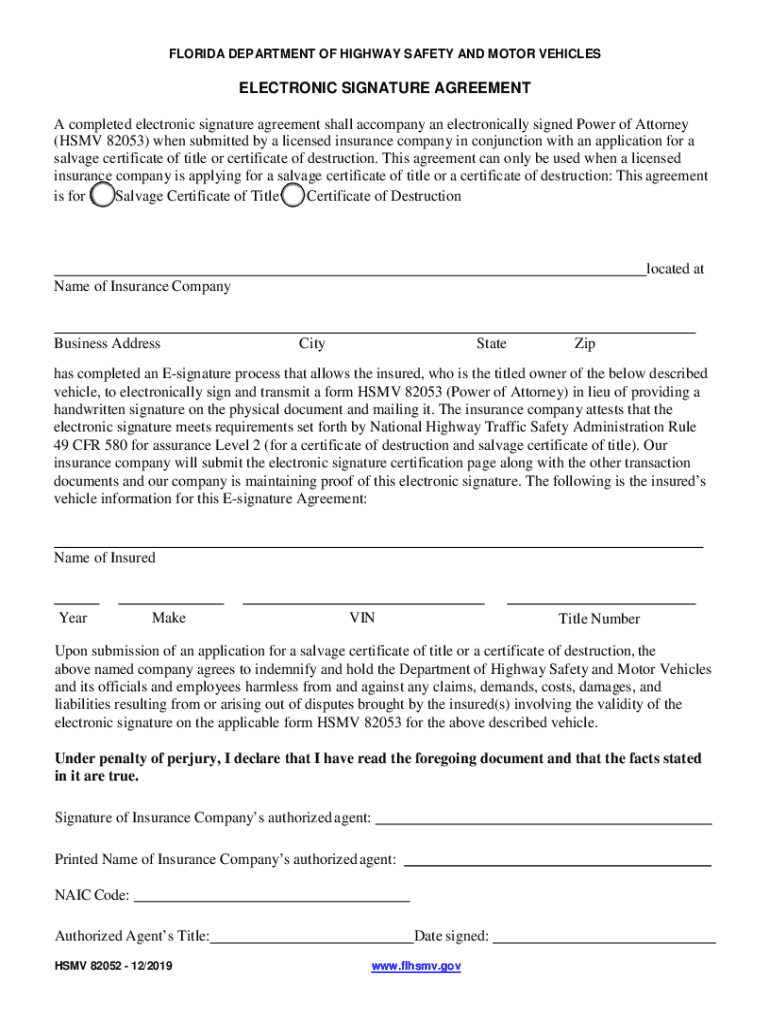







Definition & Meaning
The Florida Motor Vehicle Power of Attorney (Form HSMV 82053) is a legal document that authorizes another individual to act on behalf of a vehicle owner in matters related to the Florida Department of Highway Safety and Motor Vehicles (DHSMV). This form is particularly essential for tasks such as applying for a salvage certificate of title or a certificate of destruction, which often require the vehicle owner's explicit consent. The document allows the designated attorney-in-fact to represent the vehicle owner in a variety of motor vehicle-related transactions, ensuring that legal operations can continue even if the owner is unavailable to handle them personally.
Practical Examples and Applications
- Vehicle Title Transfer: If the vehicle owner is unable to complete a title transfer in person, they can authorize another individual to do so using this form.
- Handling Salvage Titles: For insurance purposes, an owner might delegate authority to an insurer or representative to handle the issuance of a salvage title.
- Administrative Updates: Owners can authorize changes to vehicle registration details or other administrative tasks through a trusted proxy.
How to Use the Florida Motor Vehicle Power of Attorney (Form HSMV 82053)
Utilizing the Florida Motor Vehicle Power of Attorney requires careful completion and understanding of the form's components.
- Complete Owner Information: The vehicle owner must provide their full legal name, address, and contact details.
- Attorney-In-Fact Designation: Clearly identify the person who will serve as the attorney-in-fact, including their complete details.
- Detailed Vehicle Information: List the vehicle identification number (VIN), make, model, and year to specify the concerned vehicle.
- Purpose Specification: Clearly outline the specific actions the attorney-in-fact is authorized to undertake.
- Signature and Notarization: The vehicle owner must sign the document in the presence of a notary. The form must also include the notary's seal and signature.
Real-World Application
For instance, if a vehicle owner relocates temporarily to another state, they can use this form to authorize someone in Florida to manage their vehicle affairs, thus ensuring timely registration renewals or title transfers.
Steps to Complete the Florida Motor Vehicle Power of Attorney (Form HSMV 82053)
The process of filling out this form is straightforward, but it requires attention to detail to ensure accuracy and legal validity.
- Gather Required Information: Obtain all necessary details about the vehicle, the owner's identification, and the attorney-in-fact's credentials.
- Fill Out the Form: Carefully enter the information in the designated fields, ensuring there are no errors or omissions.
- Review for Accuracy: Double-check all entries for possible errors or misspellings that could invalidate the form.
- Sign and Notarize: The vehicle owner should sign the form in front of a notary public, who will provide a seal and signature to validate the document.
- Submit the Completed Form: Depending on the transaction, submit the form to the relevant department as required, whether in-person, by mail, or through designated digital portals.
Who Typically Uses the Florida Motor Vehicle Power of Attorney (Form HSMV 82053)
This form is predominantly used by vehicle owners who need to delegate responsibilities related to their motor vehicle operations in Florida.


Typical Users
- Private Vehicle Owners: Individuals managing personal vehicle transactions when absent.
- Insurance Companies: Handling claims and issuing salvage titles on behalf of policyholders.
- Auto Dealerships: Facilitating title transfers when dealing with large volumes of vehicle transactions.
- Legal Guardians: Managing vehicles owned by minors or those legally unable to conduct their affairs.
Key Elements of the Florida Motor Vehicle Power of Attorney (Form HSMV 82053)
Understanding the critical elements of this form ensures its effective use and compliance with Florida DHSMV requirements.
- Owner Information: Comprehensive details, including full name and contact information.
- Attorney-in-Fact Identification: Accurate reporting of the representative’s identity and contact details.
- Vehicle Details: Complete description of the vehicle pertinent to the transaction.
- Scope of Authority: Detailed description of the powers granted to the attorney-in-fact.
- Signature and Notarization: Ensures the document's authenticity and legal validity.
Legal Use of the Florida Motor Vehicle Power of Attorney (Form HSMV 82053)
The form's legal standing in Florida is strengthened by its compliance with state laws governing powers of attorney, and its use is governed under Florida Statutes.
Key Legal Aspects
- ESIGN Act Compliance: Electronic signatures on the form must comply with federal regulations and Florida's mandates.
- Indemnity Clauses: Protects both the vehicle owner and the DHSMV from disputes regarding the validity of the powers granted.
- Restricted Use: Only applicable for specified motor vehicle operations and cannot be misapplied beyond the outlined authority.
State-Specific Rules for the Florida Motor Vehicle Power of Attorney (Form HSMV 82053)
The form is tailored to Florida’s statutory landscape, and users must comply with specific state guidelines.
- Notarization Requirement: Unlike some states, Florida requires notarization on all motor vehicle power of attorney agreements to establish validity.
- Vehicle Identification: Must include the VIN and all detailed descriptions of the vehicle in question to meet state verification standards.
Examples of Using the Florida Motor Vehicle Power of Attorney (Form HSMV 82053)
Practical examples underscore the importance of this form in Florida’s motor vehicle operations.
- Sale of a Vehicle: A dealership can be authorized to handle all title transfer and registration activities when a private owner sells a vehicle.
- Renovation Periods: Owners granting authorization for vehicle modifications can use the form to allow workshops to update registration details while the vehicle is under repair.




