
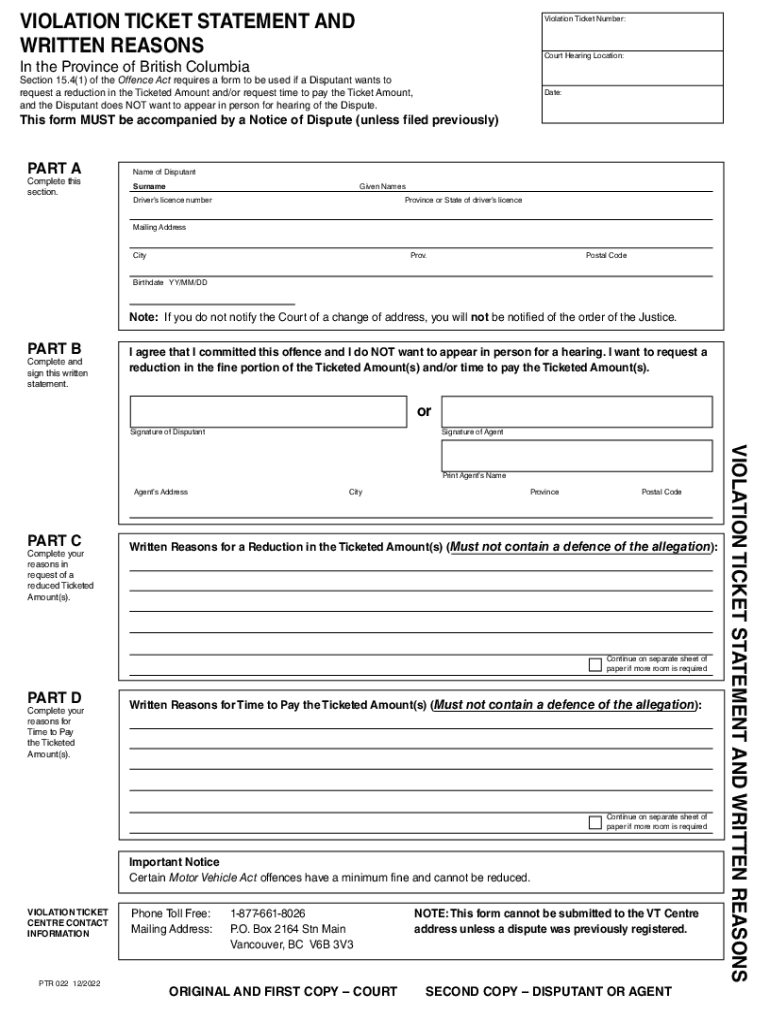







Definition and Purpose of the Violation Ticket Statement
The Violation Ticket Statement and Written Reasons form is a legal document used primarily within the jurisdiction of British Columbia. It serves a specific purpose for individuals disputing a traffic violation. This form enables disputants to formally request a reduction in the fine imposed or to extend the time required to pay the total amount. Rather than attending a hearing in person, individuals can use this document to articulate their reasons and circumstances in writing.
- Purpose: Allows disputants to seek leniency without physical appearance.
- Jurisdiction: Primarily used in British Columbia, but understanding its purpose can offer insights for similar processes in other regions.
- Reduction Requests: Focuses on financial relief or payment extensions.
This form acts as an alternative to in-person hearings, streamlining the process for both the judiciary and the disputant.
Key Components of the Violation Ticket Statement
Understanding the essential sections of this form is crucial for effective completion. Each part plays a vital role in processing the request.
- Personal Information Section: This requires comprehensive details such as name, address, and contact information to accurately identify the disputant.
- Agreement to the Offense: The form often requires acknowledgement of the offense, not as an admission of guilt but to facilitate the consideration of fine reduction.
- Written Reasons for Reduction: Here, disputants can outline specific circumstances or hardships that justify their request. It is vital to be clear and concise, providing compelling evidence or explanations.
Each component is designed to gather necessary data while allowing individuals to present their case effectively.
Steps to Complete the Violation Ticket Statement
Filling out the form involves several methodical steps to ensure accuracy and completeness. Here's a structured guide:
- Gather Required Information: Before starting, collect all necessary documents and information, such as ticket details and personal identification.
- Fill Out Personal Information: Complete this section with precise details.
- Acknowledge Offense Details: Read the offense description carefully, and fill out the agreement section if required.
- Draft Your Written Reasons: Articulate your reasons with supporting details. Ensure that each reason ties back to a relevant point of law or personal circumstance.
- Review and Revise: Double-check all information for accuracy and make necessary revisions.
- Submission: Submit the form along with the Notice of Dispute as required.
Each step requires careful attention to detail to ensure the submission is valid and persuasive.
Obtaining the Violation Ticket Statement Form
Accessing this document is straightforward, yet varies depending on jurisdictional provisions. In British Columbia, and for similar forms elsewhere, the process includes:
- Online Access: These forms are often available on official government or judiciary websites for easy download.
- Physical Locations: Local municipal offices or courthouses may provide printed copies upon request.
- Request by Mail: If online resources are inaccessible, contacting the appropriate office can result in the form being mailed.
Each method offers convenience tailored to the individual's needs and circumstances.
Legal Context and Compliance of the Form
Understanding the legal implications of this form is crucial:
- Adherence to Legal Standards: The form aligns with regional laws allowing written pleadings in lieu of personal appearance.
- Non-Admission Clause: Submitting the form does not equate to an admission of guilt but rather a plea for leniency.
- Jurisdiction Specificity: While this form is specific to British Columbia, its utility can be mirrored in other legal systems with similar procedures.
Compliance with legal standards ensures that the statement is both valid and effective.
Examples and Scenarios for Using the Form
To illustrate the form's utility, consider these scenarios:
- Financial Hardship: An individual suffering from economic challenges due to unforeseen events may use this form to request a reduction of fines.
- Medical Emergencies: If attending a hearing is not possible due to health issues, the form provides a viable alternative.
- Mistaken Violations: The form can aid those who believe their ticket was issued in error, allowing them to explain their stance without attending court.
These real-world examples underscore the form's flexibility and relevance in various situations.
Important Terminology and Concepts
A clear understanding of the terminology associated with the form is essential:
- Disputant: The individual contesting the fine.
- Notice of Dispute: A preliminary document indicating the disputant's intention to contest the violation.
- Relief Request: The act of seeking a reduction or an extension regarding the violation fee.
Familiarity with these terms aids in accurately completing and leveraging the form's intended purpose.
State-Specific Rules and Considerations
While the form discussed is specific to British Columbia, various states within the U.S. may have equivalent documents. It is vital to be aware of:
- Regional Variations: Different states may have slightly different procedures or additional requirements.
- Submission Guidelines: State guidelines may affect how, where, and when forms need to be submitted.
- Legal Nuances: Each state's legal framework can influence the interpretation and processing of such forms.
Understanding these differences ensures that when individuals use similar forms in their jurisdiction, they do so in compliance with local standards.




