
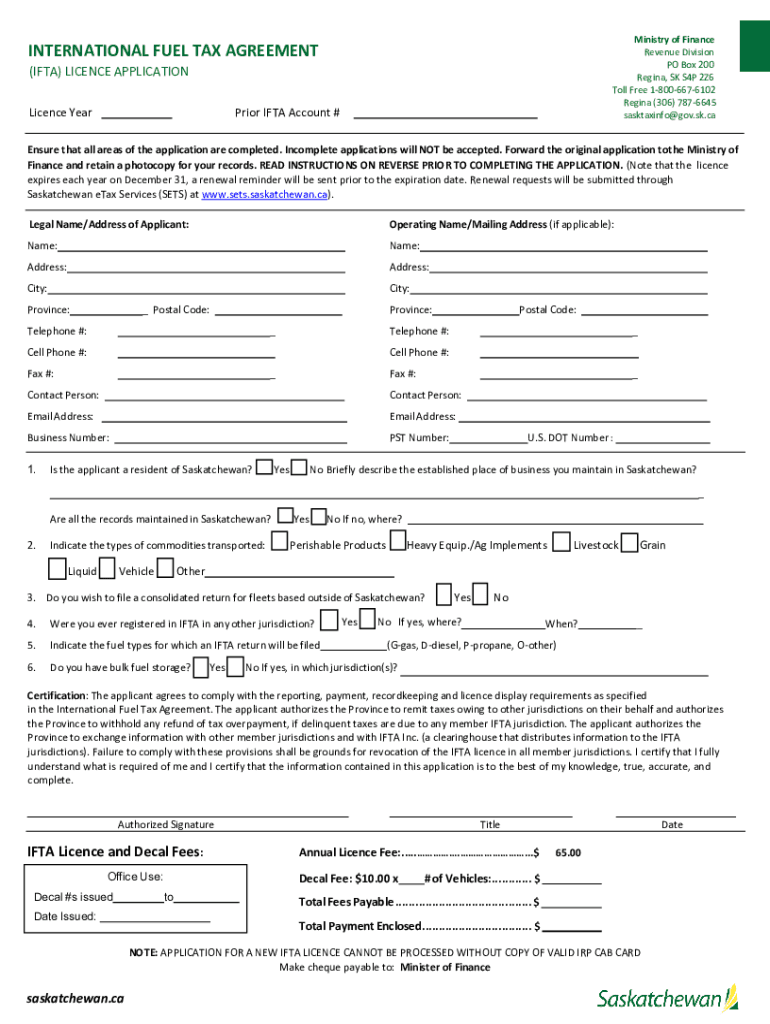







Definition and Purpose of the IFTA License Application - Publications Saskatchewan
The International Fuel Tax Agreement (IFTA) License Application is a formal document issued by the Ministry of Finance in Saskatchewan. It serves to regulate and streamline the reporting of motor fuel taxes by carriers operating in multiple jurisdictions. The application process is essential for commercial motor vehicle operators who travel across state or provincial lines, allowing them to report fuel taxes to their base jurisdiction rather than filing separately in each region. This agreement simplifies tax reporting and ensures compliance with regional fuel tax laws through a streamlined system.
Relevant Details and Use Cases
- Objective: Facilitate and simplify tax reporting for fleets operating across multiple jurisdictions.
- Scope: Applicable to qualified motor vehicles, including vehicles used for transportation of goods or passengers across state or provincial boundaries.
- Outcome: Streamlined process for managing motor fuel tax obligations.
How to Obtain the IFTA License Application - Publications Saskatchewan
To access the IFTA License Application, you can visit Publications Saskatchewan, where the Ministry of Finance provides necessary documents. The application is downloadable, ensuring easy access for applicants. It can be filled out digitally or printed and completed by hand.
Steps to Access the Application
- Visit Publications Saskatchewan: Navigate to the relevant section to find tax-related documents.
- Download the Application: Ensure you have the most current version.
- Read Instructions Carefully: Familiarize yourself with the requirements and guidelines before starting the application process.
Steps to Complete the IFTA License Application - Publications Saskatchewan
Completing the IFTA License Application involves several detailed steps to gather the necessary information and ensure accuracy. Below is a step-by-step guide:
Step-by-Step Completion Guide
- Gather Required Information: Include legal and operating names, contact information, and details about the vehicles and commodities transported.
- Fill In the Applicant Details: Accurately provide your business name, address, and contact information.
- Indicate the Type of Business: Specify whether you're operating as an LLC, corporation, or another entity type.
- Select Commodities Transported: Clearly indicate the types of commodities your fleet typically carries.
- Provide Vehicle Information: Include details about your fleet, such as number of vehicles and vehicle identification numbers.
- Calculate Fees: Review fee structures for licenses and decals, and prepare the necessary payment.
- Certification and Signature: Validate your application with an authorized signature and date.
Potential Challenges and Solutions
- Incomplete Information: Double-check all fields to prevent rejection.
- Payment Issues: Ensure funds are available for processing fees to avoid delays.
Key Elements of the IFTA License Application - Publications Saskatchewan
Understanding the key elements of the IFTA License Application is crucial for successful completion. This section outlines the core components critical to the application process.
Core Components
- Applicant Information: Business details such as name, address, and contact.
- Vehicle Details: Essential fleet information including VINs and vehicle types.
- Commodities List: Identification of goods carried by the fleet.
- Fee Payment: Information on applicable fees for licenses and decals.
- Certifications: Acknowledgment of compliance with IFTA regulations.
State-Specific Rules for the IFTA License Application
Different jurisdictions may have unique requirements for the IFTA application. This ensures alignment with local regulations and taxes.
Saskatchewan Specifics
- Provincial Regulations: Familiarize yourself with Saskatchewan's specific rules regarding vehicle operation and fuel tax obligations.
- License Renewal: Availability of renewal processes and timelines to maintain compliance.
Required Documents for the IFTA License Application
Before submitting your IFTA License Application, ensure that you have gathered all necessary documentation. This includes various records and forms required to verify information provided in the application.
Documents Checklist
- Proof of Business Registration: Valid documentation confirming your business is registered and operational.
- Vehicle Registration Papers: Ensure all vehicles in the fleet have up-to-date registration.
- Tax Compliance Records: Provide previous tax filings or any compliance-related documents.
Form Submission Methods
Once the IFTA License Application is completed, correctly submitting the form is essential for timely processing. Various submission methods are available to suit different user preferences.
Submission Options
- Online Submission: The most efficient method, often available through a designated government platform.
- Mail Submission: Fill out and send your application via traditional mail.
- In-Person Submission: Direct submission to a government office if required or preferred.
Recommendations for Submission
- Timeliness: Submit well before the deadline to ensure processing in time for required operations.
- Confirmation: Obtain acknowledgment of receipt for future reference.
Penalties for Non-Compliance with IFTA Regulations
Failure to comply with the International Fuel Tax Agreement regulations can result in significant penalties. Understanding the implications of non-compliance is critical.
Potential Consequences
- Fines and Penalties: Monetary fines for late or inaccurate submissions.
- License Suspension: Risk of suspended operations if compliance is not achieved.
- Legal Repercussions: Potential for legal action in severe cases of neglect or fraud.
Business Types That Benefit Most from the IFTA License Application
Certain businesses derive significant benefits from acquiring an IFTA license, particularly those involved in interstate operations.
Beneficial Business Types
- Trucking Companies: Especially those with operations spanning multiple states or provinces.
- Freight and Logistics Operators: Companies managing large fleets engaged in cross-border transportation.
Benefits Realized
- Simplified Tax Management: Consolidated tax reporting for all jurisdictions.
- Operational Efficiency: Streamlined processes reduce administrative burdens associated with fuel tax compliance.




