
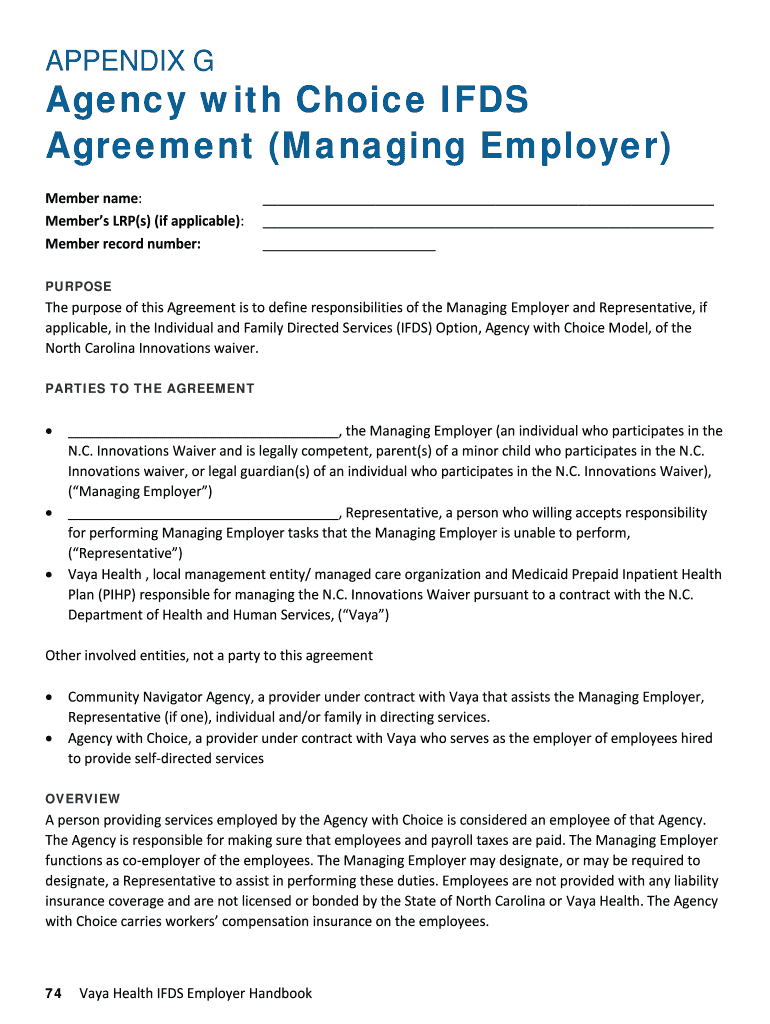







Definition & Meaning
The North Carolina agency agreement is a formal contract used to outline the responsibilities and obligations between a managing employer and a service provider. This agreement is particularly relevant in contexts where one party, referred to as the agent, represents or acts on behalf of another, known as the principal. The document serves to define the terms under which services are delivered, managed, and assessed, ensuring all parties involved are aligned with expectations and legal requirements. This agreement is vital for establishing the scope of work, clarifying roles, and providing a basis for accountability.
How to Use the North Carolina Agency Agreement
To effectively use the North Carolina agency agreement, it is crucial to begin by understanding the specific needs and requirements of both parties. Engage in comprehensive discussions to outline the terms regarding service delivery, timeframes, and performance metrics. Once an agreement is reached, both parties should carefully draft the document to include these specifics. When finalized, both the managing employer and agent should review the contents thoroughly before signing. This step ensures all aspects, such as scope of services and payment terms, are clearly understood and agreed upon.
- Ensure all parties have a copy of the signed agreement.
- Regularly review the agreement terms to ensure compliance.
- Use the document as a reference when evaluating performance or resolving disputes.
Steps to Complete the North Carolina Agency Agreement
- Identify Parties Involved: Clearly state the names and details of the principal and agent.
- Define Scope of Work: Specify services to be provided, timelines, and objectives.
- Determine Compensation: Outline payment terms, including rates, schedules, and invoicing procedures.
- Clarify Obligations: Detail the responsibilities and expectations of each party.
- Address Termination Conditions: Include terms for ending the agreement, such as notice periods and acceptable reasons for termination.
- Incorporate Legal Clauses: Ensure compliance with applicable laws and regulations by including legally required clauses.
- Sign and Date: Both parties must sign and date the agreement to make it legally binding.
Key Elements of the North Carolina Agency Agreement
The North Carolina agency agreement typically includes several critical components to ensure clarity and enforceability:
- Introduction: Defines the purpose of the agreement and the parties involved.
- Duties and Responsibilities: Lists specific tasks the agent will perform and the principal’s obligations.
- Compensation and Payment Terms: Details the payment structure, including amounts, conversion methods, and frequency.
- Confidentiality: Ensures proprietary or sensitive information shared between parties remains protected.
- Liability and Indemnification: Outlines liability terms, protecting parties from undue risk.
- Dispute Resolution: Specifies how to handle conflicts that arise during the agreement's term.
Legal Use of the North Carolina Agency Agreement
When drafting a North Carolina agency agreement, adherence to state laws and regulations is imperative. The agreement must comply with relevant legal statutes governing agency relationships:
- Compliance with State Laws: Ensure that provisions align with North Carolina statutes related to employment and agency law.
- Regulatory Considerations: If applicable, consider industry-specific regulations to avoid operational or legal complications.
Legal professionals typically recommend reviewing the agreement to confirm conformity with all relevant legal requirements, thereby minimizing risks of disputes or claims.
State-Specific Rules for the North Carolina Agency Agreement
North Carolina has unique regulations that influence the formation and interpretation of agency agreements:
- Contract Law: General principles applied nationwide may have specific interpretations within North Carolina.
- Industry-Specific Provisions: Some sectors may have additional requirements or customary practices unique to the state.
Parties should be aware of these factors and consider consulting with a legal expert familiar with North Carolina law to ensure compliance.
Examples of Using the North Carolina Agency Agreement
North Carolina agency agreements are commonly used in various settings, including:
- Real Estate: Where agents represent buyers or sellers in property transactions.
- Health Care Services: For collaborations between health care providers and patients or practitioners.
- Marketing and Advertising: In cases where agencies handle promotional activities for businesses.
In each case, the agreement serves to clarify the scope, responsibilities, and expectations, minimizing potential disputes.
Digital vs. Paper Version
The North Carolina agency agreement can be managed effectively in both digital and paper formats, depending on user preference:
- Digital Version: Offers ease of access, editing, and sharing. Ideal for tech-savvy users or teams that require remote collaboration.
- Paper Version: Necessary if digital resources are limited or when legal requirements stipulate physical copies.
DocHub, with its comprehensive suite of document management tools, offers capabilities to handle both formats, ensuring whichever version you use is secure and easily accessible.




