
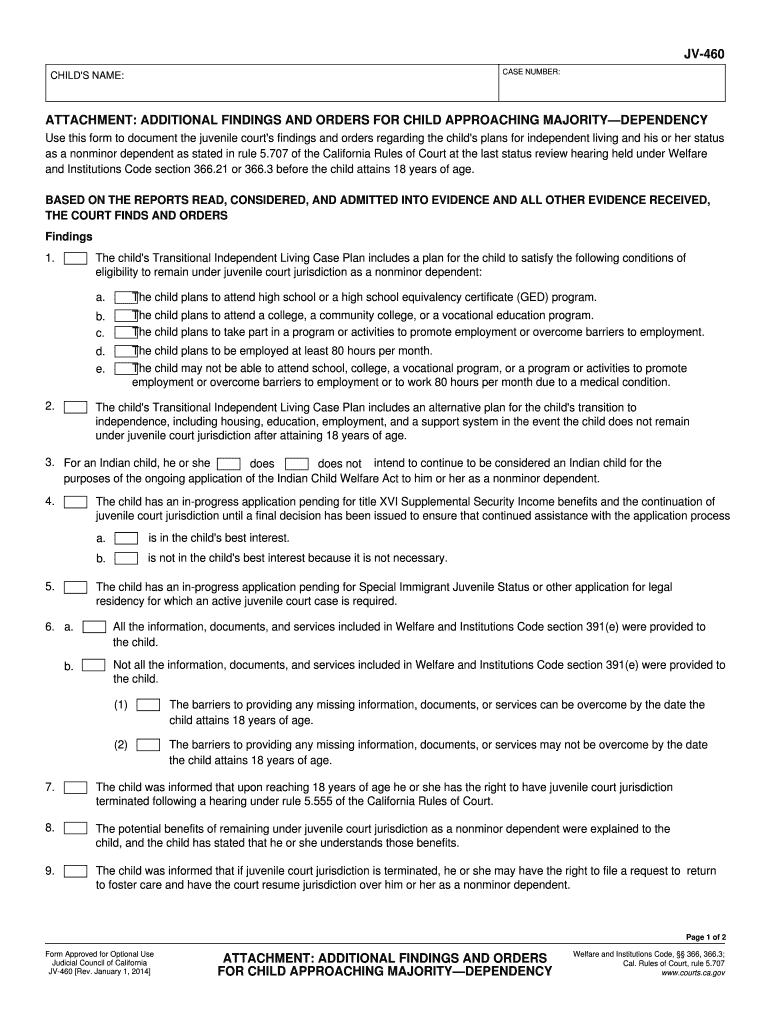







Definition and Purpose of JV-460
The JV-460 form is a critical document used within the juvenile court system, detailing the court's findings and orders concerning a child's plans for independent living as they near adulthood. This form is pivotal in outlining a child's Transitional Independent Living Case Plan, determining their ongoing eligibility to remain under juvenile court jurisdiction as a nonminor dependent. It also addresses various pending applications for benefits or legal residency, thereby serving as a comprehensive guide to a child’s legal standing and pathways as they approach independence.
How to Use the JV-460 Form
To effectively use the JV-460 form, it is essential for parties involved, such as social workers, legal representatives, and foster care providers, to understand each section's significance. The form should be meticulously filled out to reflect the child's current scenario and future plans. Start by gathering all relevant information about the child's case, including court orders and any benefit applications. Ensure that all sections are accurately completed to provide a holistic view of the child's case for the court's consideration.
Steps to Complete the JV-460 Form
-
Review the Form: Begin by thoroughly reading each section of the JV-460 to understand the information requested by the juvenile court.
-
Gather Required Information: Compile essential details such as the child's living arrangements, educational status, employment history, and any pertinent benefit applications.
-
Fill in the Form Sections: Complete each section carefully, ensuring that all information is accurate and up-to-date.
-
Consult with Relevant Parties: Engage with the child’s legal guardian, social workers, and other stakeholders to verify the information provided and gather additional insights.
-
Submit the Form: Once the form is complete and reviewed, submit it to the juvenile court as per the court's submission guidelines.
Legal Use and Importance of JV-460
Legally, the JV-460 form plays a vital role in ensuring that a child's rights and future plans are appropriately represented within the juvenile court system. The form provides a legal framework under which a child's transition into adulthood is monitored, facilitated, and supported by the court. It ensures compliance with legal standards, helping maintain the child’s eligibility for benefits and legal protections as they transition to independent living.
Key Elements of the JV-460 Form
- Transitional Independent Living Case Plan: Details the specific steps and measures in place to support the child’s transition to independent living.
- Eligibility Conditions: Outlines criteria required for the child to remain under juvenile court jurisdiction.
- Benefit Applications: Lists any pending applications for benefits or legal residency that may impact the child's status.
- Rights Upon Reaching Adulthood: Informs the child of their legal rights once they turn eighteen.
- Court Hearings: Establishes scheduled court hearings based on the child's chosen actions regarding their legal status.
Important Terms Related to JV-460
- Nonminor Dependent: Refers to a person over the age of eighteen who remains under juvenile court jurisdiction.
- Transitional Independent Living Plan (TILP): A personalized plan designed to guide the dependent’s transition to adulthood.
- Benefit Entitlements: Various legal claims or allowances the child may be entitled to as they approach their eighteenth birthday.
- Jurisdiction: The legal authority the juvenile court holds over the child’s case.
Who Typically Uses the JV-460 Form
The JV-460 is primarily utilized by social workers, legal representatives, foster care agencies, and the juvenile court itself. These stakeholders collaborate to ensure the child’s transition to adulthood is well-documented, legally compliant, and supported by appropriate plans and resources. This form is particularly crucial for children who are in foster care or are wards of the state, providing a structured pathway as they become independent adults.


State-Specific Rules for JV-460
While the JV-460 form is fundamentally consistent across jurisdictions, specific state laws and rules may influence its application and interpretation. For instance, eligibility criteria for remaining under juvenile court jurisdiction may vary, and certain benefits might be more accessible in some states than others. Therefore, it is important for those involved in the case to be aware of any state-specific regulations that might affect the completion and submission of the form.
Examples of Using the JV-460 Form
Consider a 17-year-old in foster care nearing their eighteenth birthday. The JV-460 form would be used to outline their independent living plan, ensuring they have access to necessary educational and housing resources. If the child applies for financial aid to attend college, this application would be noted in the form to ensure continued support. Regular reviews and updates to the form may occur as the child's situation and plans evolve, demonstrating the dynamic and vital role of the JV-460 in the juvenile court system under these circumstances.


