




01. Edit your form online
Type text, add images, blackout confidential details, add comments, highlights and more.

Type text, add images, blackout confidential details, add comments, highlights and more.

Draw your signature, type it, upload its image, or use your mobile device as a signature pad.

Send it via email, link, or fax. You can also download it, export it or print it out.
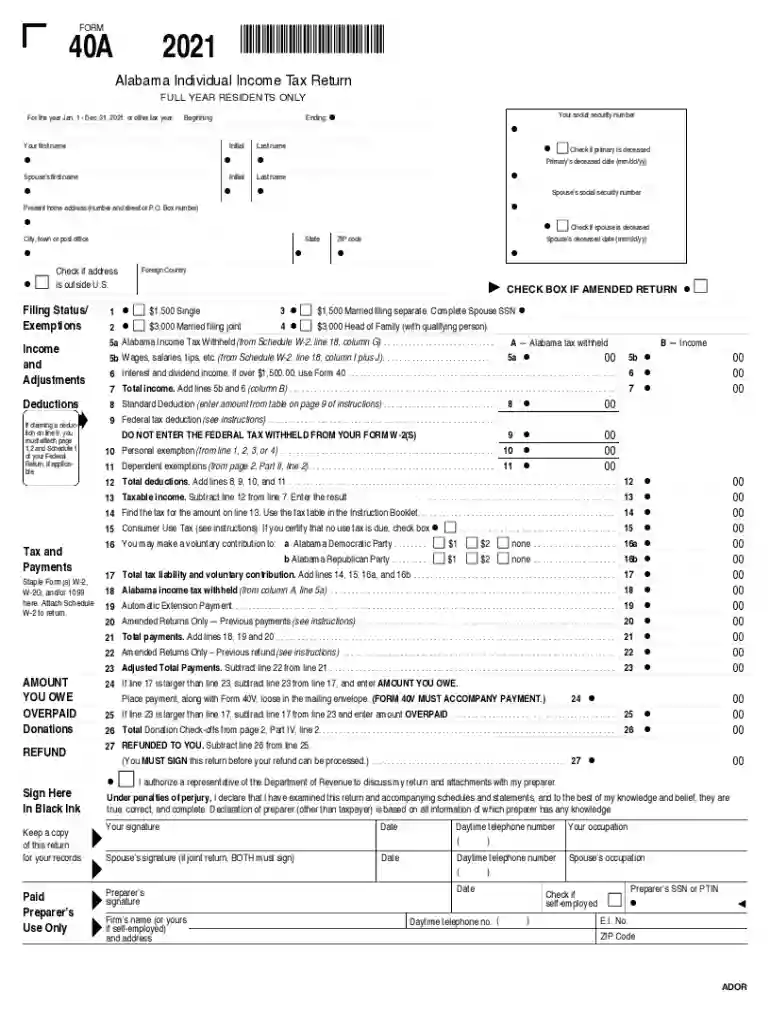
The Alabama Individual Income Tax Return, officially known as Form 40A, is a state-mandated document that full-year residents of Alabama use to report their annual income, calculate their tax liability, and determine any refund due or payment owed for the tax year. This form is essential for ensuring compliance with the state's tax laws and for contributing to public funds that finance state services and infrastructure. Taxpayers must provide detailed information about their income sources and any applicable deductions or credits.
Completing the Alabama Individual Income Tax Return requires careful attention to details and adherence to the following steps:
Obtaining Form 40A is straightforward and can be done through several methods:
The form is available in digital format to integrate with popular tax preparation software platforms, streamlining its completion and submission process.
Submitting a complete tax return requires an assembly of various documents which facilitate accurate reporting:
Understanding key terminology enhances the accuracy of filing and ensures compliance:
Consider a scenario where a taxpayer is deciding between itemized deductions and a standard deduction. If itemizing provides greater deductions, it may reduce taxable income more effectively than the standard deduction, though it requires substantiation through receipts.
The Alabama Individual Income Tax Return accommodates both digital and traditional paper submissions, each with distinct characteristics:
Timely submission of the Alabama Individual Income Tax Return is crucial:
Failure to submit returns by the deadline can result in penalties, emphasizing the importance of planning and preparation.
Non-compliance with Alabama's tax regulations can have severe consequences:
Taxpayers facing financial hardship are advised to contact the Alabama Department of Revenue to discuss payment plans or other assistance options, minimizing penalties and interest.
We've got more versions of the alabama individual income tax return form. Select the right alabama individual income tax return version from the list and start editing it straight away!
At DocHub, your data security is our priority. We follow HIPAA, SOC2, GDPR, and other standards, so you can work on your documents with confidence.
Apr 15, 2026 Visit the Alabama Department of Revenue website to view Individual Income Tax Forms and instructions. If you have previously filed anRead more
Sep 16, 2013 This revenue procedure provides domestic asset/liability per- centages and domestic investment yields needed by foreign life insurance companiesRead more
The legislature to levy and collect taxes on taxable, individual income at a rate not to exceed 5 percent. It further provides for minimum personal exemptions.Read more


