







Definition & Meaning
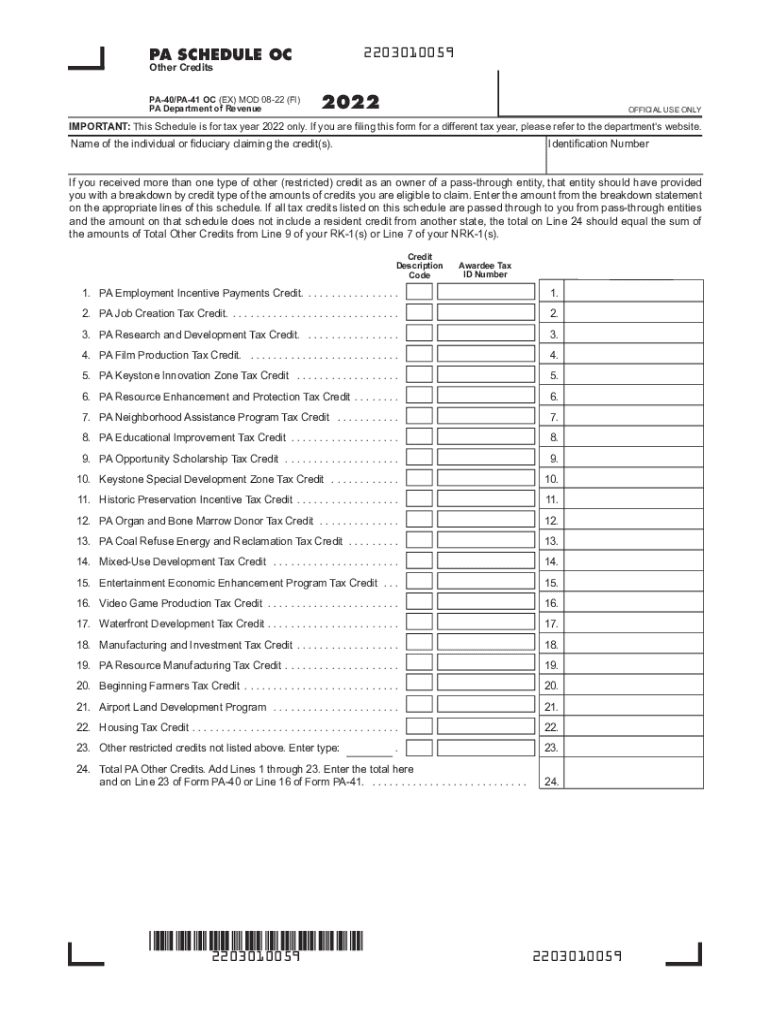
PA Schedule OC - Other Credits (PA-40 PA-41 OC) refers to a tax form used by individuals and fiduciaries in Pennsylvania to claim a variety of state-specific tax credits. This form is integral for residents and entities within the state, as it allows them to reduce their tax liabilities by taking advantage of available credit opportunities. The form encompasses credits applicable for different scenarios, offering financial benefits and incentives for complying with state tax provisions.
Key Elements of the Form
- Identification Information: Key personal or entity information, such as name, Social Security Number (SSN) or Employer Identification Number (EIN), and address, must be provided accurately.
- Credit Descriptions: Detailed descriptions of available credits, ensuring taxpayers understand eligibility criteria and how to qualify.
- Filing Type: Specification of whether the credits are filed individually, jointly, or as a fiduciary, impacting the form's processing and approval.
How to Use the PA Schedule OC - Other Credits (PA-40 PA-41 OC)
To use the PA Schedule OC effectively, you need to understand the credits that apply to your situation and gather necessary documentation. Begin by assessing each credit's eligibility criteria and compare these with your financial and tax contexts. This form is primarily used after determining eligibility for listed credits, helping to strategically reduce tax burdens.
Steps to Complete the Form
- Gather Necessary Documents: Before filling out the form, collect documents that support credit claims, such as income statements, receipts, and prior tax returns.
- Read Instructions Thoroughly: Each credit often has unique requirements, so reading the instructions is critical to avoid errors.
- Fill Out Identification Details: Enter identification details with precision to ensure the filing is processed without delays.
- Select Applicable Credits: Choose eligible credits and fill out requisite details about each claim.
- Review and Submit: Carefully review the form for accuracy before submission to prevent errors that could delay processing.
Eligibility Criteria
Eligibility to use the PA Schedule OC is determined by specific conditions related to each credit. Most credits require meeting certain income levels, engaging in specific economic activities, or residing in targeted areas. By meeting these criteria, individuals and entities can lawfully reduce taxable income figures, potentially leading to substantial savings.


Common Eligibility Requirements
- Income Thresholds: Credits might be contingent upon having an income beneath or within specific limits.
- Residency Requirements: Some credits are available only to full-time residents of Pennsylvania.
- Activity-Based Criteria: Eligibility may stem from engaging in economic or community activities defined by the state.
Filing Deadlines / Important Dates
Filing the PA Schedule OC adheres to Pennsylvania's individual or fiduciary return deadlines. Typically, these forms and related tax documents must be submitted by April 15 for timely processing. Early submission ensures ample time for any necessary corrections and adherence to legal obligations.
Important Deadlines
- Standard Submission Deadline: April 15, aligning with the federal tax filing deadline.
- Extension Filing: If an extension is granted, the new deadline typically falls on October 15.
Who Typically Uses the PA Schedule OC - Other Credits (PA-40 PA-41 OC)
Primarily, this form is used by Pennsylvania residents and entities qualified for state tax credits. This includes individuals, families, and businesses looking to take advantage of eligible reductions in their state tax liabilities.

Typical Users
- Individuals: Single filers or heads of households meeting credit eligibility.
- Fiduciaries: Trusts and estates that qualify under Pennsylvania tax law.
- Joint Filers: Married individuals choosing to file jointly can use the form to maximize credit benefits.
Penalties for Non-Compliance
Non-compliance, such as failing to file the PA Schedule OC by the deadline or misreporting information, can lead to penalties imposed by the Pennsylvania Department of Revenue. These penalties may include interest on unpaid taxes, late filing fees, and possible denial of claimed credits.
Common Consequences
- Interest Accumulation: Unpaid taxes incur interest, increasing overall liabilities.
- Late Filing Fees: Additional charges apply for submissions past the deadline.
- Potential Audits: Inaccuracies or non-compliance may trigger audits by the state’s tax authority.
Form Submission Methods (Online / Mail / In-Person)
The PA Schedule OC can be submitted through various channels, providing flexibility to taxpayers. Depending on preference and convenience, you can choose electronic filing for faster processing or traditional mail for a physical submission route.
Submission Options
- Online: Electronic filing via Pennsylvania’s online tax platform offers quick confirmation of receipt and processing.
- Mail: Traditional mailing involves sending completed forms to specified addresses for manual processing.
- In-Person: Direct submission at designated tax offices is sometimes available for those preferring personal delivery.
Software Compatibility (TurboTax, QuickBooks, etc.)
Many popular tax software suites support the PA Schedule OC, ensuring easy integration into comprehensive tax filing systems. Programs like TurboTax, QuickBooks, and other state-compliant software streamline completing and submitting this form, minimizing error risks and enhancing overall filing efficiency.
Supported Software
- TurboTax: Direct entry of credit information into the PA Schedule OC form interface.
- QuickBooks: Synchronizes financial data to automate input fields and calculate credits accurately.
- State Approved Systems: Other state-approved software can be used, simplifying compliance and submission processes.




