




01. Edit your rev 1630 online
Type text, add images, blackout confidential details, add comments, highlights and more.

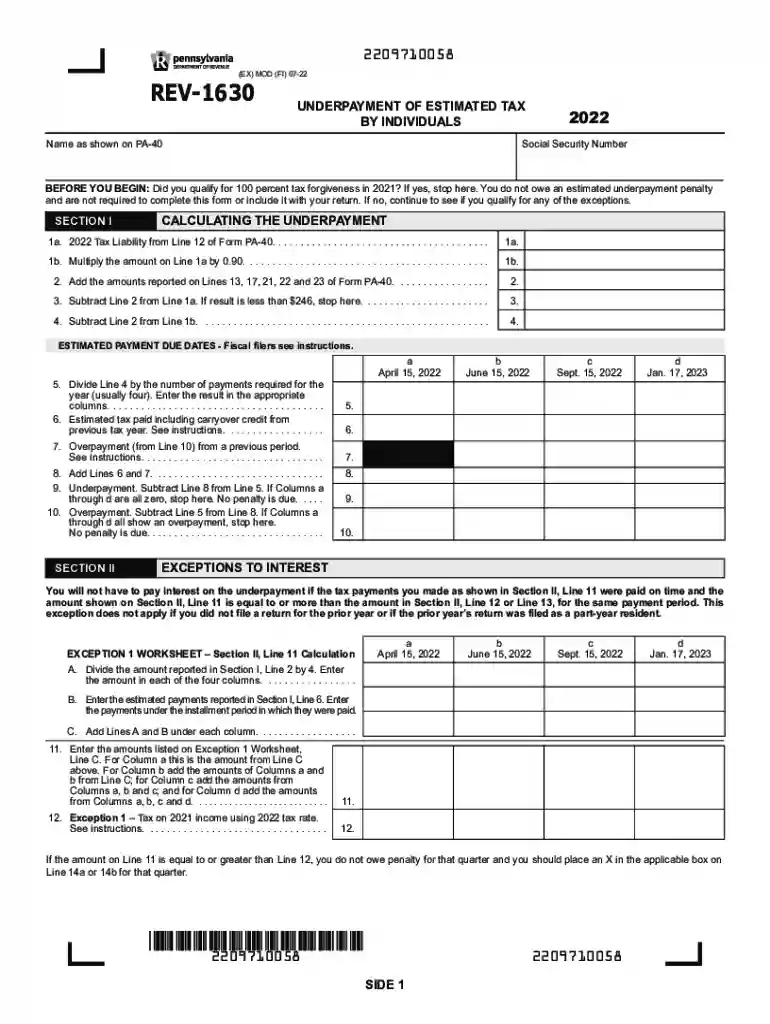
Type text, add images, blackout confidential details, add comments, highlights and more.

Draw your signature, type it, upload its image, or use your mobile device as a signature pad.

Send pa rev 1630 via email, link, or fax. You can also download it, export it or print it out.
The "2022 Underpayment of Estimated Tax by Individuals (REV-1630)" form is a critical document for assessing any underpayment of estimated tax by individuals within Pennsylvania. It guides taxpayers in calculating their tax liability accurately to determine if they owe penalties for inadequate estimated tax payments throughout the year. This process involves evaluating estimated payments against actual tax liabilities and involves understanding any exceptions that may apply to interest penalties.
Completing the REV-1630 form requires a systematic approach to ensure accurate reporting and compliance:
Gather Financial Information: Collect all necessary tax-related documentation, including income records, previous year's tax returns, and estimated tax payment receipts.
Calculate Estimated Payments: Review the quarters for which estimated tax payments were made, and document amounts paid in each period.
Determine Total Tax Liability: Use income records and tax laws to calculate your total tax liability for the year and compare it to your estimated payments.
Identify Underpayment: Calculate if any underpayment exists by deducting estimated payments from total tax liability.
Apply Applicable Exceptions: Determine if your situation qualifies for any exceptions to interest penalties, such as utilizing prior year tax forgiveness.
Complete Form Fields: Accurately fill in the required fields on the REV-1630 form according to the instructions provided.
Review and Submit: Double-check the completed form for accuracy before submission, ensuring that all calculations and fields are correctly filled.
Using the REV-1630 form is essential for several reasons:
Compliance with Tax Laws: It ensures adherence to Pennsylvania tax regulations, avoiding penalties and interest due to underpayment.
Accurate Financial Reporting: For individuals, accurate tax filing reflects a clear picture of financial obligations and tax responsibilities.
Avoidance of Penalties: Proper completion of the form can identify applicable exceptions to mitigate potential penalties.
Self-Assessment of Estimated Taxes: It allows taxpayers to self-evaluate their tax liabilities and adjust estimated payments for future quarters.
Individuals most likely to need the REV-1630 form include:
Self-Employed Individuals: Those with variable income streams who make quarterly estimated payments.
Retirees: Individuals with retirement income not subjected to withholding and who rely on estimated tax payments.
Business Owners: Sole proprietors and single-member LLCs with irregular income.
Investors: Those who earn significant income from dividends or capital gains may benefit from calculating estimated tax liabilities.


Understanding the filing and deadline requirements is crucial:
Estimated Payment Due Dates: Typically due on the 15th of April, June, September, and January, coinciding with the quarterly calendar.
Annual Tax Deadline: Typically April 15th of the following year, unless extended.
Due Date for Filing REV-1630: Generally aligns with the annual tax filing deadline, but can vary based on state extensions or unique circumstances.
Failure to comply with the requirements of the REV-1630 form can result in:
Interest Penalties: Accrued on late payments that are computed from the date estimated payments were due.
Monetary Fines: Potential fines depending on the level of underpayment or other compliance issues.
Possible Legal Action: In severe cases, persistent non-compliance may result in legal consequences.
The REV-1630 form can be completed either digitally or through traditional paper submission:
Digital Version: Many prefer online submission owing to speed, convenience, and integration with tax software platforms.
Paper Submission: Traditional filing, although less common, remains an option for those without access to digital resources.
The REV-1630 form is compatible with several tax software applications that facilitate easy completion and submission:
TurboTax and QuickBooks: Integrate seamlessly with the form, offering step-by-step guidance for accurate filing.
Other Tax Software: Programs supporting state-specific forms and estimated tax calculations often accommodate the REV-1630 form.
Understanding crucial terminology within the context of the REV-1630 form is critical:
Estimated Tax Payments: Quarterly payments made to fulfill current tax obligations based on projected earnings.
Tax Liability: The entire amount owed to tax authorities after all deductions and credits.
Exceptional Circumstances: Situations where penalties may be waived or reduced due to specific criteria being met.
These blocks provide comprehensive information needed to understand and utilize the "2022 Underpayment of Estimated Tax by Individuals (REV-1630). Forms/Publications" effectively.
We've got more versions of the rev 1630 form. Select the right rev 1630 version from the list and start editing it straight away!
At DocHub, your data security is our priority. We follow HIPAA, SOC2, GDPR, and other standards, so you can work on your documents with confidence.
Important: To avoid the 5 percent per month underpayment penalty, the amendment must be made on the quarterly return for the period of the under remittance.Read more
If you prefer to pay estimated tax rather than having tax on other income withheld from your paycheck, see Form 1040-ES, Estimated Tax for Individuals. StepRead more
Estimated Tax Penalty (Topic No. 306 Penalty for Underpayment of Forms 1040A and 1040EZ were discontinued beginning in 2018. TAX RATES. Individual TaxRead more


