
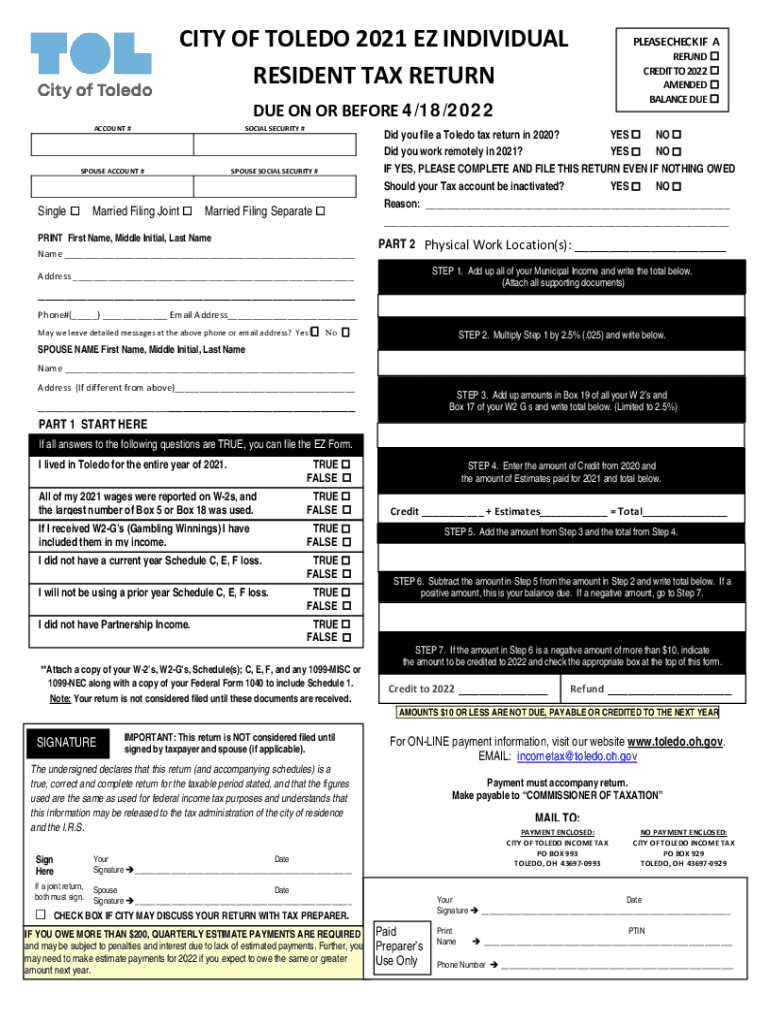







Definition & Meaning of Individual Resident Tax Return
An individual resident tax return is a document used by residents of a particular jurisdiction, such as a city or town, to report their income and calculate the municipal tax they owe for a specific tax year. Unlike federal or state tax returns, these forms are designed primarily for local taxation purposes. They typically include sections for personal information, detailed income sources, tax credits, and deductions available under local laws. Completing this form ensures compliance with local tax obligations and can sometimes result in a refund if overpayments have been made.
Practical Example
Consider a resident of Toledo, Ohio, who needs to file a 2021 individual resident tax return. The form requires them to declare their total earnings, list any eligible deductions, and compute the local tax amount owed. This process allows the city to collect necessary funds for public services while ensuring taxpayer transparency.
Steps to Complete the Individual Resident Tax Return
-
Gather Required Documents:
- Collect all necessary tax documents, including W-2s, 1099s, and any other income records.
- Ensure access to relevant documents, such as proof of residency and deduction evidence.
-
Fill in Personal Details:
- Start by entering your full name, address, and Social Security Number.
- Confirm residency status for the tax year in question.
-
Report Income:
- Enter all sources of income, including wages, interest, and dividends.
- Use supporting documents to ensure accuracy.
-
Calculate Deductions and Credits:
- List any local deductions or credits applicable to your situation.
- Common deductions include property taxes or specific resident-only benefits.
-
Determine Tax Owed or Refund:
- Calculate the total tax liability using the local tax rates.
- Subtract any credits to find the final amount owed or due as a refund.
-
Review Form for Accuracy:
- Double-check all entries for errors or omissions.
- Ensure all necessary fields are filled and correctly completed.
Potential Challenges
Errors in calculations or missing documentation can lead to delays or penalties. Cross-verification with initial income documents is crucial to avoid such issues.
Who Typically Uses the Individual Resident Tax Return
Primarily, individual resident tax returns are utilized by:
- Residents of Municipalities: Those living in cities that impose local income taxes have a legal requirement to file these returns.
- New Residents: Individuals who have recently relocated to a city during a tax year may need to file for partial-year residency.
- Retirees and Students: Both groups often have particular income sources that need accurate reporting for compliance.


Edge Cases
In some cases, non-residents earning income within the municipality may also be required to file. Understanding the local laws would be essential for these cases.
Required Documents for Filing
-
Income Verification:
- W-2 forms for wage earnings.
- 1099 forms for freelance or contract work.
-
Proof of Residency:
- Utility bills or rental agreements.
- Confirmation of a permanent address within the jurisdiction.
-
Deduction Records:
- Receipts for paid property taxes.
- Education expenses if applicable.
Variations and Exceptions
The types of accepted documents may vary by city, so it's important to consult local guidelines or reach out to the relevant municipal authority.
Form Submission Methods: Online, Mail, In-Person
-
Online Submission:
- Many municipalities offer online portals where residents can complete and submit their tax returns digitally, ensuring fast and secure processing.
-
Mail Submission:
- Traditional paper filing is still an option, often requiring postmarks by a certain deadline.
- Forms must be mailed to the appropriate city tax office.
-
In-Person Submission:
- Some cities allow in-person submission at designated municipal buildings, often providing personal assistance if required.
Digital vs. Paper Version
The choice between digital and paper submissions may influence processing times and convenience. Online systems typically feature automated checks for missing information.
Filing Deadlines / Important Dates
-
Annual Filing Deadline:
- Similar to federal deadlines, most municipalities require returns to be submitted by April 15 of each year.
-
Extension Requests:
- Extensions may be requested, but they often require submission of a preliminary form prior to the original deadline.
Consequences of Late Filing
Missing key dates can result in penalties or interest on overdue taxes, making it crucial for taxpayers to note these deadlines well in advance.
Taxpayer Scenarios: Self-Employed, Retired, Students
-
Self-Employed:
- Need to account for diverse income streams and potentially pay estimated quarterly taxes to avoid penalties.
-
Retired Individuals:
- Must account for pension earnings and Social Security, which may be subject to local taxes.
-
Students:
- Should consider part-time job earnings and any education-related deductions available on the local level.

Common Misunderstandings
Misreporting earnings from side jobs or misunderstandings about retirement income can lead to errors. Ensuring clear documentation and understanding of obligations is essential.
Common Legal Uses and Misuses
Legal Use
Filing the individual resident tax return correctly ensures lawful compliance with local regulations and contributes to community resources through tax contributions.
Misuse Consequences
Submitting false information, whether intentionally or by negligence, can lead to investigations and penalties, emphasizing the importance of accuracy and honesty in reporting.
Software Compatibility: TurboTax, QuickBooks, etc.
-
TurboTax:
- Offers support for many local returns, streamlining the process with guided steps tailored to specific municipal requirements.
-
QuickBooks:
- Can assist business owners in tracking income and expenses, preparing for accurate reporting.
-
Additional Tax Software:
- Other platforms may support local filing, but verifying compatibility for city-specific forms is crucial.
Benefits
Using compatible software simplifies the filing process, ensures compliance, and helps prevent errors that can result from manual entry.
Eligibility Criteria
Eligibility to file typically includes:
- Residing within the taxed jurisdiction for more than half of the tax year.
- Earning above a specific income threshold, often outlined by local laws.

Special Considerations
Certain exemptions or modified criteria may exist for active military members or temporary workers. Reviewing local regulations is advisable for clarity.




