







Definition & Meaning
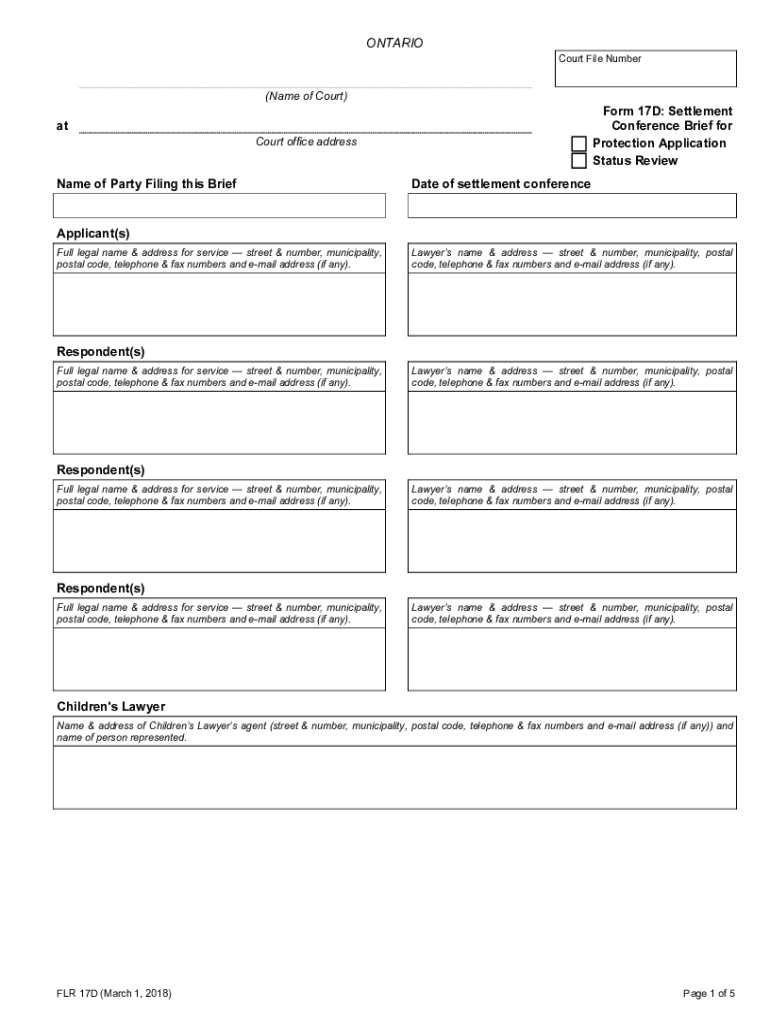
The "Court File Number - Form 17D: Settlement Conference Brief" is a legal document primarily used in Ontario for cases involving children's welfare. It is part of the procedures dealing with Protection Applications or Status Reviews. The primary objective is to facilitate settlement discussions in court, ensuring all relevant information related to the children involved is organized and presented for review. It includes sections that identify outstanding issues, detail procedural matters, and document offers to settle.
Steps to Complete the Court File Number - Form 17D: Settlement Conference Brief
-
Basic Information: Start by filling in the court file number and details of the parties involved. The names, addresses, and roles of each party, such as guardians or legal representatives, should be clearly indicated.
-
Child's Information: Provide comprehensive details about the child or children involved, including names, ages, and current living arrangements. This section helps the court understand the child's circumstances.
-
Outstanding Issues: Clearly outline any unresolved issues that require court intervention. This may cover aspects such as custody, visitation rights, or parental responsibilities.
-
Procedural Matters: Note any procedural nuances or requirements specific to the case. This might include upcoming court dates or previous judicial orders affecting the case.
-
Offers to Settle: Document any offers to settle made by the parties involved. This section is crucial for showing a willingness to negotiate and resolve disputes without further litigation.
Key Elements of the Court File Number - Form 17D
- Party Information: Essential for identifying all stakeholders.
- Living Situation of the Child: This affects judgments related to welfare.
- Unresolved Issues: Highlighting these guides court focus.
- Proposals for Settlement: Shows efforts towards amicable resolution.
Each element ensures the court has a comprehensive view of the situation to make informed decisions.
Who Typically Uses the Court File Number - Form 17D
This form is primarily used by legal practitioners, family courts, and involved parties in child welfare cases. Lawyers representing either side fill out the brief to prepare for settlement conferences. Additionally, family members or guardians involved in the child's life might engage with the document to provide necessary information or perspectives related to the case. It ensures that each party's stance is clearly outlined and considered during legal proceedings.


Legal Use of the Court File Number - Form 17D
The legal significance of Form 17D lies in its role in structuring pre-trial negotiations. It serves as a platform for parties to express concerns and propose resolutions. The form facilitates transparency in the negotiation process, helping the court identify areas where the parties may agree or require further adjudication. Proper use of this form is integral in ensuring that deliberations during the settlement conference are efficient and effective.
Important Terms Related to Court File Number - Form 17D
- Settlement Conference: A meeting in which parties attempt to resolve issues outside of court.
- Protection Application: A request to the court to address child safety.
- Status Review: Periodic assessment of a child's living conditions and welfare.
Understanding these terms is crucial for correctly completing and utilizing the form.
Examples of Using the Court File Number - Form 17D
- Scenario 1: A family undergoing a custody dispute fills out Form 17D to outline their preferred terms of custody, visitation, and child support.
- Scenario 2: A guardian requests a status review to update the court on improvements in a child’s living situation, arguing against previously imposed restrictions.
These scenarios highlight the document's utility in diverse child welfare contexts.
State-Specific Rules for the Court File Number - Form 17D
While Form 17D is used in Ontario, it's important for users in the United States to be familiar with analogous state-specific forms if similar proceedings unfold. For instance, different states might have variants for child protection applications or standardized guidelines around custody and settlement conference documents. Consulting local legal experts will ensure compliance with regional laws.




