
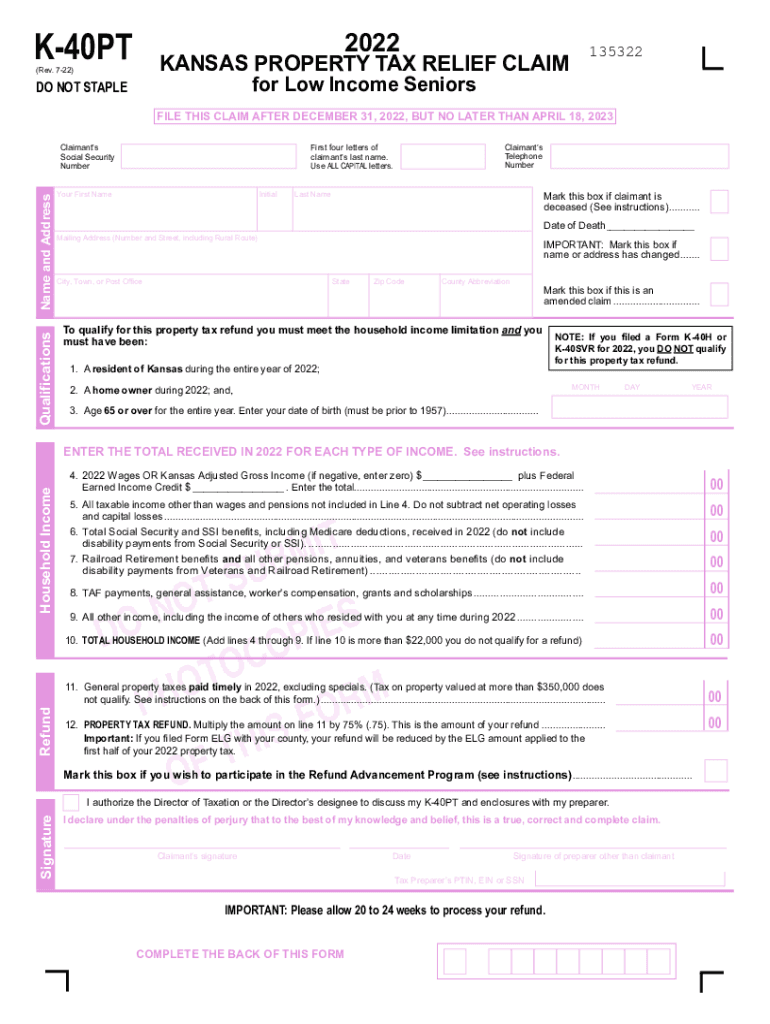







Definition & Meaning
Form K-40PT, known as the Kansas Property Tax Relief Claim for Low Income Seniors, is designed to assist eligible homeowners aged 65 and over in Kansas. This form allows applicants to claim a property tax refund based on their household income, offering financial relief for seniors with limited resources. The objective is to ensure that low-income seniors have the means to manage their property tax obligations, thereby reducing the financial burden on this vulnerable demographic.
Eligibility Criteria
To qualify for the Form K-40PT, applicants must meet specific criteria. Primarily, the claimant must be a Kansas resident aged 65 or older. In addition, there are income limits that must not be exceeded, as the program targets low-income seniors. The criteria also require the property to be owner-occupied and serve as the primary residence. Understanding these criteria is crucial, as they directly determine the eligibility for receiving tax relief.
- Age Requirement: 65 years or older.
- Residency: Must be a Kansas resident.
- Income Limit: Household income must fall below a specified threshold.
- Property Type: Owner-occupied, primary residence.


Required Documents
When applying for the Form K-40PT, applicants need to gather various documentation to complete their claim accurately. These documents play a pivotal role in verifying eligibility and ensuring the application process proceeds smoothly.
- Proof of Age: Birth certificate or government ID.
- Proof of Income: Tax returns, Social Security statements, or pension details.
- Property Documents: Deed or tax statement indicating homeownership.
- Residency Proof: Utility bills or official correspondence proving residency.
Steps to Complete the K-40PT
Completing the Form K-40PT involves several detailed steps. Each step must be meticulously followed to ensure the application's accuracy.
- Collect Necessary Documents: Gather all required documentation before starting the form.
- Fill Personal Information: Enter personal details such as name, address, and Social Security number.
- Provide Income Details: List income sources and amounts to verify eligibility.
- Complete Property Information: Describe the property and attach relevant documents.
- Review and Sign: Double-check entries for accuracy and sign the form.
- Submit: Send the completed form via the preferred submission method.
Filing Deadlines / Important Dates
Understanding the filing deadlines for the K-40PT is essential to ensure the claim is processed timely. Missing these dates can result in denied relief.
- Regular Filing Deadline: The deadline is typically April 15th, in alignment with federal tax filing dates.
- Extension Information: Extensions may be available under specific circumstances, but must be requested ahead of deadline.
- Notification of Approval: Applicants can expect to hear back within 30 to 45 days after submission, barring any complications that might delay processing.
Form Submission Methods
Applicants can submit the K-40PT through multiple channels, offering flexibility to cater to individual preferences and capabilities.
- Online Submission: Forms can be submitted through the Kansas Department of Revenue website.
- Mail: Hard copies can be mailed to the designated state address.
- In-Person: Applications can also be delivered directly to authorized state offices.
Application Process & Approval Time
The process for applying and receiving approval for the Form K-40PT involves several stages:
- Submission: Ensure all information is complete and accurate.
- Verification: State authorities will review the application and documents.
- Approval Notification: Confirmation and details of the relief will be sent to the applicant.
- Processing Time: Typically takes between four to six weeks to receive confirmation of approval.
Taxpayer Scenarios
The K-40PT form is applicable in various taxpayer scenarios, providing relief to a broad segment of the senior population in Kansas.
- Retired Individuals: Seniors relying on fixed incomes such as Social Security or pensions.
- Disabled Seniors: Additional considerations may apply for individuals with disabilities.
- Homeowners with Limited Resources: Those who own their homes but have limited disposable income.

Examples of Using the Form K-40PT
Using real-world examples can help illustrate the utility of the K-40PT.
- Case Study 1: A 70-year-old widow with an annual income of $18,000 could significantly reduce her financial strain by receiving a tax refund based on her limited income.
- Case Study 2: A retired couple residing in Kansas, living off Social Security and modest savings, uses the form to alleviate yearly property tax pressures.
State-Specific Rules
Specific Kansas regulations govern the use of the Form K-40PT, integrating unique state laws into the application and processing stages.
- State-Specific Income Limits: Kansas sets specific income thresholds aligned with this relief program.
- Property Tax Caps: Certain limitations might apply to the benefit amount depending on the property value.
Penalties for Non-Compliance
Applicants need to be aware of potential penalties related to the form.
- Inaccurate Submissions: Providing false information can lead to fines or denial of future claims.
- Failure to Meet Deadlines: Missing submission deadlines can disqualify an applicant from receiving tax relief, underscoring the importance of timely filing.




