




01. Edit your form online
Type text, add images, blackout confidential details, add comments, highlights and more.

Type text, add images, blackout confidential details, add comments, highlights and more.

Draw your signature, type it, upload its image, or use your mobile device as a signature pad.

Send it via email, link, or fax. You can also download it, export it or print it out.
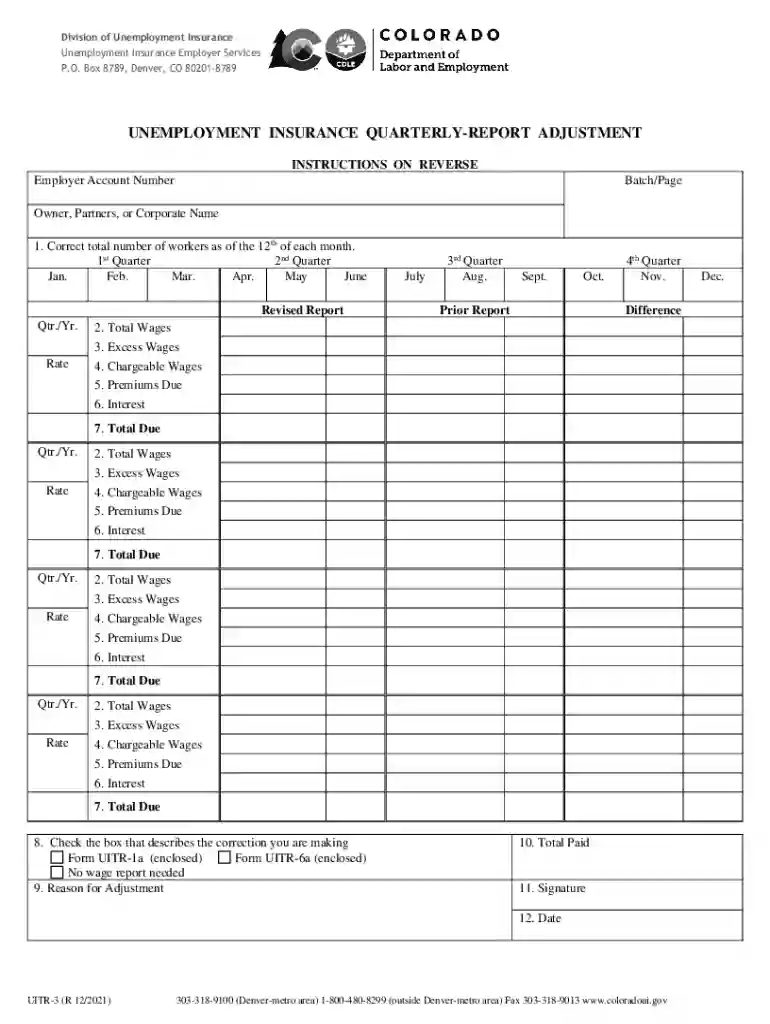
The UITR-3, known as the Unemployment Insurance Quarterly Report Form 3, is a significant document required by employers in the United States. It is utilized to report quarterly details pertaining to unemployment insurance contributions. The main purpose of this form is to provide essential information about the number of employees, wages paid, and any associated taxes or premiums due to ensure compliance with state unemployment insurance laws. By completing the UITR-3, businesses contribute to the unemployment insurance system, a safety net for workers who lose their jobs through no fault of their own.
Employers can acquire the UITR-3 from their state’s employment or labor department. Many states provide downloadable forms on their respective websites, ensuring easy access. Alternatively, forms can be requested by contacting the agency directly if physical copies are needed. Accessing the form through the state portal often comes with additional resources and guidelines for completion.
While the UITR-3 is a uniform form in its objectives, each state may have specific rules regarding completion and submission. These rules can include different due dates, accepted submission methods, and variations in the calculation of premiums. It's essential for employers to consult their state's employment department to understand these nuances, ensuring compliance with local regulations. Some states also provide instructional booklets that outline the detailed filing process.
Employers must ensure the UITR-3 is correctly filled out and filed punctually to remain compliant with state unemployment insurance laws. Failure to accurately complete or timely file this form can result in penalties or interest charges. Furthermore, accurate reporting ensures correct assessment of unemployment insurance contributions and maintains eligibility for insurance claims by employees.
In many states, employers have the option to file the UITR-3 digitally through a state-run online portal, which often provides a faster, more convenient filing process. Digital filing systems tend to offer automatic calculations and immediate confirmation of receipt, reducing the risk of errors and misplaced documents. However, a paper version is also available for employers who prefer traditional methods or lack access to digital platforms. Each method requires the same level of accuracy and detail in reporting.
Consider a mid-sized corporation operating in Ohio that employs 150 workers. The employer would use the UITR-3 form to report quarterly employment data including total worker count, gross wages paid, and any non-taxable wages. This form guides the employer in calculating necessary state unemployment insurance premiums paid for the quarter. The form will need to be submitted to Ohio's Department of Jobs and Family Services according to the state's deadlines to ensure compliance and maintain good standing.
We've got more versions of the uitr 3 form. Select the right uitr 3 version from the list and start editing it straight away!
At DocHub, your data security is our priority. We follow HIPAA, SOC2, GDPR, and other standards, so you can work on your documents with confidence.
Sep 3, 2025 Nine Inch Nails performed in Brooklyn, NY, at Barclays Center on September 3, 2025, as part of the Peel It Back Tour.Read more
Apr 24, 2026 This course is an intermediate guitar ensemble for the study and performance of selected guitar ensemble works.Read more


