




01. Edit your it 212 att online
Type text, add images, blackout confidential details, add comments, highlights and more.

Type text, add images, blackout confidential details, add comments, highlights and more.

Draw your signature, type it, upload its image, or use your mobile device as a signature pad.

Send it via email, link, or fax. You can also download it, export it or print it out.
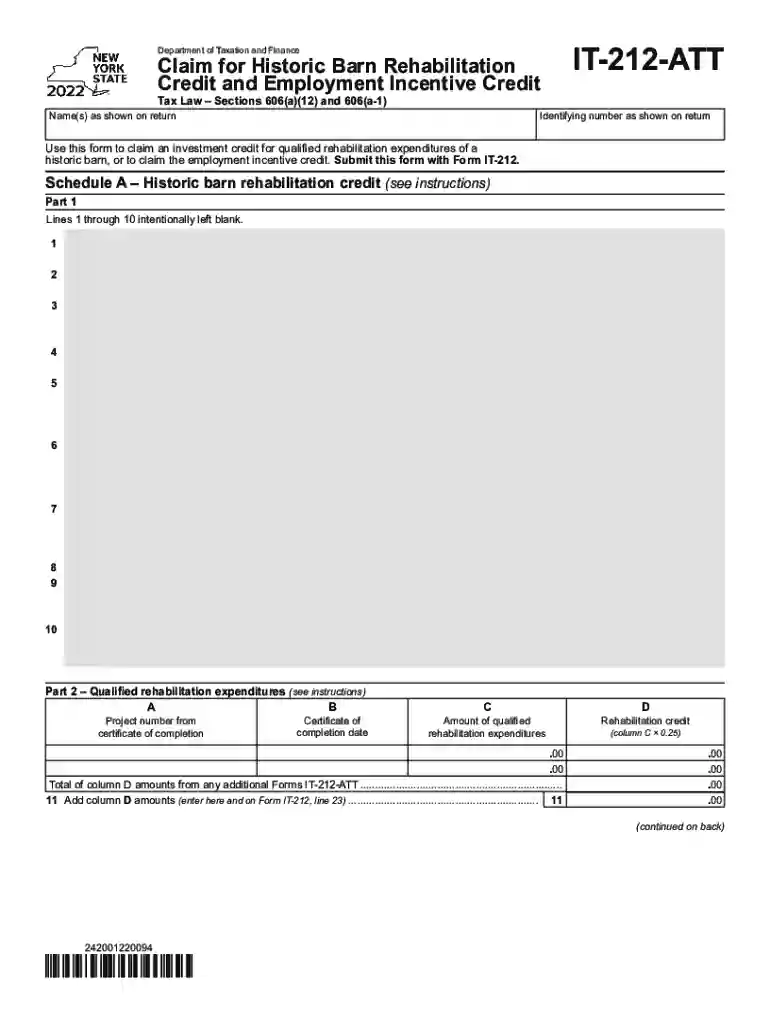
The Form IT-212-ATT, "Claim for Historic Barn Rehabilitation Credit And Employment Incentive Credit Tax Year 2022," serves as a critical tax document for taxpayers in New York State aiming to leverage specific tax credits. This form facilitates the application of two distinct types of tax credits: the Historic Barn Rehabilitation Credit and the Employment Incentive Credit. Its primary purpose is to promote the preservation of historic barns through financial incentives and encourage employment growth within the state.
The Historic Barn Rehabilitation Credit allows taxpayers to claim a credit for expenses incurred in the rehabilitation of eligible historic barns. This aims to preserve cultural heritage while providing fiscal advantages to those investing in such endeavors. Meanwhile, the Employment Incentive Credit supports businesses that increase their workforce, thus fostering job creation and economic development within New York State.
Eligibility for the Form IT-212-ATT is contingent upon meeting specific prerequisites for each credit type.


Completing the Form IT-212-ATT requires precision and adherence to New York State tax regulations. Follow these steps:
Accurate completion of the Form IT-212-ATT demands specific documentation. Essential documents include:
Critical components form the backbone of the IT-212-ATT. These elements involve intricate calculations and precise data:
The Form IT-212-ATT operates under regulations unique to New York, reflecting the state's legal framework and economic priorities. Key considerations include:
Taxpayers have options regarding the format of the IT-212-ATT.
Non-compliance with filing requirements may result in significant penalties, discouraging inaccuracies in claim submissions. Possible repercussions include:
Each section of the IT-212-ATT is meticulous in its focus but collectively contributes to fostering economic growth through preservation and job creation. Properly navigating its requirements ensures optimal tax credit application and compliance with New York State tax laws.
We've got more versions of the it 212 att form. Select the right it 212 att version from the list and start editing it straight away!
Electronic document signing demands a software solution that works in compliance with data security and eSignature regulations. DocHub is an excellent tool for that, as it fulfills all the above mentioned requirements. Whatever method you prefer to sign your Form IT-212-ATT Claim for Historic Barn Rehabilitation Credit And Employment Incentive Credit Tax Year 2022 in DocHub, your electronic signature will be legally binding and court-admissible.
You may quickly fill out, edit, and even eSign your Form IT-212-ATT Claim for Historic Barn Rehabilitation Credit And Employment Incentive Credit Tax Year 2022 utilizing DocHub. Create a new account and begin your free trial. After that, you may upload the document with the form and simply make all the required edits. No need to print on paper or use a third-party application to sign it, as you can put your electronic signature on your document quicker via DocHub.
At DocHub, your data security is our priority. We follow HIPAA, SOC2, GDPR, and other standards, so you can work on your documents with confidence.
state and federal historic rehabilitation tax credits, Rehabilitation work was completed by June 2022. state and federal historic rehabilitation tax credits,
Form IT‐212‐ATT is used to determine if you are eligible to claim the historic barn rehabilitation credit (Schedule A) or the employment incentive credit (EIC)


