State Net Operating Loss ProvisionsTax Foundation 2026

Get Form
State Net Operating Loss ProvisionsTax Foundation Preview on Page 1

Here's how it works

01. Edit your form online
Type text, add images, blackout confidential details, add comments, highlights and more.

02. Sign it in a few clicks
Draw your signature, type it, upload its image, or use your mobile device as a signature pad.

03. Share your form with others
Send it via email, link, or fax. You can also download it, export it or print it out.

Understanding the State Net Operating Loss ProvisionsTax Foundation

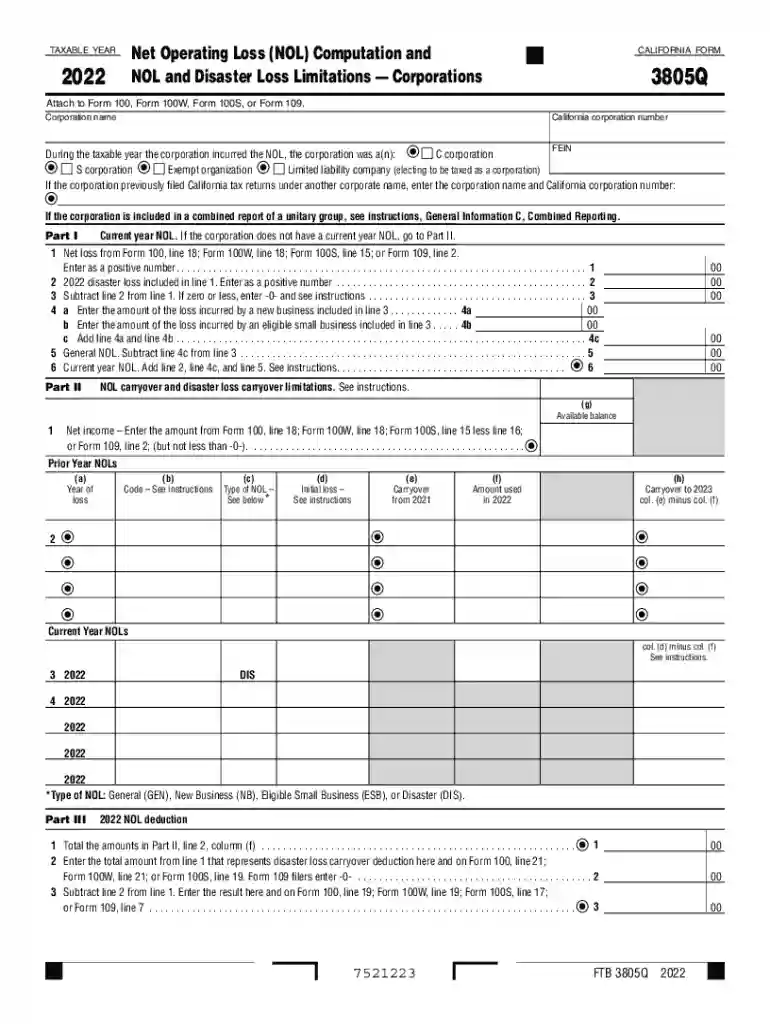
State Net Operating Loss (NOL) Provisions are designed to help businesses within a state offset taxable income with previous losses. The purpose of these provisions is to reduce tax liabilities, thereby providing relief and promoting business continuity during financial downturns. This guide examines the intricacies of the State Net Operating Loss ProvisionsTax Foundation, highlighting practical usage, legal frameworks, and specific scenarios under which these provisions apply.

How to Use the State Net Operating Loss Provisions

  1. Identify Eligibility: Determine if your corporation qualifies for NOL provisions based on state-specific criteria. Typically, C corporations, S corporations, and partnerships with incurred losses can apply.

  2. Calculate NOL: For precise calculations, businesses need to report current year losses, including any disaster loss limitations and carryovers from previous years.

  3. Documentation: Ensure accurate records of loss-related documentation, including disaster loss affidavits and small business loss reports, are maintained for submission.

Steps to Complete the State Net Operating Loss ProvisionsTax Foundation

  1. Form Collection: Obtain the necessary NOL forms from your state tax authority or use software compatible with these provisions like TurboTax.

  2. Complete Required Sections: Fill in the sections requiring details about your business entity type, incurred losses, and any carryover calculations.

  3. Attach Supplementary Documents: Include disaster loss limitations, small business deductions, and any applicable previous year carryovers.

  4. Review and Submit: Double-check entries for accuracy and submit through designated channels, such as online submission platforms or mailing to the state tax office.

Important Terms Related to State Net Operating Loss Provisions

  • Carryback: Refers to applying an NOL to previous tax years to receive a refund for prior paid taxes.
  • Carryforward: Utilization of NOL in future years to offset future taxable income.
  • Disaster Loss: Specific losses caused by declared disasters, impacting NOL calculations.

Legal Considerations for State Net Operating Loss Provisions

Compliance with legal statutes governing NOL calculations is crucial. Each state may have variations in how they handle NOL carrybacks and carryforwards. Additionally, accurate reporting is required to avoid penalties or disputes with tax authorities.

State-Specific Rules for the State Net Operating Loss Provisions

Each state might implement unique requirements regarding NOL handling:

  • California: NOL suspensions may apply, and entities should adhere to disaster loss limitations.
  • New York: Different NOL carryforward limits and periods may exist, requiring detailed attention to state regulations.

Examples of Using State Net Operating Loss Provisions

Consider a tech startup in California that experienced financial losses from a product launch failure. By utilizing the State NOL Provisions, it calculates the carryforward to reduce taxable income for upcoming profitable years. Each documented loss, including losses from specific years or related to economic downturns, helps in substantial tax savings.

Required Documents for Filing

  • Tax forms specific to your state
  • Documentation of income losses, carryovers, and any disaster-related loss documentation
  • Entity type verification documents

Filing Deadlines and Important Dates

Filing deadlines vary by state and coincide with the standard corporate tax filing periods. Ensure timely compliance to avoid penalties and maximize the advantage of the NOL provisions.

Form Submission Methods

  • Online Submission: Preferred for ease and speed, requiring a digital signature.
  • Mail Submission: Hard copies can be mailed or filed in-person at local tax offices, depending on state preference.

Business Types Benefiting Most from NOL Provisions

Businesses experiencing variable income, such as startups, seasonal businesses, or those undergoing restructuring, stand to benefit significantly. For instance, small entities and tech companies facing initial investment losses can utilize provisions to stabilize their financial standing.

The information provided here outlines integral components of utilizing the State Net Operating Loss ProvisionsTax Foundation. This ensures businesses apply, calculate accurately, and adhere to state-specific regulations proficiently, optimizing financial strategies effectively.

See more State Net Operating Loss ProvisionsTax Foundation versions

We've got more versions of the State Net Operating Loss ProvisionsTax Foundation form. Select the right State Net Operating Loss ProvisionsTax Foundation version from the list and start editing it straight away!
Versions Form popularity Fillable & printable
2023 4.5 Satisfied (20 Votes)
2022 4.5 Satisfied (23 Votes)
2021 4.3 Satisfied (22 Votes)
2020 4.8 Satisfied (97 Votes)
2019 4.2 Satisfied (83 Votes)
2018 4.4 Satisfied (151 Votes)
2017 4.1 Satisfied (36 Votes)
2017 4.4 Satisfied (249 Votes)
be ready to get more

Complete this form in 5 minutes or less

Get form

Got questions?

We have answers to the most popular questions from our customers. If you can't find an answer to your question, please contact us.
Contact us
NOL Steps Complete your tax return for the year. Determine whether you have an NOL and its amount. If applicable, decide whether to carry the NOL back to a past year, or to waive the carryback period and instead carry the NOL forward to a future year. Deduct the NOL in the carryback or carryforward year.
While the federal NOL provisions now allow for unlimited carryforward periods, as reflected above, not all states follow this policy. The trend, however, has been favorable for taxpayers in recent years, even in many of the states that did not automatically conform to the new TCJA rules.
In general, your NOL deduction for tax years beginning after December 31, 2020, cannot exceed the sum of: (1) the NOLs carried to the year from tax years beginning before January 1, 2018; plus, (2) the lesser of: (a) the NOLs carried to the year from tax years beginning after December 31, 2017, or (b) 80% of the excess
If your deductions and losses are greater than your income from all sources in a tax year, you may have a net operating loss (NOL). You may be able to claim your loss as an NOL deduction. The NOL can be carried over to future tax years.
To claim a tax refund from the NOL carryback, you will generally want to file Form 1139 for a C corporation NOL or Form 1045 for an individual NOL caused by losses from partnerships, S corporations, LLCs, or sole proprietorships. The IRS generally will process these refund claims within 90 days.

Security and compliance

At DocHub, your data security is our priority. We follow HIPAA, SOC2, GDPR, and other standards, so you can work on your documents with confidence.

Learn more
ccpa2
pci-dss
gdpr-compliance
hipaa
soc-compliance
be ready to get more

Complete this form in 5 minutes or less

Get form

People also ask

The rules state that the amount of the NOL is limited to 80% of the excess of taxable income without respect to any 199A (QBI), 250 (GILTI), or the NOL. For example: In this example, tax is paid on $20,000 of income even though there was an NOL carryover more than the current years income.
Current Rules NOL carrybacks are generally eliminated, except for certain farming losses which can be carried back 2 years. NOLs can be carried forward indefinitely. The NOL deduction is limited to 80% of taxable income for tax years after 2020. 8.
Claim the loss on line 7 of your Form 1040, Form 1040-SR or Form 1040-NR. If your net capital loss is more than this limit, you can carry the loss forward to later years.

Related links