



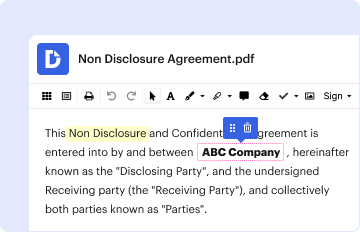
01. Edit your form online
Type text, add images, blackout confidential details, add comments, highlights and more.

Type text, add images, blackout confidential details, add comments, highlights and more.
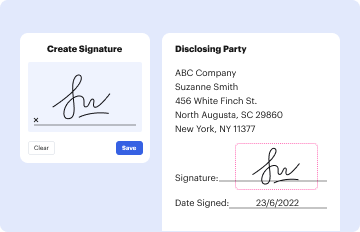
Draw your signature, type it, upload its image, or use your mobile device as a signature pad.

Send it via email, link, or fax. You can also download it, export it or print it out.
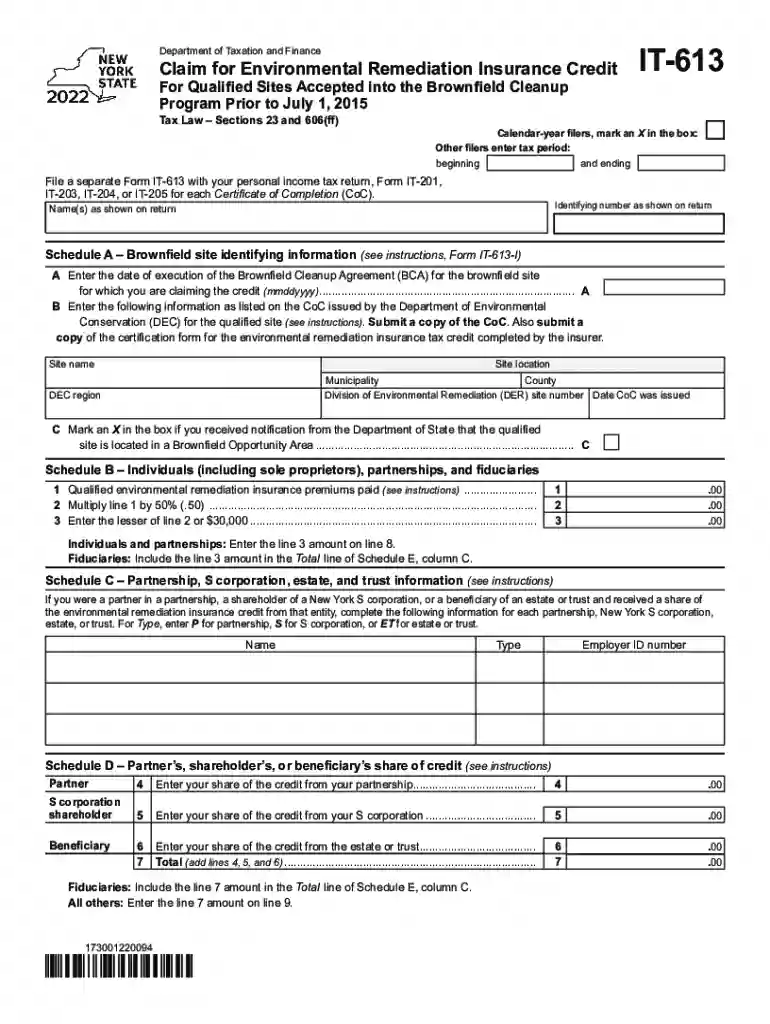
Form IT-613, known as the Claim for Environmental Remediation Insurance Credit, is a tax credit form used in the United States for individuals, partnerships, and fiduciaries participating in the Brownfield Cleanup Program. This program aims to incentivize the cleanup of contaminated sites, referred to as brownfields, by offering tax credits to those who carry insurance for such remediation activities. The form enables claimants to detail the insurance premiums paid and calculate the corresponding credit applicable to their personal income tax returns.
Gather Required Information:
Fill Out Identification Information:
Detail Insurance Premiums:
Calculate the Credit:
Attach Supporting Documentation:
Submit with Tax Return:
Brownfield Program Acceptance:
Eligible Entities:
Insurance Documentation:


Proof of Insurance:
Payment Receipts:
Brownfield Cleanup Program Documentation:
Proper Filing Method:
Accuracy and Completeness:
Audit Trail:
Fines and Interest:
Revocation of Credits:
Digital Access:
Paper Filing:
Scenario 1: Small Business
Scenario 2: Individual Investor
Corporations and LLCs:
Partnerships:
Significance:
Documentation is Crucial:
Compliance Equals Success:
We've got more versions of the Form IT-613 Claim For Environmental Remediation Insurance Credit ... form. Select the right Form IT-613 Claim For Environmental Remediation Insurance Credit ... version from the list and start editing it straight away!
With DocHub, it’s pretty simple. The service offers users an add-on called DocHub for Gmail, which you can find in the Google Workspace Marketplace without being charged. Set it up and give it access to your Google account. Open your email with your Form IT-613 Claim For Environmental Remediation Insurance Credit ... attached and click on the add-on button in the right-side panel. Log in to your DocHub account, and upload the form to our editor, where you can fill it out and sign.
If your go-to electronic mail service is Gmail, you can easily incorporate your DocHub editor into your work. Edit your Form IT-613 Claim For Environmental Remediation Insurance Credit ... with DocHub instruments and attach it to your drafts in Gmail. See how easy it is to exchange files and work together having a swift PDF editing solution at hand.
At DocHub, your data security is our priority. We follow HIPAA, SOC2, GDPR, and other standards, so you can work on your documents with confidence.
Did [NAME] take the Form 4 or Form 6 exam? Find out if the household member took either the Form 4 or Form 6 exam. Code 1 if they took the Form 4Read more
Oct 1, 2010 If the taxpayer paid premiums for environmental remediation insurance, claimed a deduction for such premiums, and claimed the environmentalRead more
To qualify for the credit, you must execute a Brownfield Cleanup. Agreement (BCA) under the Environmental Conservation Law. (ECL), and have a Certificate ofRead more


