






Definition & Meaning
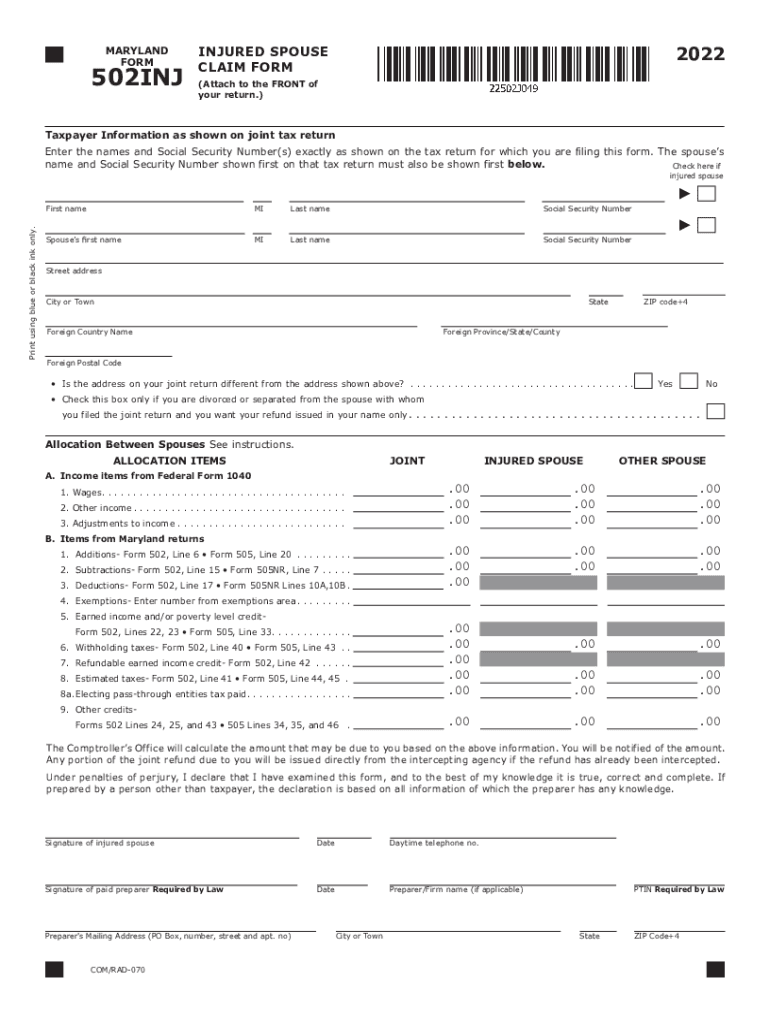
The Maryland Form 502INJ, also known as the Injured Spouse Claim Form, is a tax document used by individuals who have filed a joint tax return and seek to recover their share of a tax refund that has been, or potentially will be, intercepted due to the other spouse's debts. This form is essential for protecting a spouse's portion of the refund from being applied to debts of their partner, such as unpaid child support or federal student loans. The form requests specific personal and financial details, enabling the separation of income and refunds attributable to each spouse.
Steps to Complete the 502INJ 121322 a. 502INJ 121322 a
-
Gather Personal Information:
- Include both spouses' names, Social Security numbers, and filing statuses.
- Joint filers should also provide current addresses and contact details.
-
Allocate Income and Deductions:
- Precisely divide the income and tax withholdings between both spouses.
- Use supporting documents, such as W-2s and 1099s, as references for accurate allocations.
-
Complete Required Sections:
- Ensure all mandatory fields in the form are filled out.
- Attach any additional documentation that supports the claim.
-
Attach to Joint Tax Return:
- Attach the completed form to the front of your joint tax return before submission.
- Ensure that both forms are submitted together to avoid processing delays.
-
Review for Accuracy:
- Double-check all entries and calculations for accuracy.
- Verify that all submitted figures correlate with supporting documentation.
Who Typically Uses the 502INJ 121322 a. 502INJ 121322 a
-
Married Couples Filing Jointly:
- Primarily utilized by married couples who file jointly and face a potential offset due to one spouse's obligations.
-
Spouses with Outstanding Debts:
- Those who are currently subject to tax refund interceptions due to federal debts like child support arrears, student loans, or federal taxes.
-
Taxpayers Facing Offset Risks:
- Applicants concerned about state offsets impacting their tax refunds.


Legal Use of the 502INJ 121322 a. 502INJ 121322 a
The Injured Spouse Claim Form ensures compliance with relevant tax laws and protections, enabling spouses to retain their rightful share of tax refunds free from the financial responsibilities of their partners. Filing this form aligns with the legal right to a fair allocation of joint tax resources when one spouse's separate debts threaten to absorb shared refunds. Legal language embedded within the form underscores the precise conditions and limitations under which the injured spouse can assert their claim, ultimately supporting equitable tax settlement practices as governed by Maryland state law.
Filing Deadlines / Important Dates
Filing the Form 502INJ should align with the overall tax filing deadline to ensure that the claim is considered as part of the annual tax return process. Key deadlines include:
-
Annual Tax Filing Deadline:
- Typically April 15 for federal and state tax filings, unless otherwise extended by authorities.
-
Amended Return Deadlines:
- If filing with an amended joint return, submit the Injured Spouse form within three years of the original tax filing.
Avoid delays by considering postal delivery times if mailing the submission. Taxpayers should stay informed about potential deadline extensions occasionally issued in response to extraordinary circumstances.
Required Documents
-
W-2 and 1099 Forms:
- Essential for detailing income sources and amounts for each spouse.
-
Joint Tax Return:
- Attach the completed Form 502INJ directly to this document.
-
Debt Verification Notices:
- Documentation of existing debts that may lead to offset is advantageous for claim support.
-
Proof of Tax Withholdings:
- Documents evidencing federal and state tax withholdings can aid in assessing each spouse’s contribution and refund entitlements.
State-Specific Rules for the 502INJ 121322 a. 502INJ 121322 a
Although guided by federal principles, the application of the Injured Spouse Form in Maryland involves state-specific nuances which users must observe:
-
State Debt Collection Practices:
- Understand Maryland’s unique treatment of debts that might influence tax refunds.
-
Distinctive Allocation Procedures:
- Maryland guidelines dictate specific methods for allocating tax liabilities and assets among spouses.
-
Local Documentation Needs:
- Some claims may necessitate additional state forms or documents concerning specific debts or offsets managed at the state level.
Penalties for Non-Compliance
Non-compliance with submitting a correctly filed Form 502INJ may lead to:
-
Loss of Refund:
- Failure to separate debts accurately might result in the interception of the entire tax refund to cover a spouse's obligations.
-
Potential Interest and Penalties:
- In cases where debts remain unsatisfied, additional financial penalties might accrue on outstanding amounts.
-
Delays in Return Processing:
-
Incorrect or incomplete forms could lead to prolonged processing times and delayed refunds.
Disclosure Requirements
The Form 502INJ mandates full disclosure of pertinent details to justify the claim:
-
Complete and Honest Income Reporting:
- Full transparency regarding both personal and shared income sources ensures valid income allocation.
-
Debt Status and Circumstances:
- Comprehensive disclosure of the status and nature of debts perceived to affect tax refunds is mandatory.
-
Spousal Agreement:
- Both parties must understand and agree upon labeled deductions and income splits to ensure accurate disclosure.
Taxpayer Scenarios
Various taxpayer situations highlight the utility of Form 502INJ:
-
Self-Employed Individuals:
- Owners of single-member LLCs may use this form when personal debts risk impacting self-employed income.
-
Retirees:
- Elderly couples where one spouse garners fixed-income while the other faces social security offsets due to past debts.
-
Students and Dependent Workers:
- Younger couples incorporating dependent exemptions might file when student loans cause potential refund offsets.