







Definition and Meaning
The term "have a dependent or minor children together, or a spouse is pregnant" refers to specific conditions that impact legal and family-related forms, such as petitions for the dissolution of marriage in the U.S. This condition is central to determining legal proceedings related to family law, as having dependent children or a pregnant spouse influences parenting plans, child support arrangements, and even alimony in separation or divorce cases. Dependent children typically include those under 18, but may also include children over 18 who are still financially reliant on the parents.
Eligibility Criteria
To use a form or petition involving "have a dependent or minor children together, or a spouse is pregnant," specific eligibility criteria must be met. For instance, both parties must have at least one child under the age of 18 or a confirmed pregnancy. This criterion directly influences legal processes, such as seeking joint custody, establishing visitation rights, and determining child support obligations. Eligibility may vary slightly by state, so it is crucial to consult local regulations or legal counsel to ensure compliance with state-specific requirements.


Steps to Complete the Petition
-
Gather Required Information: Start by collecting all pertinent information, including details about children, such as names, birthdates, school attendance, and health care providers. Include any medical information if a spouse is pregnant.
-
Complete the Form: Fill out the necessary sections of the form, ensuring meticulous detail, especially regarding information about dependent children or pregnancy.
-
Attach Supporting Documents: Include any required documentation, such as birth certificates, proof of pregnancy, and relevant financial documents.
-
Sign and Review: Double-check all entries for accuracy and ensure that you and your spouse, if applicable, sign the form where required.
-
File the Petition: Submit the completed form to the appropriate court or legal entity, either online or through mail, in-person submission may be required in certain jurisdictions.
-
Serve the Spouse: Legally notify your spouse of the filed petition, following your state's service of process rules.
Legal Use and Importance
The form's usage due to having children or a pregnant spouse holds legal implications. It enforces regulations concerning child custody, child support, and supervised visitation. Legal guardians or parents must disclose such dependencies as it directly affects the case outcome, court decisions, parenting plans, and the equitable distribution of marital assets. It ensures that children's best interests are maintained through mandatory considerations and regulations, focusing on welfare and financial stability.
State-Specific Rules
Each state may impose its own rules concerning forms that involve dependent or minor children or pregnancy. For example, states like California have specific mandated parenting classes or mediation sessions prior to finalizing a divorce involving minors. Investigating local, family law statutes can uncover nuances that may affect your case, like the allocation of parental responsibilities, visitation guidelines, and emergency protocols during a spouse's pregnancy.
Florida's Example
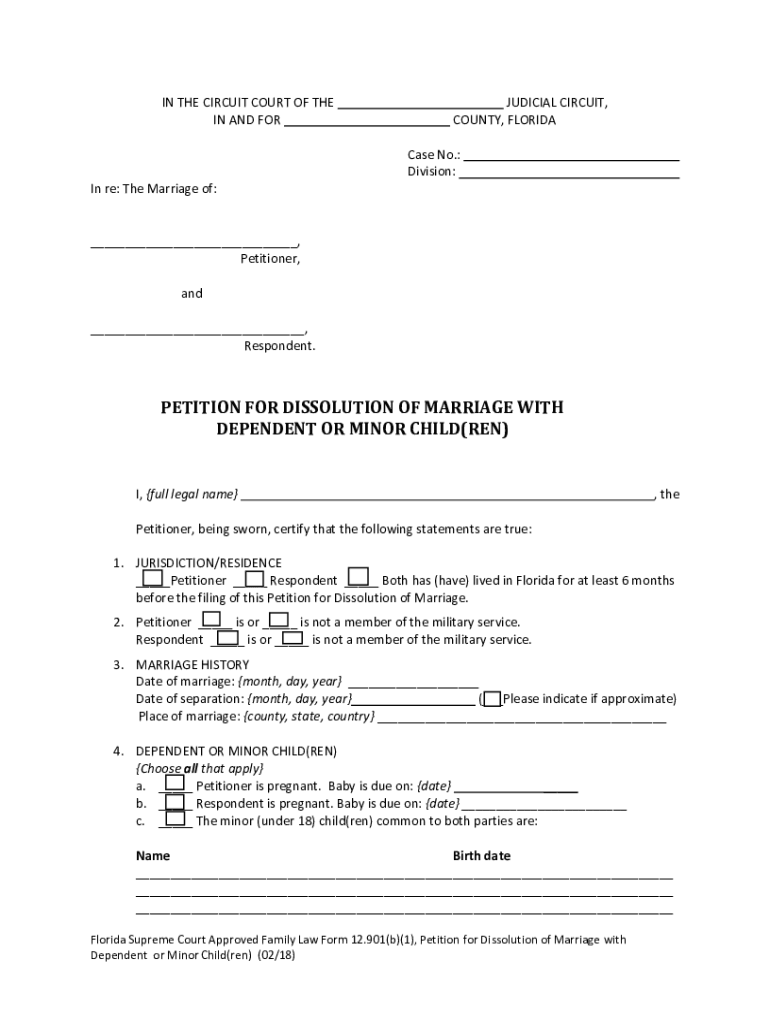
In Florida, the family law form 12.901(b)(1) requires extensive detail when children or pregnancy is involved. Parenting plans need full individualization, with stipulations that may not apply in other states. Understanding and adhering to these specific guidelines is vital for compliance and effective legal processing.
Key Elements of the Form
- Child Information Section: Includes full names, birthdates, and information about schooling.
- Parental Responsibilities and Plans: Outlines terms for custody and decision-making authority.
- Financial Statements: Requires disclosure of income and expenses for determining support levels.
- Medical and Schooling Details: States provisions for joint decision-making in medical or educational needs.
- Signatures and Notarization: Legal accountability through signed consent and potentially notary verification.
Examples and Case Scenarios
In scenarios where parents are divorcing and share responsibilities for minor children, these particular forms become essential. For instance, a couple undergoing a divorce with two minor children will use the form to define joint custody terms, financial support, and logistical planning surrounding education and extracurricular commitments.
Real-World Scenario
Consider a couple in New York with a three-year-old child and another on the way. Utilizing these forms provides the court with deep insights into both parents' responsibilities and commitments, thus ensuring decisions are fair and supportive of the children's welfare.
Important Terms and Definitions
- Dependent Children: Minors under the legal care of parents or guardians.
- Custody: Legal responsibility and right to make decisions for a child.
- Pregnancy Verification: Medical documentation confirming a pregnancy.
- Visitation Rights: Scheduled times when a non-custodial parent can visit their child.
Filing Deadlines and Important Dates
Upon filing a form relevant to having minor children or a pregnant spouse, meeting court deadlines is imperative. These are often aligned with parental agreement submissions or responsive declarations to petitions. Missing such deadlines can delay proceedings or alter interim child support or custody arrangements temporarily.
In summary, forms involving minors or pregnancy emphasize protecting the children's best interests through clearly defined legal processes. These forms require detailed personal, financial, and situational information, reflecting their comprehensive nature tailored to individual circumstances.




