




01. Edit your form online
Type text, add images, blackout confidential details, add comments, highlights and more.

Type text, add images, blackout confidential details, add comments, highlights and more.

Draw your signature, type it, upload its image, or use your mobile device as a signature pad.

Send it via email, link, or fax. You can also download it, export it or print it out.
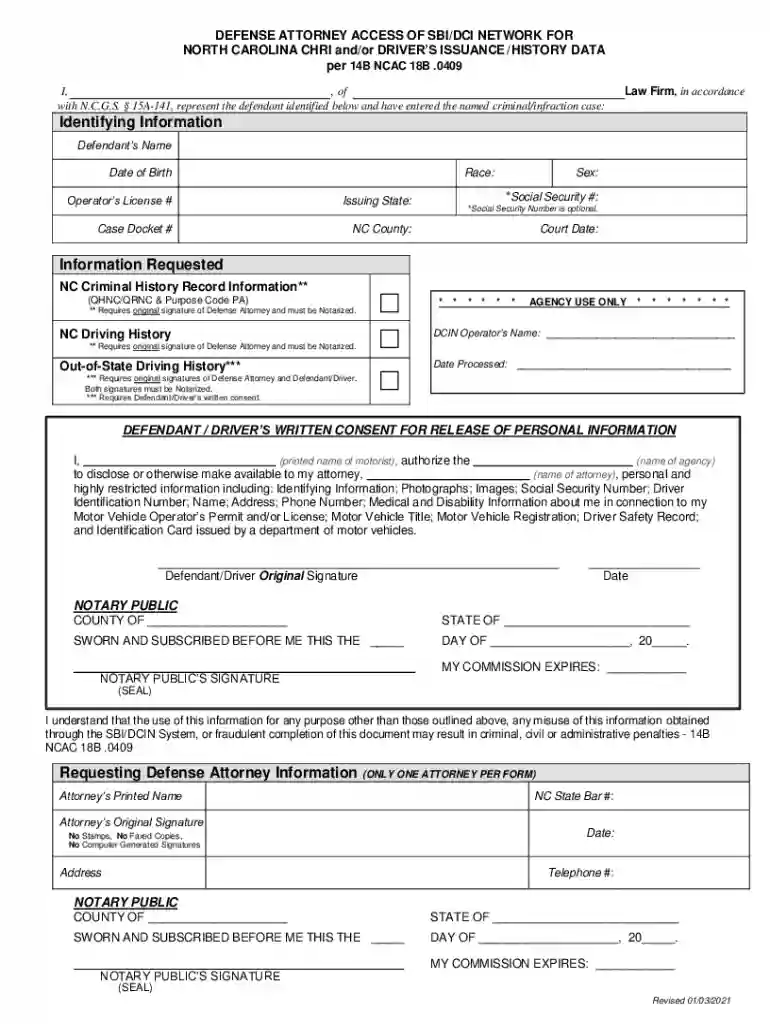
The "files.nc.govncdpsdivI, Law Firm with Identifying Information Information Requested" form is a vital legal document used by defense attorneys in North Carolina to access sensitive information pertaining to their clients. Primarily, it serves as a request form to obtain criminal history and driving history data, as governed by state-specific regulations. Understanding its role is crucial for legal practitioners, as it facilitates the lawful acquisition of necessary information for case preparation.
Navigating through the use of this form is integral for legal professionals to ensure compliance and efficiency.
Filling out the form requires attention to detail and strict adherence to procedural guidelines.
Strict adherence to legal guidelines is imperative when using this form to prevent misuse.
Identifying the primary users of this form helps in understanding its operational context.


The form comprises various sections, each demanding specific attention to detail.
Being aware of the nuances and variations in state-specific rules can impact the form's processing and acceptance.
Understanding the variants and alternatives of this form can aid in selecting the right tool for legal proceedings.
We've got more versions of the files.nc.govncdpsdivI, Law Firm with Identifying Information Information Requested form. Select the right files.nc.govncdpsdivI, Law Firm with Identifying Information Information Requested version from the list and start editing it straight away!
Managing your documents with DocHub this way is extremely straightforward once you have downloaded its extension for Google Chrome. Go to the Chrome Web Store and install DocHub - Sign PDF from Gmail to get it. Give our tool access to your Google account, and then open an email with the files.nc.govncdpsdivI, Law Firm with Identifying Information Information Requested attached and point to the file with your cursor - the DocHub extension button will automatically appear there. Click on it to open your document in our editor. Make any essential modifications, complete the blanks, and click Sign to create your legally-binding eSignature.
You can find the latest and most relevant version of the files.nc.govncdpsdivI, Law Firm with Identifying Information Information Requested in our DocHub forms collection. Browse it by categories or use the search field to find the exact template that suits your case. You can open this form for editing once you find it.
At DocHub, your data security is our priority. We follow HIPAA, SOC2, GDPR, and other standards, so you can work on your documents with confidence.


