




01. Edit your pa form unclaimed property online
Type text, add images, blackout confidential details, add comments, highlights and more.

Type text, add images, blackout confidential details, add comments, highlights and more.

Draw your signature, type it, upload its image, or use your mobile device as a signature pad.

Send pa negative via email, link, or fax. You can also download it, export it or print it out.
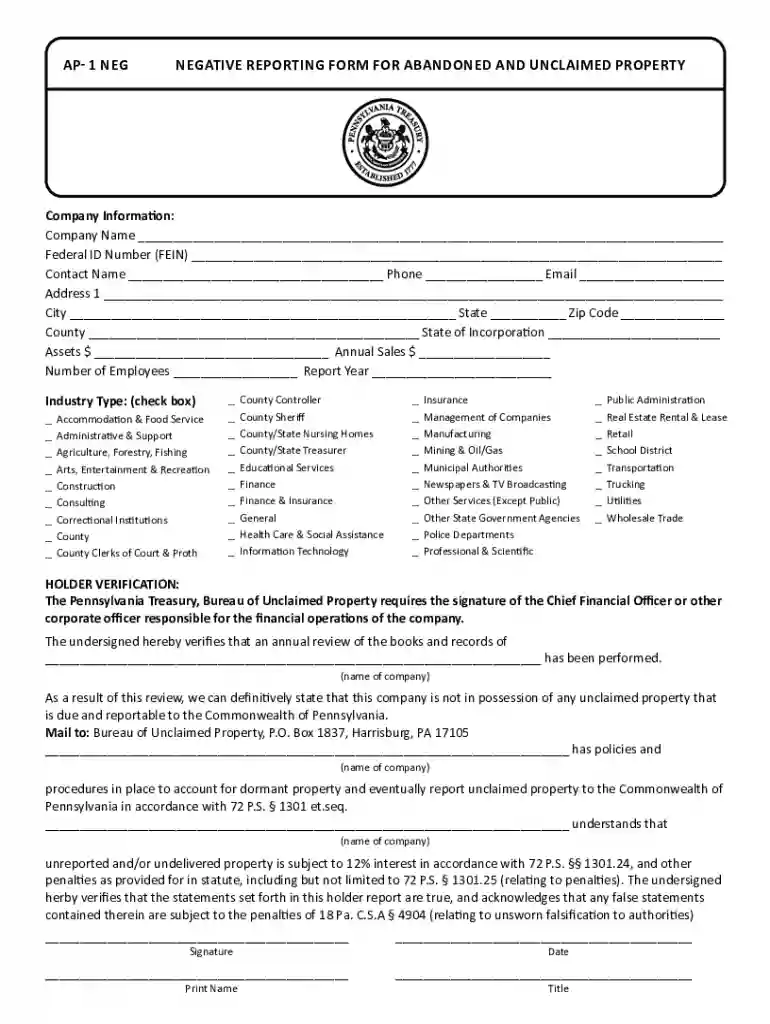
Form AP-1, also known as the "Report of Abandoned and Unclaimed Property," is a financial reporting document used by companies to declare any unclaimed or abandoned property they might hold. This form serves a critical purpose in ensuring compliance with state regulations by allowing companies to officially report properties that have been left inactive or unclaimed for specific periods. The form is a legal requirement and is specifically designed to prevent financial institutions and businesses from wrongly holding onto such properties without making appropriate efforts to reunite them with their rightful owners. Examples of unclaimed properties include unpaid wages, uncashed checks, inactive accounts, and unredeemed deposits.
Completing Form AP-1 accurately is crucial for compliance with state regulations. Below is a detailed step-by-step guide:
Gather Required Information: Begin by compiling a list of all unclaimed properties. This includes checking business records for any potential dormant accounts or unpaid obligations.
Fill in Company Details: Enter essential company information, such as the name, address, contact details, and federal identification number. This data ensures the identification of the reporting entity.
Detail Unclaimed Properties: For each unclaimed item, document relevant details such as the property's nature, the last known contact with the owner, and the value of each item.
Verification and Signature: A corporate officer or authorized individual must verify the accuracy of the information and provide a signature. This validation enforces the form's legal standing.
Submit the Form: Depending on state requirements, submission can occur through electronic means, mail, or sometimes even in person. Attach any required documentation or additional forms for a comprehensive report.
The legal implications of not reporting unclaimed property through Form AP-1 are serious. Companies must comply with state laws, which typically require them to make reasonable attempts to contact the owners before declaring property abandoned. Failure to report, or late reporting, can result in fines, penalties, or other legal actions against the business. Moreover, filing this form helps prevent potential financial audits and legal disputes, saving the company from costly litigation and maintaining its reputation. Each state may have slight variations in rules, so familiarity with regional laws is advised.
While Form AP-1 serves a consistent purpose nationwide, state-specific nuances affect its completion:
Understanding these state-specific dimensions ensures compliance and optimal reporting accuracy.
Form AP-1 is typically utilized by various entities, including:
These businesses benefit by maintaining compliance and ensuring transparency with state authorities.


Several important terminologies are associated with Form AP-1 that entities must be familiar with:
Understanding these terms is essential for correctly completing and submitting the form.
Different scenarios exemplify the need for Form AP-1:
Each situation demands due diligence and accurate documentation to conform with legal expectations.
Crucial deadlines vary by state, yet universally, businesses must adhere to annual reporting requirements. Typically, states set a reporting deadline in either the fall or spring to coincide with the fiscal year closure. Businesses must confirm their specific state deadlines to avoid penalties.
Non-compliance with state laws regarding unclaimed and abandoned property can lead to severe penalties. These may include financial fines, heightened scrutiny during financial audits, and potential legal actions. Following the guidelines for completing Form AP-1 is essential to mitigate these risks and protect the organization’s reputation and financial standing.
We've got more versions of the pa form unclaimed property form. Select the right pa form unclaimed property version from the list and start editing it straight away!
Microsoft Word doesn’t have signing tools to create valid electronic signatures and enforceable paperwork. Fortunately, DocHub is an online eSignature-compliant editor that supports different file formats, such as .doc files. Sign in to your account and upload the Word edition of your pa neg from your device and cloud, or URL - our editor will automatically convert it into an editable PDF. Make all essential changes in your form and click Sign to create your own legally-binding electronic signature. There are four signing options from which to choose.
As a comprehensive document editing platform, DocHub is accessible on mobile phones. Open DocHub in your choice of mobile internet browser and use our intelligent mobile-friendly toolset to fill out your ap 1 neg.
At DocHub, your data security is our priority. We follow HIPAA, SOC2, GDPR, and other standards, so you can work on your documents with confidence.


