




01. Edit your pre interview checklist online
Type text, add images, blackout confidential details, add comments, highlights and more.

Type text, add images, blackout confidential details, add comments, highlights and more.

Draw your signature, type it, upload its image, or use your mobile device as a signature pad.

Send it via email, link, or fax. You can also download it, export it or print it out.
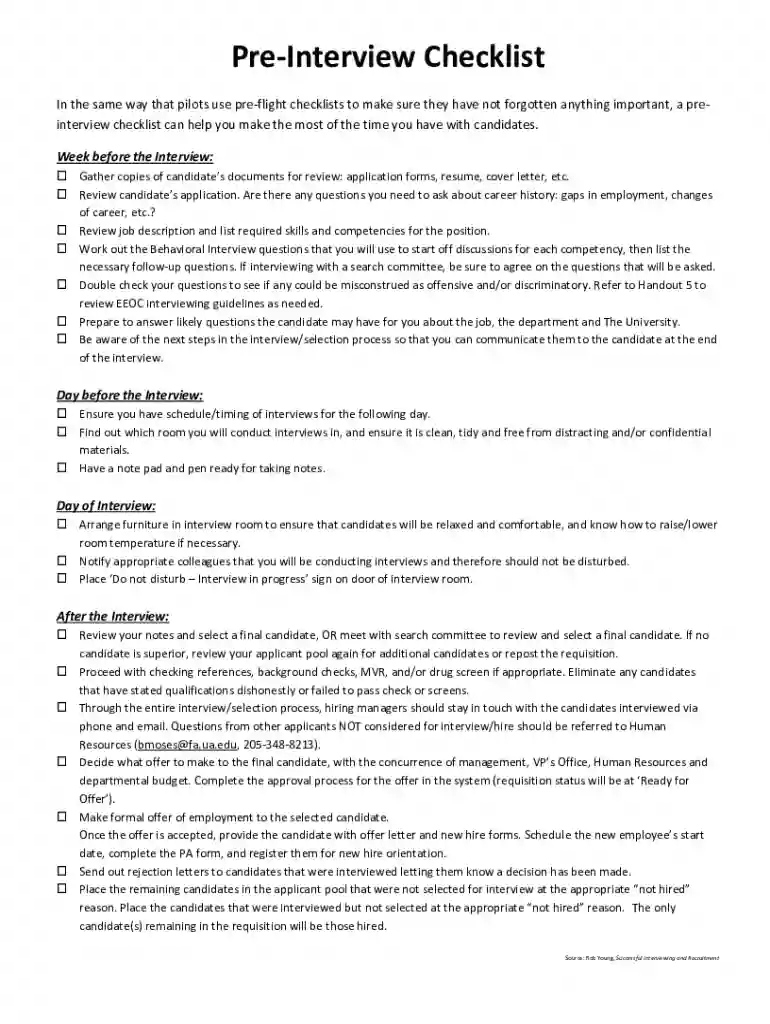
The pre-interview checklist is an essential tool for hiring managers to streamline the interview process. It includes several critical components that ensure a productive and efficient experience. Key elements typically involved are:
Candidate Document Review: Prior to the interview, review the candidate's resume, cover letter, and any other pertinent documents. This helps in understanding the background, skills, and experiences the candidate brings to the table.
Question Preparation: Develop a list of questions tailored to the specific role and aligned with the candidate's background. This not only aids in assessing the candidate's fit for the position but also encourages meaningful dialogue.
Interview Environment Setup: Ensure the interview space, whether physical or virtual, is conducive to a professional discussion. This includes checking equipment for virtual meetings and arranging a quiet, private physical space.
Interview Panel Briefing: If multiple interviewers are involved, coordinate and communicate the structure and focus areas of the interview. This ensures consistency and comprehensiveness in the evaluation process.
Successfully completing the pre-interview checklist involves several methodical steps aimed at organization and thorough preparation:
Gather Candidate Information: Collect all candidate-related documents and ensure they are easily accessible for reference during the interview.
Tailor Questions: Use the job description and candidate documents to create specific questions that address different aspects of the candidate's qualifications.
Set Interview Logistics: Confirm the date, time, and format of the interview with all participants. For virtual interviews, verify all technological components are working correctly.
Coordinate with the Team: Distribute the candidate’s documents and a copy of the interview agenda to all panel members prior to the interview.
Conduct a Dry Run: Especially for virtual interviews, conducting a test run ensures all systems operate smoothly and helps avoid disruptions.
Using a pre-interview checklist is crucial for ensuring consistency and efficiency throughout the interview process. It helps:
Maintain Focus: By following a structured format, interviewers can keep discussions aligned with the job requirements and candidate qualifications.
Reduce Bias: A standardized checklist promotes impartiality by focusing on predefined criteria, reducing subjective bias.
Enhance Preparedness: Having a well-prepared checklist empowers interviewers with confidence and clarity during the interview.
Improve Candidate Experience: Structured interviews convey professionalism and respect for the candidate’s time, enhancing the overall candidate experience.
The pre-interview checklist is employed primarily by:
Hiring Managers: They spearhead the interview process and rely on the checklist for guidance and consistency.
Human Resources Personnel: HR professionals use the checklist to facilitate and ensure compliance throughout the recruitment process.
Interview Panels: Multi-member panels benefit from the checklist to ensure cohesive evaluation criteria and discussion points.
Recruiters: They often use the checklist to brief their clients or companies on the prep work needed to ensure effective hiring decisions.


Obtaining a pre-interview checklist can be straightforward and involves several sources:
HR Software: Many modern human resources information systems (HRIS) include pre-built templates for pre-interview checklists.
Online Resources: Numerous HR and recruiting websites offer downloadable templates that cater to various industries and roles.
Internal Company Templates: Companies often have existing templates as part of their onboarding and talent acquisition process, available for internal use.
Professional Organizations: Memberships in HR associations may provide access to curated resources, including checklist templates.
The pre-interview checklist can be tailored to fit different organizational needs. Examples of its application include:
Technical Interviews: Focus on role-specific technical questions, equipment tests, and problem-solving tasks.
Behavioral Interviews: Prepare questions that probe the candidate’s past experiences, team interactions, and cultural fit.
Panel Interviews: Structure interactions between multiple interviewers and the candidate, ensuring each has a clear focus area.
Remote Interviews: Special emphasis on technology setup and contingency planning for potential technical difficulties.
A complete pre-interview checklist requires several documents to facilitate a thorough understanding and assessment of the candidate:
Candidate’s Resume and Cover Letter: Essential for evaluating the candidate’s work history, education, and motivation.
Job Description: Provides a framework for aligning interview questions with role responsibilities and requirements.
Reference Checks: Where applicable, prepare to discuss prior employment verification and references.
Interview Agenda: Outline the topics to cover, time allocations, and specific responsibilities of each interviewer participating in the process.
The pre-interview checklist can be integrated with several platforms to enhance efficiency:
Applicant Tracking Systems (ATS): Utilize the checklist within an ATS to automatically track which steps have been completed for each candidate.
Calendar Applications: Synchronize interview times and prep stages through tools like Google Calendar or Outlook.
Document Management Platforms: Store and share checklists and candidate details using platforms such as Google Drive, Dropbox, or OneDrive to ensure collaborative accessibility.
This comprehensive setup supports a seamless transition from preparation to execution within the interview process, providing utility, clarity, and a structured approach that benefits both the interviewer and the candidate.
We've got more versions of the pre interview checklist form. Select the right pre interview checklist version from the list and start editing it straight away!
| Versions | Form popularity | Fillable & printable |
|---|---|---|
| 2013 | 4.8 Satisfied (155 Votes) |
At DocHub, your data security is our priority. We follow HIPAA, SOC2, GDPR, and other standards, so you can work on your documents with confidence.
Step 10: Prepare for the Interview 1. Schedule and Complete a Medical Examination 2. Register for Courier Service/Other Pre-Interview Instructions 3. GatherRead more
Week before the Interview: □ Gather copies of candidates documents for review: application forms, resume, cover letter, etc. □ Review candidates application.


