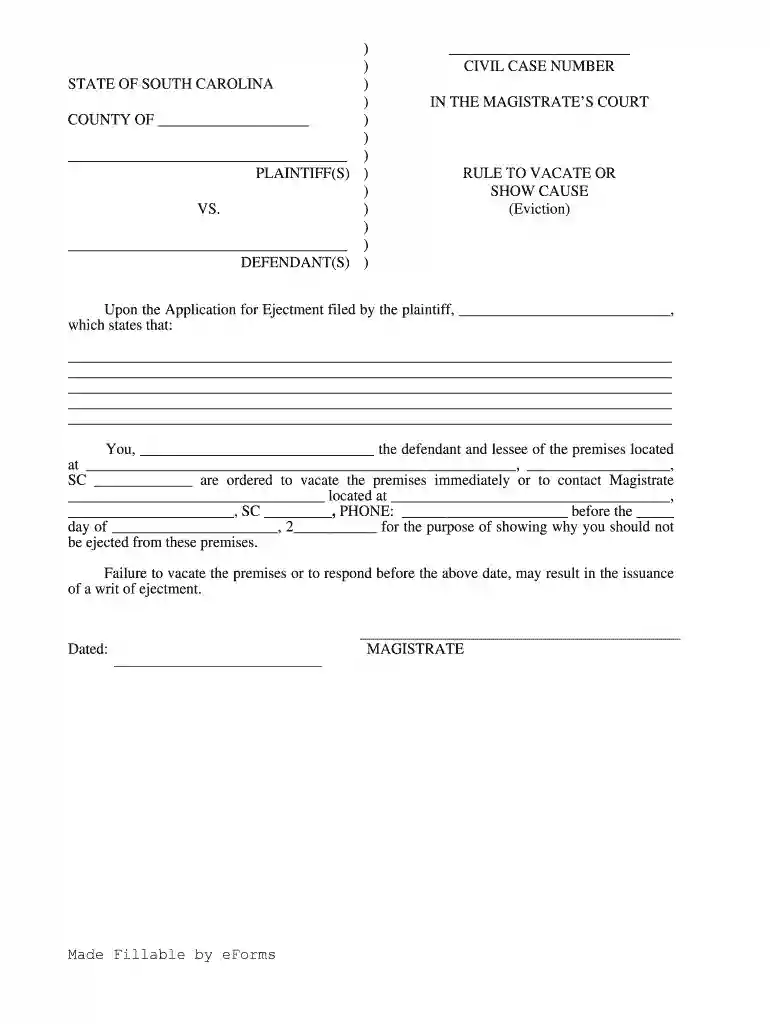
Civil case number state of south carolina ) ) county of ) ) arrest ... 2026

Get Form
civil case number state of south carolina ) ) county of ) ) arrest ... Preview on Page 1

Here's how it works

01. Edit your form online
Type text, add images, blackout confidential details, add comments, highlights and more.

02. Sign it in a few clicks
Draw your signature, type it, upload its image, or use your mobile device as a signature pad.

03. Share your form with others
Send it via email, link, or fax. You can also download it, export it or print it out.

How to use or fill out civil case number state of south carolina ) ) county of ) ) arrest ... with our platform

Form edit decoration
9.5
Ease of Setup
DocHub User Ratings on G2
9.0
Ease of Use
DocHub User Ratings on G2
  1. Click ‘Get Form’ to open it in the editor.
  2. Begin by entering the 'COUNTY OF' section with the appropriate county name where the case is filed.
  3. In the 'PLAINTIFF(S)' section, input the names of all plaintiffs involved in the case.
  4. Next, fill in the 'DEFENDANT(S)' section with the names of all defendants.
  5. Enter the 'CIVIL CASE NUMBER' assigned to your case for proper identification.
  6. Complete the details regarding the premises and contact information for both parties as required in the form.
  7. Finally, review all entries for accuracy before saving or printing your completed document.

Start using our platform today to streamline your document editing and ensure a smooth process!

See more civil case number state of south carolina ) ) county of ) ) arrest ... versions

We've got more versions of the civil case number state of south carolina ) ) county of ) ) arrest ... form. Select the right civil case number state of south carolina ) ) county of ) ) arrest ... version from the list and start editing it straight away!
Versions Form popularity Fillable & printable
2019 4.8 Satisfied (135 Votes)
2018 4.2 Satisfied (64 Votes)
2016 4 Satisfied (52 Votes)
be ready to get more

Complete this form in 5 minutes or less

Get form

Got questions?

We have answers to the most popular questions from our customers. If you can't find an answer to your question, please contact us.
Contact us
Common Types of Civil Litigation Cases in South Carolina Personal Injury Claims. Personal injury claims are another common type of civil litigation. Property Disputes. Business Litigation. Employment Disputes. Consumer Protection Cases. Real Estate Litigation. Family Law Disputes. Probate and Estate Litigation.
SLED CATCH (Citizens Access to Criminal Histories) is a name-based search to view and print South Carolina criminal records information.
How can I view records of civil, special proceeding, or estates cases? Information about civil, special proceeding, or estates cases in the North Carolina court system can be accessed on the public, self-service terminals in the clerk of courts office in any county.
Step 1: Determine Your Legal Standing and Claim Step 2: Identify the Appropriate Court. Step 3: Draft and File the Complaint. Step 4: Serve the Defendant. Step 5: The Defendants Response. Step 6: Discovery Phase. Step 7: Pre-Trial Motions and Mediation. Step 8: Trial. Step 9: Post-Trial Motions and Appeals.
The file for a court case can be viewed by visiting the clerk of courts office in the county where the case is located. Staff can provide copies of documents in court files for a fee. Also, see the Remote Public Access Program to learn more about licensing for data access and extracts.

Security and compliance

At DocHub, your data security is our priority. We follow HIPAA, SOC2, GDPR, and other standards, so you can work on your documents with confidence.

Learn more
ccpa2
pci-dss
gdpr-compliance
hipaa
soc-compliance

People also ask

North Carolina Public Records law states the records of any agency of North Carolina government or its subdivisions are public records available upon request by any citizens unless otherwise protected. A list of exceptions to this rule are listed in Chapter 132 of the N.C. General Statutes.
North Carolinas Public Records and Open Meetings laws ensure that the public can know what government officials and entities do. North Carolinians are entitled to see any public record.

Related links