




01. Edit your form online
Type text, add images, blackout confidential details, add comments, highlights and more.

Type text, add images, blackout confidential details, add comments, highlights and more.

Draw your signature, type it, upload its image, or use your mobile device as a signature pad.

Send it via email, link, or fax. You can also download it, export it or print it out.
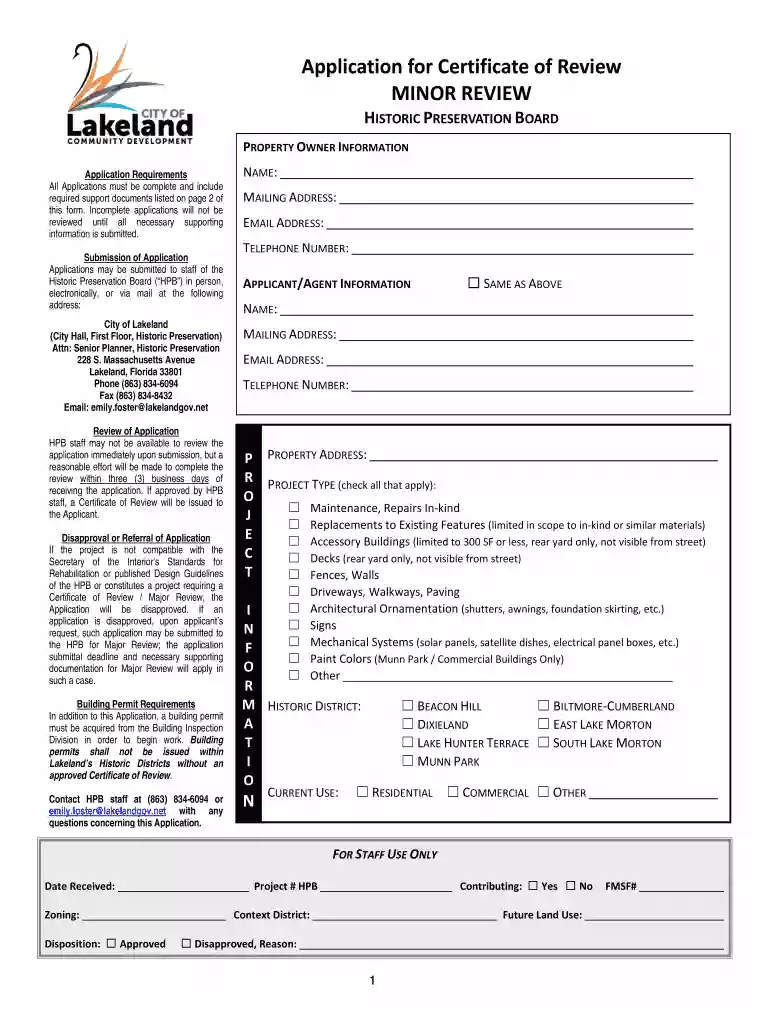
The Application for Certificate of Review MINOR REVIEW - City of [specific city name], is a formal process managed by the Historic Preservation Board (HPB). This application is essential for conducting specific renovations or alterations within designated historic districts. The primary purpose is to ensure that any modifications align with historical preservation standards, safeguarding the aesthetic and historical integrity of these areas.
Completing the Application for Certificate of Review involves several detailed steps. Here's a comprehensive guide to help you navigate the process:
Gather Required Documentation: Examples include architectural plans, photographs of the current structure, and a detailed description of the proposed modifications.
Complete the Application Form: This involves filling out all necessary fields accurately, ensuring that all mandatory sections are comprehensively covered.
Attach Supporting Documents: You must include evidence such as detailed plans and any other documentation that supports the application's necessity and appropriateness.
Submit the Application: Depending on your location, submission methods may include online platforms, mailing, or in-person delivery to the city's planning department.
Understanding the specific terminology used in the Application for Certificate of Review is crucial for successful completion. Some essential terms include:
The certificate must be used in accordance with legal guidelines prescribed by the city and the HPB. Compliance with these rules not only facilitates a smoother review process but also protects the applicant from potential legal repercussions.
Several key elements are integral to the application's acceptance and approval:
The application mandates the inclusion of several critical documents:
This application process is predominantly used by individuals or organizations planning small-scale renovations within historic zones. Typical users include:


While the application process follows a general framework, nuances can exist based on the state or city:
In some cases, different versions of the application may be available to accommodate varying project scales:
Major Review Applications: For substantial renovations, a distinct, more comprehensive form is required, potentially involving longer review periods and additional documentation.
Alternative Modifications: For non-structural changes, lighter applications may be used.
Each of these components is critical to ensuring that the Application for Certificate of Review MINOR REVIEW is completed accurately and effectively. By understanding the purpose, following detailed steps, and adhering to relevant legal and local guidelines, applicants can improve the chances of obtaining approval smoothly and efficiently.
We've got more versions of the Application for Certificate of Review MINOR REVIEW - City of ... form. Select the right Application for Certificate of Review MINOR REVIEW - City of ... version from the list and start editing it straight away!
Sure, a typed name is recognized as a legitimate electronic signature when you create it on your document using a compliant solution like DocHub. Simply upload your Application for Certificate of Review MINOR REVIEW - City of ... to our editor, click Sign in the top tool pane → Create your signature → Type your name in the proper tab, and choose how it will appear on your document.
You may complete and eSign your Application for Certificate of Review MINOR REVIEW - City of ... online, even on a tight deadline. All you need to access high quality editing tools on any device is a DocHub account, that you can register within a couple of moments. When you sign up, upload your file or find what you are looking for in our catalog, complete it using the editing tools you need, and place your electronic signature on it at the end.
At DocHub, your data security is our priority. We follow HIPAA, SOC2, GDPR, and other standards, so you can work on your documents with confidence.
May 28, 2025 For minor works, state law allows for administrative review by staff rather than review by the full preservation commission. OrdinaryRead more
The application must be completed by the property owner or an authorized agent. There is no fee for a minor review. Call 407.246.2172 for more information. 407


